
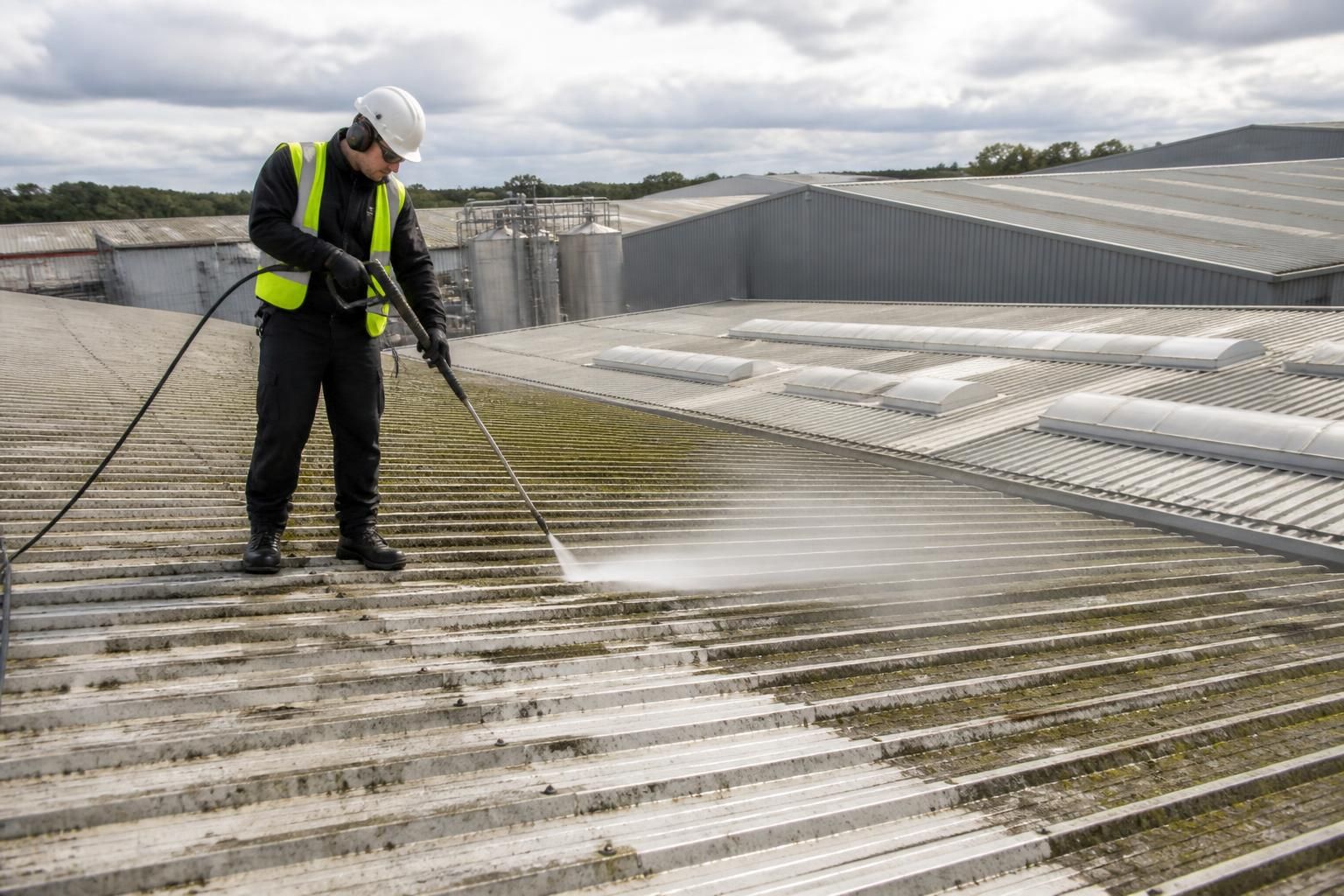
What is the importance of using biocides in industrial roof cleaning?
Biocides are important in industrial roof cleaning because they kill moss, algae, lichen and other organic growth that can retain moisture, block drainage and accelerate roof deterioration. Used selectively and in accordance with environmental requirements, they help maintain a cleaner roof for longer, reduce regrowth and support lower ongoing maintenance needs.
Biocides are important in industrial roof cleaning because they control moss, algae, lichen and other biological growth that can retain moisture, obstruct drainage and contribute to the deterioration of roofing materials. They are usually applied as part of a planned cleaning system rather than used as a substitute for removing heavy contamination. When selected and applied correctly, a biocide can reduce regrowth, help keep the roof cleaner for longer and support lower ongoing maintenance requirements.
Organic growth is more than a cosmetic issue on an industrial roof. Moss can hold water against the surface, spread across laps and joints, and interfere with gutters, outlets and rainwater channels. Algae and lichen can form persistent films or attach firmly to the coating. In combination with repeated wetting, frost and weathering, this contamination may contribute to surface degradation, blocked drainage and premature maintenance needs.
A biocide targets the living organisms responsible for this growth. It may be used before cleaning to weaken contamination and make removal more controlled, or after cleaning to treat residual spores and reduce the likelihood of rapid regrowth. The correct approach depends on the roof material, the extent of contamination, the drainage layout and the condition of coatings, seals and joints.
- It helps control regrowth: Cleaning removes visible contamination, but spores and microscopic residues can remain. A suitable treatment helps reduce the organisms that would otherwise recolonise the surface.
- It protects drainage: Reduced moss and organic debris helps keep gutters, outlets and rainwater systems clearer, although these areas still require physical inspection and cleaning.
- It supports roof longevity: Limiting prolonged dampness and biological activity can reduce avoidable stress on roof coatings, membranes, tiles, concrete surfaces and associated details.
- It improves maintenance planning: A roof that remains free from heavy organic growth is easier to inspect for defects such as corrosion, damaged sheets, failed sealants, open laps and blocked outlets.
- It can reduce disruptive repeat cleaning: Slower regrowth may mean fewer intensive interventions, helping site managers plan maintenance around operations and access requirements.
Biocides do not repair a leaking, corroded or structurally defective roof. They cannot replace the renewal of failed coatings, damaged membranes, broken tiles, defective flashings or deteriorated sealants. Before treatment, the roof should be assessed to identify its construction, age, surface finish, drainage arrangements and any areas that may be vulnerable to water or chemical exposure.
Product selection is particularly important on industrial buildings because roofing systems vary considerably. Coated metal sheets, fibre cement, concrete, clay tiles, asphaltic materials and single-ply membranes may each have different tolerances. A treatment suitable for one surface may stain another, affect a coating or create an unnecessary risk to seals and adjacent materials. The product label, safety data and manufacturer guidance should be checked, and a small inconspicuous test area can help confirm compatibility before wider application.
Application should be controlled rather than indiscriminate. The cleaning team will normally consider the weather, surface temperature, wind, rainfall forecast, surrounding premises and the time required for the product to work. Overspray must be controlled around rooflights, vents, plant, vehicles, façades, neighbouring properties and areas used by staff or the public. Where necessary, vulnerable items are protected and access or work activities below are managed during treatment.
Environmental controls are an essential part of responsible biocide use. The chemical must be approved and used for its intended purpose, at the stated dilution and in accordance with the product instructions. Run-off should not be allowed to enter surface-water drains, watercourses, soil or planted areas unless the relevant requirements specifically permit it. Collection, diversion, containment or controlled discharge may be needed, depending on the site and the cleaning method. Wastewater and contaminated debris should be handled through an appropriate disposal route.
Industrial roof cleaning also requires consideration of workplace and chemical safety. A suitable risk assessment and method statement should address work at height, fragile roof areas, access equipment, weather conditions, chemical handling, emergency procedures and exclusion zones. Operatives should use the personal protective equipment specified for the product and task, while nearby workers and members of the public should be protected from contact with treatment and wash water. The work should comply with applicable UK requirements, including the Control of Substances Hazardous to Health principles and relevant biocidal product and environmental controls.
The sequence used on site will vary. A typical process may include a roof survey, removal of loose debris, protection of sensitive areas, application of a compatible treatment, an appropriate dwell period, controlled cleaning and a final inspection. On some roofs, a low-pressure or soft-washing approach is preferable to aggressive pressure washing. High pressure can drive water beneath laps, damage fragile surfaces, strip protective coatings or disturb sealants, so the cleaning method should be chosen alongside the biocide rather than treating the chemical as a standalone solution.
It is also important to distinguish between immediate visual results and longer-term biological control. Some products act quickly, while others continue working after application and may not produce an instant change in appearance. Heavy lichen or established moss may still need careful mechanical removal, and shaded or persistently damp areas may experience regrowth sooner than exposed sections. Ongoing inspections and gutter maintenance remain worthwhile, particularly where surrounding trees, poor drainage or high humidity increase contamination.
For these reasons, biocides should be viewed as one part of a complete industrial roof maintenance plan. The most reliable specification combines a material assessment, an appropriate cleaning technique, controlled chemical use, protection of drainage and the surrounding environment, and clear post-cleaning recommendations. This approach removes existing biological contamination while helping the roof remain serviceable, accessible for inspection and less vulnerable to avoidable maintenance problems.
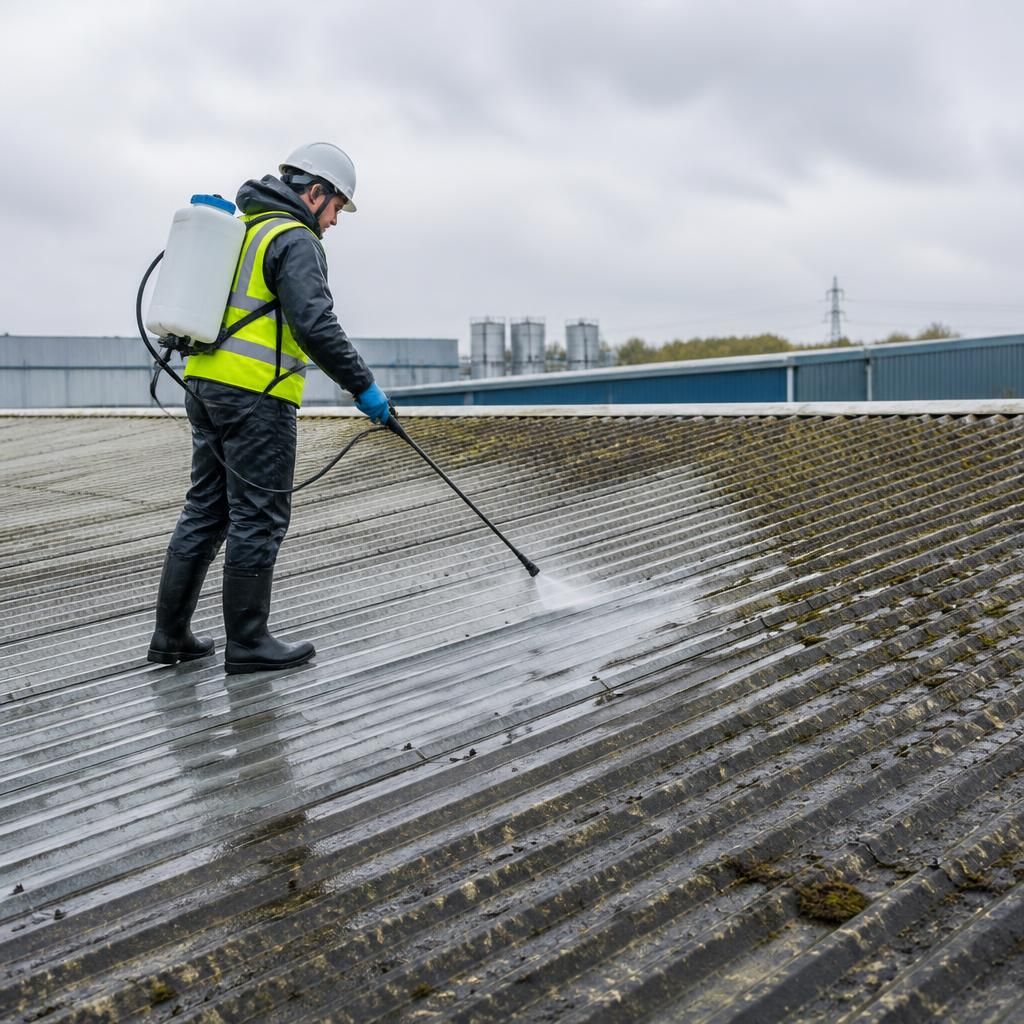
Biocides are treatments used to control moss, algae, lichen and other organic growth on industrial roofs. Their main benefit is reducing regrowth after cleaning, helping limit moisture retention and keeping drainage routes clearer for longer.
They should be selected for the specific roofing material and applied as part of a controlled cleaning process. A biocide does not repair corrosion, failed sealants, damaged membranes or leaks, and it cannot replace the physical removal of heavy moss or debris. The roof surface, drainage layout and nearby features should be assessed first, with run-off and overspray carefully managed to protect plants, watercourses, rooflights, equipment and people below.