
How can I verify the experience and credentials of an industrial roof washing service provider?
Verify an industrial roof washing provider by checking its relevant experience, insurance, trained personnel, health and safety procedures, and documented results on comparable sites. Ask for current evidence rather than relying solely on testimonials or verbal assurances.
Verify an industrial roof washing provider by checking its relevant experience, insurance, trained personnel, health and safety procedures, environmental controls and documented results on comparable sites. Request current evidence before work begins, rather than relying solely on testimonials, website claims or verbal assurances.
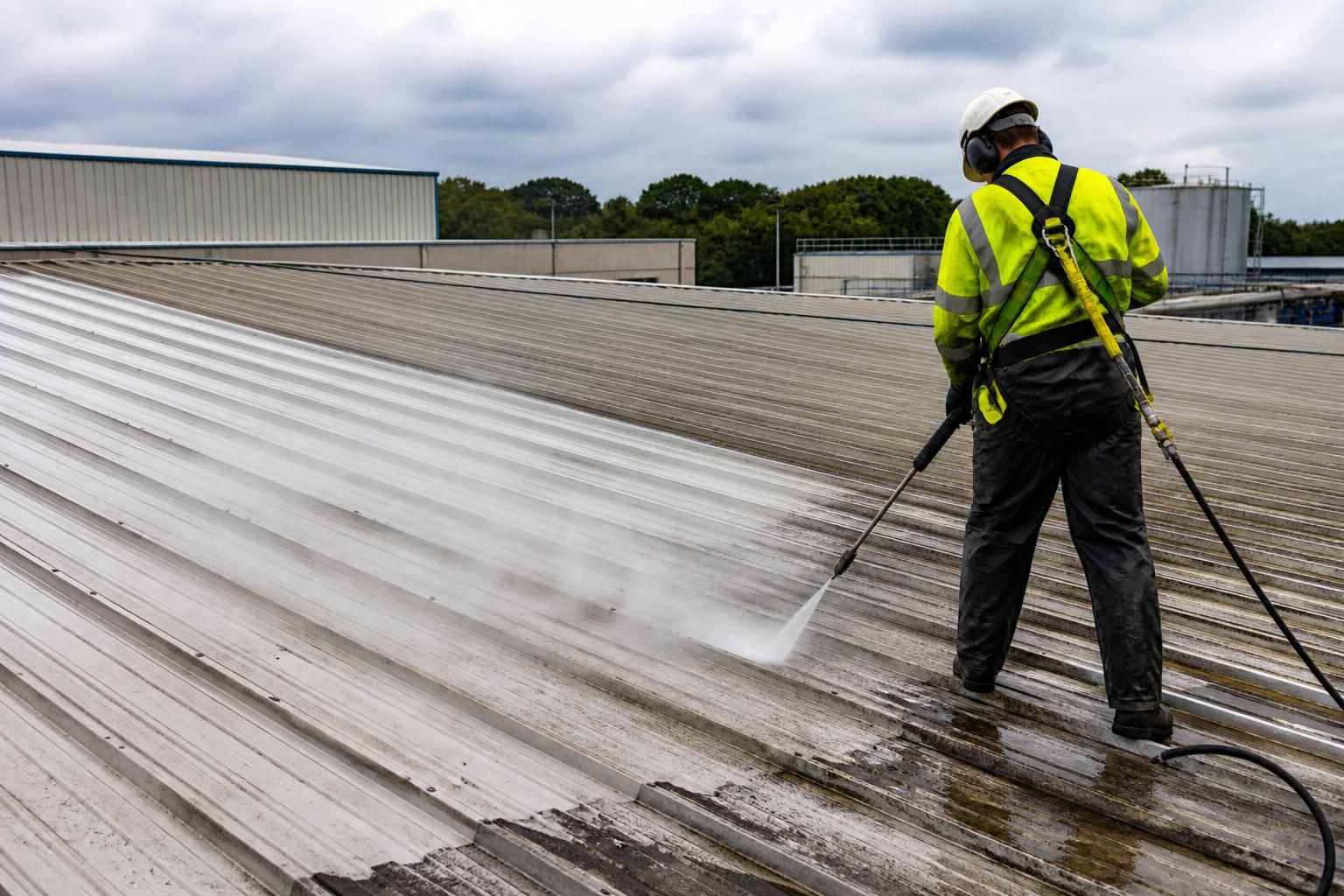
Start with experience relevant to your site. Industrial roof cleaning is not the same as domestic pressure washing. Ask whether the provider has worked on similar roof types, including profiled metal, coated steel, fibre cement, concrete, composite panels or membrane systems. Their experience should also reflect the scale and complexity of your premises, such as large roof areas, fragile surfaces, occupied buildings, restricted access, rooftop plant and areas above production or storage facilities.
Ask for examples of comparable completed projects. Useful evidence may include photographs taken before and after cleaning, anonymised method statements, inspection findings and references from property managers, facilities teams, construction companies or other commercial clients. A credible provider should be able to explain the cleaning method used, why it was suitable for the roof and how potential damage, water ingress and disruption were controlled.
Check the provider’s legal and insurance documentation. Request certificates that are current for the proposed work, including:
- Public liability insurance at a level appropriate to the site, contract and potential third-party damage.
- Employers’ liability insurance where the business employs staff.
- Professional indemnity cover where the contractor provides design, specification or consultancy advice and that advice forms part of the contract.
- Relevant company, tax and registration details, so you know which legal entity is responsible for the work.
- Evidence that any subcontractors are declared, suitably insured and subject to the same safety and quality requirements.
Check the policyholder name, expiry date, scope of cover and any exclusions. Insurance should not be treated as proof of competence, but an unwillingness to provide current certificates is a significant reason to pause the appointment.
Assess competence and training. The contractor should be able to identify who will plan, supervise and carry out the work. Ask for evidence of training relevant to the proposed operation, such as work at height, access equipment, roof access, manual handling, abrasive or high-pressure equipment, emergency procedures and the safe use of cleaning chemicals. Where powered access equipment, scaffolding or specialist lifting equipment is required, operators should hold appropriate training and authorisation for the equipment being used.
Competence also includes practical judgement. Workers should understand that roof sheets, rooflights, translucent panels, flashings, sealants and fixings may have different load and cleaning limitations. A competent provider will not assume that every roof can be walked on or cleaned with the same pressure, temperature or chemical treatment.
Review the proposed risk assessment and method statement. Before work starts, request site-specific RAMS rather than a generic document. It should cover the actual building, roof construction, access routes, working area and surrounding operations. Look for clear arrangements for:
- Preventing falls from roof edges, openings and fragile surfaces.
- Identifying and protecting rooflights, weak areas and areas that cannot safely bear personnel or equipment.
- Using guardrails, scaffolding, mobile elevating work platforms, crawling boards, fall-restraint or fall-arrest systems where appropriate.
- Controlling hoses, cables, equipment, runoff and pedestrian or vehicle movements at ground level.
- Protecting roof-mounted plant, vents, electrical equipment, stock, vehicles and occupied areas.
- Managing wind, rain, ice, poor visibility and other conditions that could make the work unsafe.
- Responding to a fall, injury, equipment failure, chemical exposure, blocked drainage or accidental water ingress.
The method statement should explain the sequence of work, not simply list the equipment. It should show how the roof will be inspected, how a trial area will be assessed, how the chosen cleaning system will be controlled and how the finished surface will be checked.
Confirm that chemicals and wastewater will be managed correctly. If detergents, biocides or other treatments are proposed, ask for the product name, safety data sheet, intended application, dilution instructions and precautions. The provider should explain how products will be prevented from entering rainwater drains, watercourses, soil or neighbouring property. It should also identify the arrangements for collecting, containing, filtering or disposing of contaminated runoff where required.
Ask whether the proposed products are authorised for their intended use in the relevant UK jurisdiction and whether the operatives have received COSHH information and training. A responsible contractor will consider surrounding vegetation, wildlife, drainage systems and the material being cleaned before selecting a treatment. They should not describe a chemical as environmentally safe without explaining its actual controls and disposal arrangements.
Inspect the quality of the quotation and survey. A reliable quotation should be based on an inspection or sufficient technical information, rather than only the roof area and a few photographs. The survey should consider roof material and condition, access, height, drainage, fragile areas, existing coatings, corrosion, moss or lichen, staining, nearby surfaces and operational constraints.
The quotation should state what is included and excluded. Check whether it covers access equipment, protection of assets, preparatory work, biocide application, rinsing, wastewater control, waste disposal, reinstatement of moved items and final inspection. It should also clarify whether the work is intended to remove organic growth, improve appearance, prepare a surface for coating or address a specific contamination issue. Cleaning cannot correct failed coatings, corrosion perforation, defective seals or structural problems, so these limitations should be recorded rather than concealed.
Ask how results will be documented. Evidence of a professional process may include a pre-start condition report, photographs of vulnerable areas, records of the cleaning system used, chemical and equipment details, incident records, waste transfer documentation where applicable and a completion report. For larger or sensitive sites, agree in advance how areas will be inspected and who will approve the finished work.
Photographs are useful, but they should be interpreted alongside the condition survey. A roof can appear cleaner while still having damaged coatings, blocked outlets or untreated growth in joints and concealed areas. The completion report should identify any defects discovered during the work and distinguish cleaning outcomes from repairs that were outside the agreed scope.
Check independent assurance without treating accreditations as a substitute for competence. Membership of a recognised trade body, third-party safety assessment or SSIP-style health and safety scheme can provide additional assurance. However, the assessment should be current and relevant to the work being procured. Ask what was assessed, whether the organisation’s own employees or subcontractors were covered and when the assessment expires. A logo on a website is not sufficient evidence; request the current certificate or verify it through the issuing organisation.
Also check whether the provider has suitable quality, environmental and occupational health and safety procedures. Formal certification can be helpful for larger contracts, but a smaller contractor may still be competent if it can provide clear, site-specific records and demonstrate effective control of the work. The key issue is whether the documented system is actually followed on site.
Use references carefully. Request references for projects with similar roof materials, access conditions and operational risks. Ask the reference contact whether the contractor arrived with the agreed documentation, protected the building and surrounding areas, communicated changes, controlled runoff, left the site clean and dealt properly with defects or complaints. A reference should confirm the provider’s reliability and working practices, not merely that the roof looked cleaner afterwards.
Before appointing the contractor, compare the evidence rather than selecting solely on price. A substantially lower quotation may omit access controls, runoff management, protection of assets, waste disposal or necessary preparation. Confirm the scope, programme, responsibilities, payment stages, cancellation arrangements and process for variations in writing. Do not allow work to begin until the relevant insurance, RAMS, access plan, chemical information and site requirements have been reviewed and accepted by the responsible person for the premises.

The strongest evidence of an industrial roof washing provider’s competence is a site-specific plan showing how the work will be carried out safely and without damaging the roof. Before appointment, ask to review the risk assessment and method statement (RAMS), together with current insurance certificates and training records for the people who will complete the work.
The RAMS should address the actual roof construction, fragile areas, rooflights, access equipment, roof edges, weather conditions, drainage, nearby operations and emergency arrangements. It should also explain how cleaning pressure, chemicals, hoses and wastewater will be controlled. Compare this information with photographs or references from similar industrial sites. A provider that can clearly explain its methods and provide current, relevant documentation offers more reliable evidence of competence than a website accreditation or a low quotation alone.