
What methods are most effective for removing graffiti from building exteriors?
The most effective graffiti removal method depends on the paint type, substrate and age of the marking, but professional steam cleaning, pressure washing and specialist chemical treatments are commonly used. The safest approach combines the least aggressive suitable method with controlled pressure, appropriate detergents and careful rinsing to remove graffiti without damaging masonry, brickwork, cladding or coatings.
The most effective graffiti removal method depends on the paint or marker used, the age of the graffiti, and the surface beneath it. Professional steam cleaning, controlled pressure washing and specialist chemical treatments are the main approaches used on building exteriors. In practice, the safest and most reliable result usually comes from selecting the least aggressive method that will remove the marking, testing it on an inconspicuous area, and then adjusting temperature, pressure, dwell time and rinsing to suit the substrate.
Assessment should come before cleaning. Graffiti may consist of aerosol paint, marker ink, bitumen, adhesive residue or several layers of different products. Fresh markings are generally easier to remove because they have had less time to cure and penetrate porous materials. The surface is equally important: brick, natural stone, concrete, render, painted metal, powder-coated cladding and plastic panels all respond differently to heat, pressure and chemicals. A method that is suitable for robust masonry could mark, strip or distort a coated panel.
A professional assessment should consider the condition of the façade, existing paint or protective coatings, nearby glazing, seals, signage, lighting and drainage routes. It should also identify whether the graffiti is on a listed or otherwise sensitive building, where the appearance and fabric of the surface must be protected. A small test patch helps confirm whether the chosen process removes the marking without creating a visible difference in colour, texture or sheen.
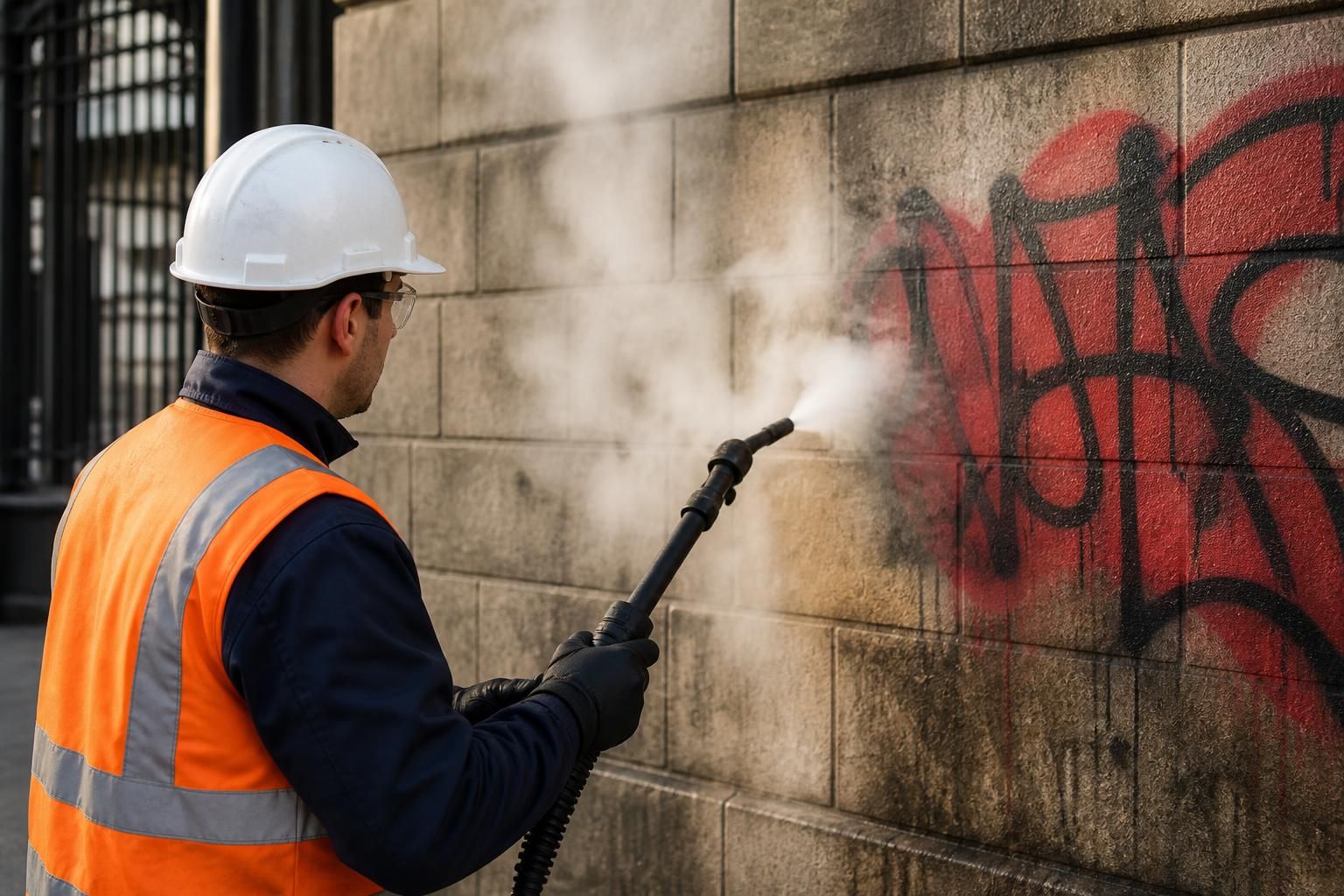
Steam cleaning is often the preferred first approach for sensitive or porous surfaces. Low-pressure steam softens many paints, inks and adhesive residues while reducing the mechanical force applied to the substrate. It can be particularly useful on brickwork, stone, rendered surfaces and façades where high pressure could open joints, drive contamination further into pores or remove the face of the material. Steam can also be effective around detailed masonry, signs and fittings because the operator can work accurately across smaller areas.
Steam cleaning is not suitable for every marking or surface. Older, heavily layered or chemically resistant coatings may need a compatible graffiti remover before steam is applied. Heat must also be controlled around sealants, plastic components, vulnerable coatings and certain painted finishes. The operator should avoid prolonged heating in one place and use suitable collection or drainage controls where the run-off contains loosened paint or detergent.
Pressure washing is effective on durable, sound surfaces when it is carefully controlled. Water pressure can remove loosened graffiti from concrete, robust brickwork, some masonry and suitable hard-standing areas. The correct nozzle, spray pattern, working distance and water flow are as important as the pressure itself. Excessive pressure can erode mortar joints, damage soft brick, expose aggregate in concrete, strip paint and leave a visibly cleaned patch that differs from the surrounding façade.
Pressure washing is therefore best used after a chemical pre-treatment has softened the graffiti, rather than relying on force alone. The operator should work from a suitable distance, avoid directing water into joints or building openings, and rinse in a controlled direction. On façades, run-off must be prevented from staining lower elevations or entering surface-water drainage without appropriate controls.
Specialist chemical treatments are useful where paint has bonded strongly to the surface. Graffiti removers are formulated to break down particular types of paint, ink, lacquer or adhesive. The product must be compatible with the substrate and any existing coating. A chemical that works well on bare masonry may soften painted metal, discolour render, attack sealants or leave residues on natural stone.
Application requires controlled coverage and the correct dwell time. If the product is removed too quickly, it may not have softened the marking; if it is left too long, it may affect the underlying surface. After treatment, the area should be thoroughly rinsed or neutralised in line with the product guidance. Chemical handling also requires suitable personal protective equipment, ventilation and measures to protect pedestrians, vegetation, vehicles and adjacent materials.
Soft washing can be appropriate for delicate façades and coated surfaces. It uses a lower-pressure application of a suitable cleaning solution, followed by controlled rinsing. This reduces the risk of mechanical damage when compared with aggressive pressure washing. However, soft washing is not automatically safe for every surface: the solution, concentration, contact time and rinse method must be selected for the particular coating and surrounding environment. It should not be treated as a substitute for testing and surface assessment.
Abrasive methods, such as blasting, are generally reserved for situations where other approaches cannot remove deeply embedded or exceptionally resistant graffiti. Abrasives can permanently alter the texture and appearance of brick, stone and concrete, so they should only be considered after less aggressive methods have been assessed. Even then, the abrasive medium and operating parameters must be chosen carefully, and a test area is essential.
An effective professional removal process normally follows a controlled sequence:
- Inspect and identify the substrate, graffiti type, surrounding materials and any existing protective coating.
- Protect windows, doors, vents, signage, landscaping, vehicles and pedestrian routes.
- Carry out a discreet test patch using the least aggressive suitable method.
- Apply a compatible remover or pre-treatment where required, allowing it to work for the recommended period.
- Remove the softened marking using steam, low-pressure washing or another approved method.
- Rinse and inspect the area, repeating treatment locally rather than increasing aggression across the whole surface.
- Manage contaminated water, removed paint and chemical residues responsibly.
- Check the finished area in consistent light and consider protective treatment where appropriate.
Protective anti-graffiti coatings can make future removal easier, particularly on vulnerable or repeatedly targeted surfaces. These coatings are not suitable for every façade and may alter the surface sheen or appearance. The coating should be selected for the substrate, applied to a properly prepared surface and maintained according to the manufacturer’s guidance. It is also important to address access, lighting, security and prompt reporting, because rapid removal can discourage repeated marking and reduce the time contaminants remain bonded to the surface.
For commercial and industrial premises, the cleaning method should also account for site operations and public safety. Work may need to be scheduled around deliveries, tenants, pedestrians or traffic, with exclusion zones and suitable access equipment. Cleaning at height must be planned by competent operatives, and water, chemicals and loosened coatings must be prevented from creating slip, contamination or drainage hazards.
In summary, steam cleaning is often the best starting point for sensitive or porous building exteriors, controlled pressure washing suits sound durable surfaces, and specialist chemical treatment helps break down stubborn or layered graffiti. The strongest results come from combining methods where necessary rather than applying maximum pressure or the strongest chemical immediately. Careful testing, substrate-specific settings, responsible run-off management and a thorough final inspection are what remove graffiti effectively while preserving the building exterior.
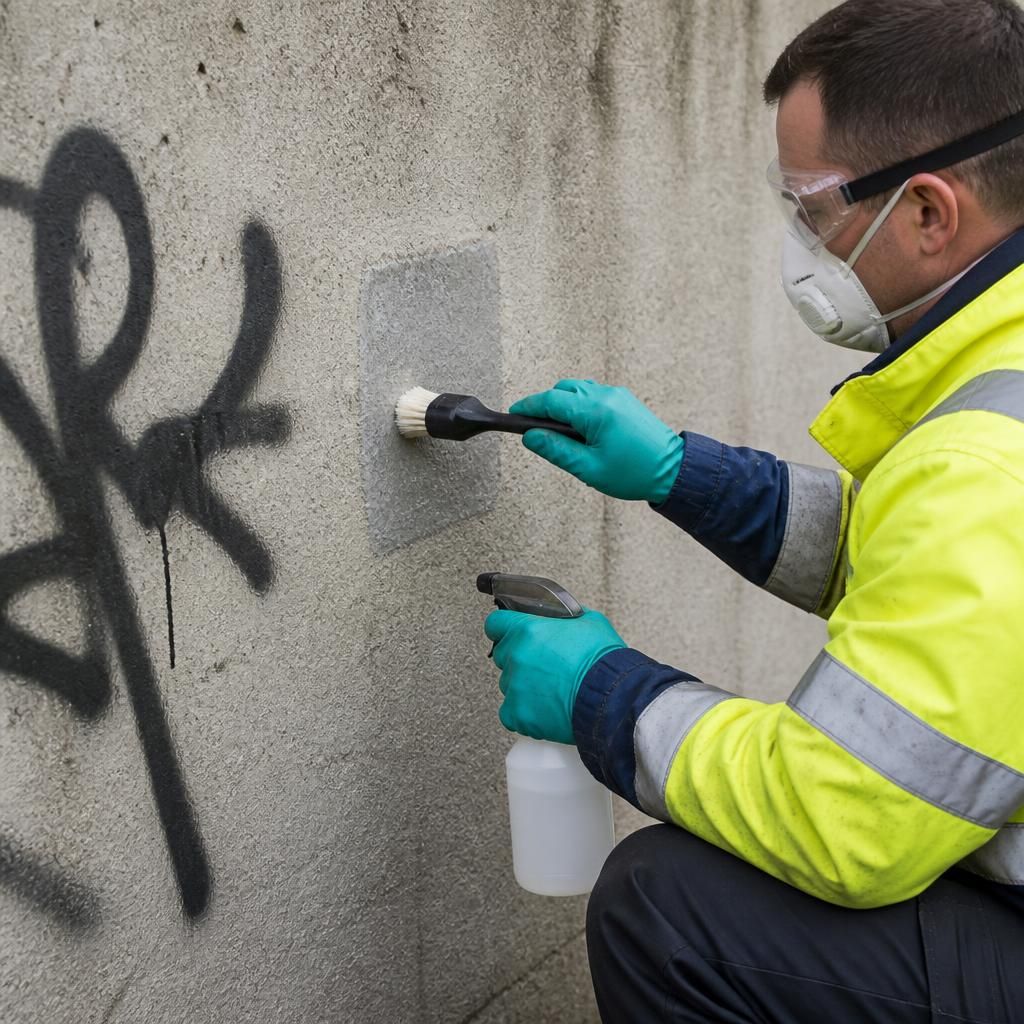
Testing a small, inconspicuous area is an essential part of professional graffiti removal because the same treatment can affect different building materials in very different ways. A controlled test shows whether steam, a compatible chemical remover or low-pressure rinsing will lift the marking without altering the colour, texture or protective coating beneath it.
The test should reflect the proposed working method, including the cleaning solution, dwell time, temperature, pressure and rinse process. The area should then be inspected once dry, as damage such as staining, coating softening or a visible change in sheen may not be immediately apparent. Only when the result is satisfactory should the method be applied across the wider façade.