
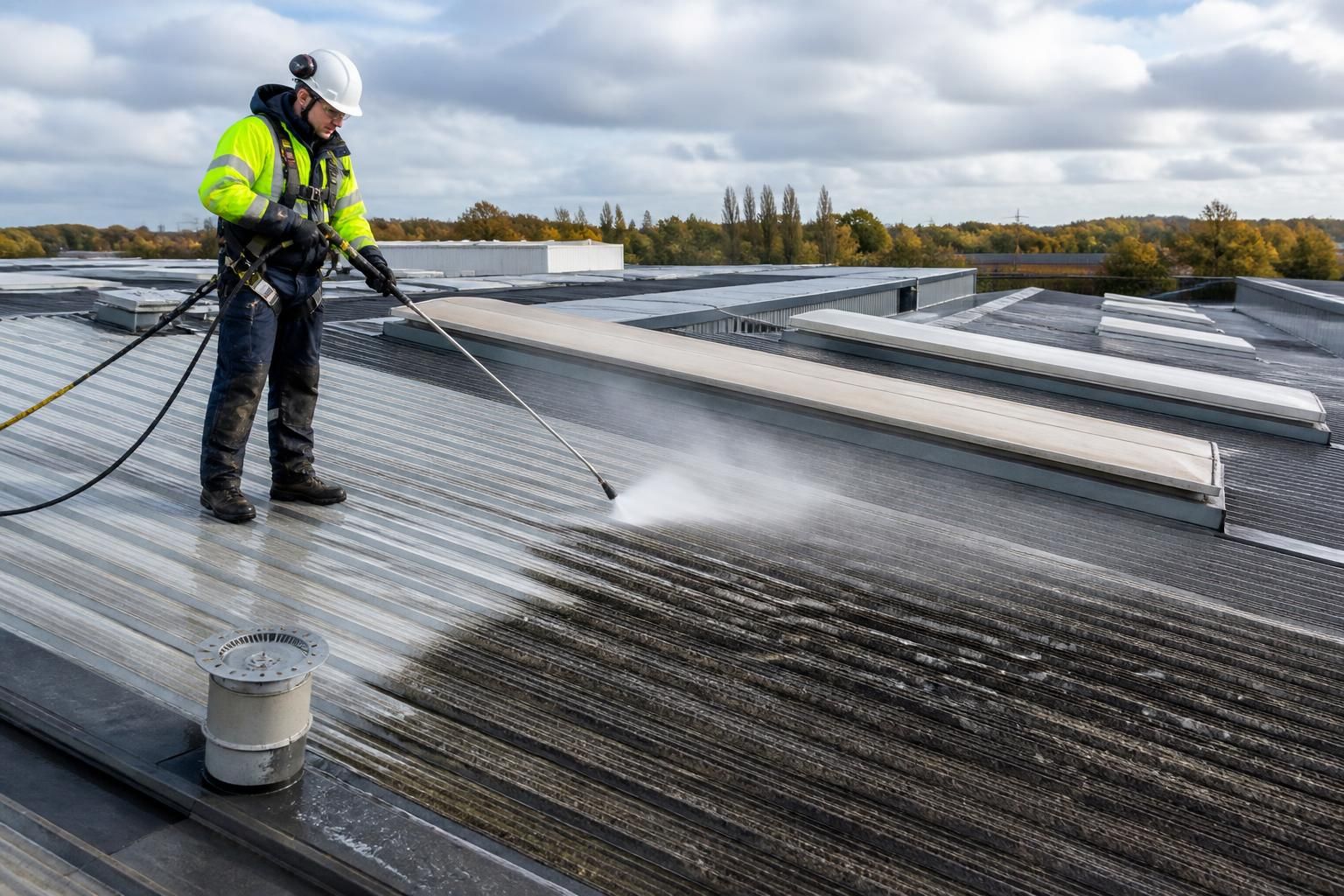
How can professional roof cleaning equipment enhance the effectiveness and efficiency of exterior cleaning operations?
Professional roof cleaning equipment improves exterior cleaning by combining controlled pressure, specialist soft-wash and steam systems, suitable access equipment and targeted treatments. This enables safer, more consistent removal of moss, algae, dirt and staining while reducing water use, labour time and the risk of damage to roof surfaces.
Professional roof cleaning equipment improves exterior cleaning operations by matching the cleaning method, water flow, pressure, access system and treatment to the roof material and type of contamination. This controlled approach removes moss, algae, lichen, atmospheric dirt and staining more consistently than general-purpose equipment, while reducing the risk of surface damage, unnecessary water use, rework and avoidable time on site.
Commercial roofs vary considerably. Sloped tiled roofs, metal cladding, flat membranes, concrete surfaces and fragile or weathered materials each require different levels of pressure, temperature and chemical contact time. Professional equipment allows the operator to adjust these variables rather than applying the same process to every surface.
More controlled cleaning performance
Professional systems provide accurate control over pressure and flow. This is important because cleaning effectiveness does not depend on pressure alone. Excessive pressure can dislodge tiles, strip protective coatings, force water beneath laps and seals, or damage aged surfaces. Insufficient pressure may leave embedded staining and result in repeated passes.
Adjustable equipment helps operators select an appropriate setting for the roof condition and cleaning method. Low-pressure soft washing can be used where the contamination is biological and the roof surface is vulnerable. Pressure washing may be suitable for robust, stable surfaces when used with the correct nozzle, distance and technique. Steam cleaning can provide effective removal with lower water flow where heat is beneficial and the substrate can safely tolerate it.
- Variable pressure and flow: enables more precise cleaning of delicate, textured or heavily soiled areas.
- Specialist nozzles and lance systems: help distribute water evenly and reduce concentrated impact on the surface.
- Soft-wash equipment: applies a controlled treatment to biological growth without relying on aggressive mechanical force.
- Steam systems: use heated water to loosen dirt and biological deposits while limiting the volume of water introduced to the site.
- Professional pumps and filtration: support consistent application and help manage water quality where site conditions require it.
Improved removal of moss, algae and organic growth
Moss, algae and lichen can grip roof surfaces and retain moisture. Simply blasting the visible growth away may leave spores, staining or residues behind, allowing contamination to return. Professional roof cleaning equipment supports a staged process: controlled removal, application of a suitable treatment, rinsing or low-impact cleaning where appropriate, and inspection of the finished surface.
Soft-wash systems are particularly useful for biological contamination. They apply a formulated cleaning solution at low pressure, allowing it to work across the affected area without the force associated with conventional jet washing. The selected treatment must be suitable for the roof material and carefully controlled to protect surrounding surfaces, vegetation, drainage systems and occupants.
Where deposits are bonded to the surface, specialist scrapers, brushes or steam equipment may be used alongside the treatment. This combination is generally more effective than repeatedly increasing water pressure. It also reduces the likelihood of damaging tiles, coatings or seals in an attempt to remove stubborn contamination quickly.
Greater efficiency on commercial and industrial sites
Professional equipment improves productivity by allowing larger areas to be treated consistently and by reducing the need for repeated cleaning passes. High-capacity pumps, suitable hose systems and purpose-designed attachments can support efficient work across extensive roof areas, subject to the available water supply and site layout.
Efficiency is not simply a matter of working faster. It also involves planning the sequence correctly. Operators can use the equipment to apply treatment in manageable sections, allow the required dwell time, rinse with suitable control and inspect the result before moving on. This reduces missed areas, limits unnecessary handling of equipment and makes the cleaning process easier to monitor.
For ongoing maintenance contracts, repeatable equipment settings and documented cleaning methods help produce a consistent standard across visits. They also make it easier to identify changes in roof condition, recurring contamination and areas that may require repair rather than further cleaning.
Safer access and reduced manual handling
Roof cleaning involves significant work-at-height and slip risks, particularly where moss and algae have made the surface wet or unstable. Professional equipment can improve safety when it is used with a suitable access plan. Long-reach cleaning systems, telescopic lances, elevated work platforms and other access equipment may allow more work to be completed from a safer position, reducing the need for operators to walk directly on vulnerable roof areas.
Access equipment must be selected according to the building height, roof design, ground conditions, overhead obstructions and the reach required. It does not remove the need for risk assessments, exclusion zones, appropriate personal protective equipment and competent operation. Hoses and power cables should also be routed to prevent trip hazards, contact with sharp edges or interference with access routes.
Mechanised systems can reduce manual carrying and repetitive scrubbing, but they still require trained operators. Correct handling is essential because poorly controlled spray, unsafe hose pressure or incorrect positioning of an access platform can create risks for workers, pedestrians, vehicles and the building itself.
Lower risk of damage to roof materials
The main advantage of specialist equipment is control. A professional operator can reduce pressure around tile edges, flashings, rooflights, vents, membranes and other vulnerable details. They can also avoid directing water beneath overlaps or towards openings where moisture could enter the building.
Before cleaning begins, the roof should be assessed for loose or broken tiles, failing pointing, damaged membranes, deteriorated coatings, blocked outlets and existing leaks. Cleaning equipment cannot correct these defects, and applying water to a compromised area may expose or worsen an existing problem. Recording the condition before work helps distinguish pre-existing defects from issues identified during cleaning.
Surface testing is also important. A small, discreet area can be cleaned using the proposed method to check how the material responds. This helps establish whether the pressure, temperature, detergent and dwell time are appropriate before the process is extended across the roof.
Better water and chemical management
Professional systems can make water use more controlled. Low-flow soft washing and steam cleaning may use less water than prolonged high-pressure rinsing, although the most suitable method depends on the contamination, roof material and required finish. Water recovery or containment measures may be needed where runoff could enter surface drains or affect neighbouring property.
Chemical treatments should never be selected solely for their strength. The product must be compatible with the substrate and used in accordance with its instructions and the site assessment. Operators should protect plants, stored materials, vehicles, glazing and painted surfaces from overspray and runoff. Residues should be managed responsibly, particularly on commercial premises with drainage, watercourse or environmental restrictions.
Controlled application equipment helps maintain an even coverage and reduces overspray. This improves treatment consistency while limiting waste and reducing the amount of product that has to be handled, rinsed or contained.
More consistent results and easier quality control
Professional roof cleaning equipment supports a defined method rather than an improvised one. The operator can record the roof type, contamination, equipment settings, cleaning products, access arrangements and any areas excluded from the work. This creates a useful maintenance record for property managers, facilities teams and building owners.
Inspection should take place during and after cleaning. It can identify remaining growth, areas requiring a second treatment, blocked gutters, damaged roof components or staining that is embedded rather than removable. Photographic records are useful for confirming the completed areas and highlighting maintenance issues that need attention by a roofing contractor or other specialist.
A clean appearance is not the only measure of success. The roof should be left without avoidable damage, excessive standing water, uncontrolled chemical residue or displaced debris. On larger sites, a consistent finish across adjoining elevations and roof sections is also important for the appearance and professional presentation of the property.
How the equipment should be selected
The correct equipment depends on the roof construction, age and condition; the type and depth of contamination; the building’s use; access restrictions; drainage arrangements; and the surrounding environment. A suitable assessment should consider:
- the roof material and any protective coating or membrane;
- the condition of tiles, joints, flashings, seals, rooflights and drainage outlets;
- the required access height and whether work can be completed from ground level or an elevated platform;
- the safe pressure, temperature and flow range for the surface;
- the need for soft-wash treatment, mechanical agitation, steam cleaning or a combination of methods;
- water supply, electricity, runoff control and equipment positioning on the site;
- the presence of staff, visitors, vehicles, neighbouring properties, landscaping and sensitive equipment;
- weather conditions and whether wind, frost, rain or heat could affect safety or treatment performance.
For most commercial roof cleaning projects, the best outcome comes from combining methods rather than relying on one machine. A controlled soft-wash treatment may deal with biological growth, while low-pressure rinsing, manual tools or steam equipment address remaining deposits. Suitable access equipment then allows the work to be completed with less direct loading on the roof and better control around details.
Professional roof cleaning equipment therefore enhances effectiveness by improving cleaning control, treatment consistency and access to difficult areas. It enhances efficiency by reducing unnecessary pressure, water use, manual effort and repeat work. Its benefits depend on competent operation and a method designed for the specific roof; powerful equipment used without that assessment can increase risk rather than improve the result.
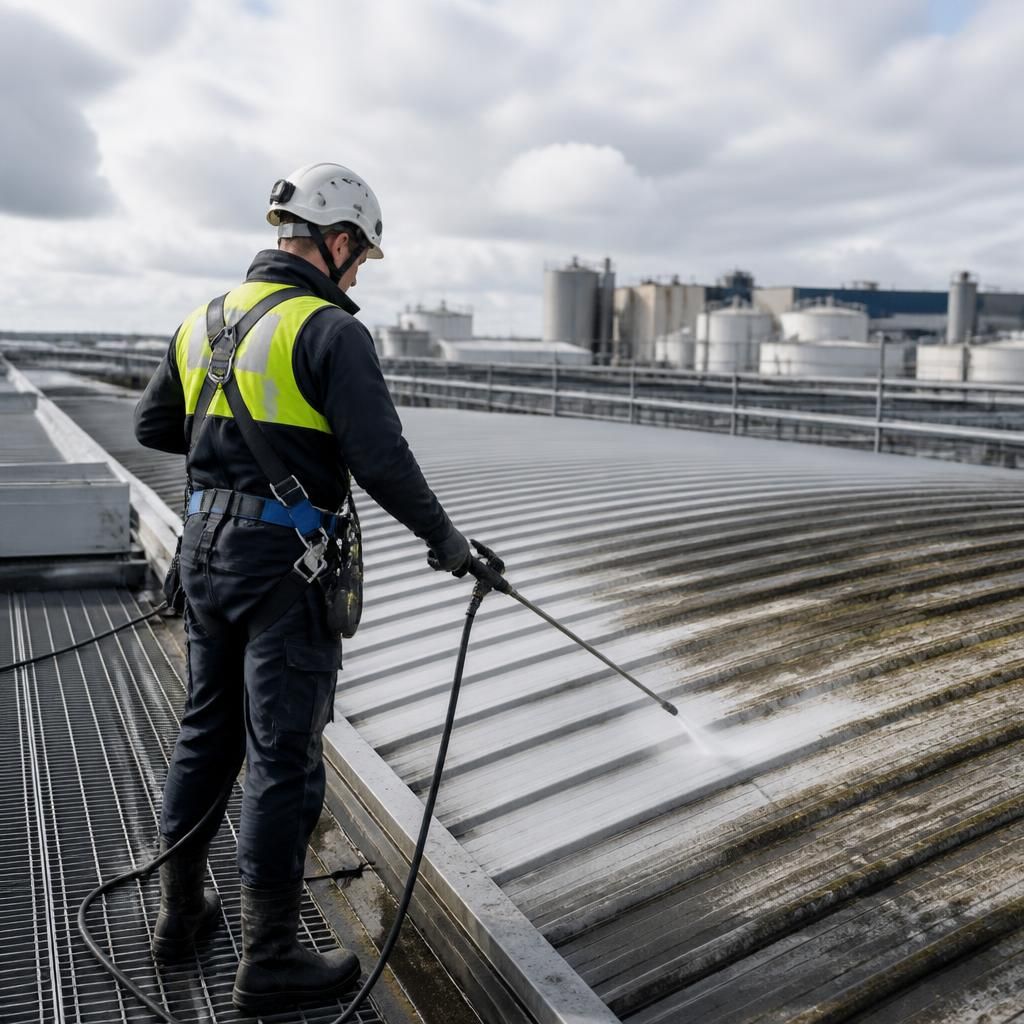
Professional roof cleaning equipment improves results by giving operators precise control over pressure, water flow and treatment application. This allows moss, algae, lichen and atmospheric dirt to be removed without applying unnecessary force to tiles, coatings, membranes, flashings or roof seals.
Using the correct combination of soft-wash systems, low-pressure rinsing, steam equipment and suitable access tools also reduces repeat work. Contamination can be treated according to its cause, while long-reach equipment helps operators clean difficult areas from a safer position and minimise direct foot traffic on vulnerable roof surfaces.
Arrange a professional roof cleaning assessment
Arrange a professional roof cleaning assessment to identify the most suitable equipment, access method and treatment for your roof. We can review its condition, contamination, drainage and surrounding risks before recommending a safe, efficient cleaning plan.