
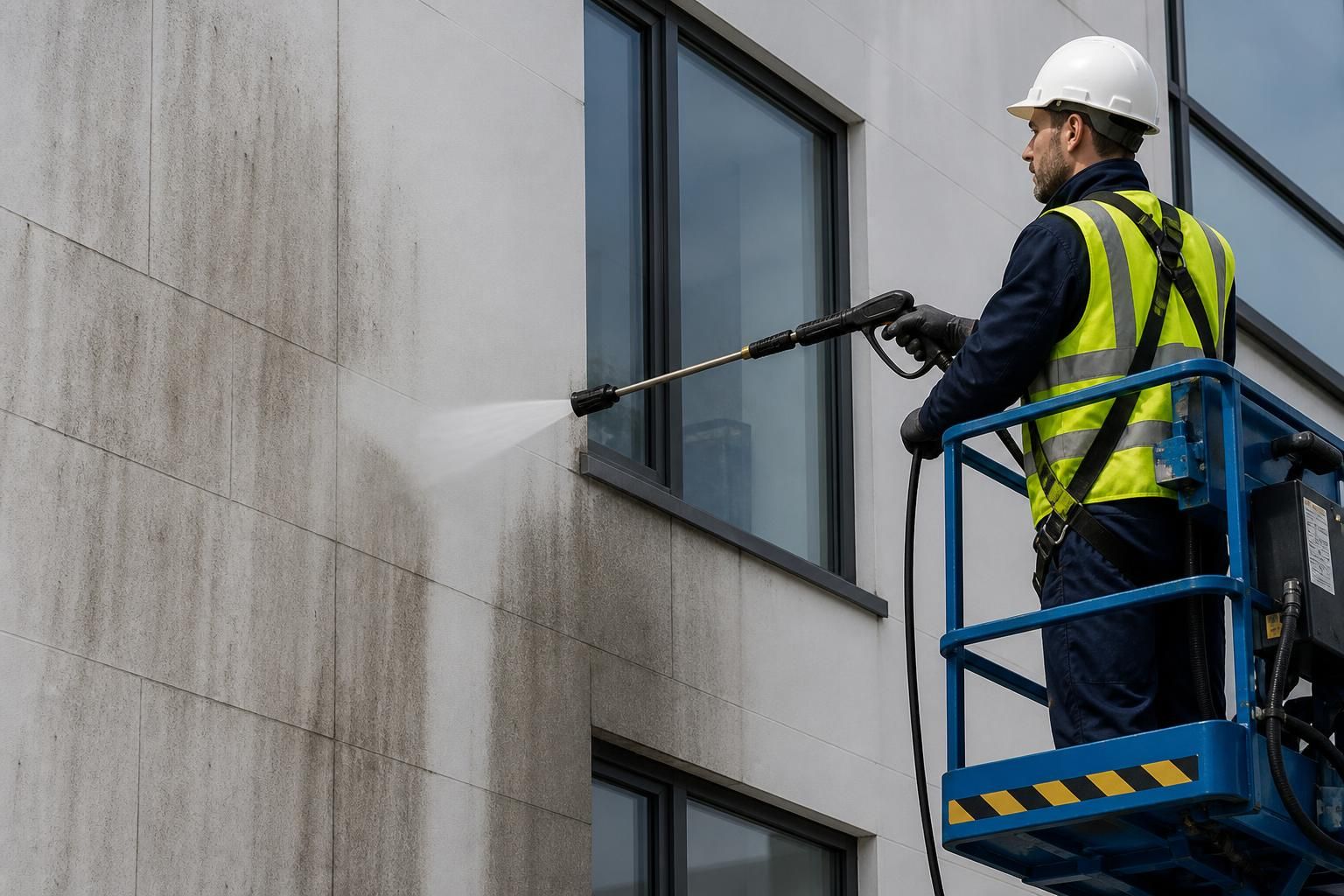
How does pressure washing help in maintaining façade longevity and appearance?
Pressure washing helps maintain façade longevity by removing dirt, algae, pollutants, bird deposits and other contaminants that can retain moisture and contribute to surface deterioration. Using the correct pressure, temperature and cleaning method for the façade material also restores a clean, professional appearance without causing avoidable damage.
Pressure washing supports façade longevity by removing contaminants that can hold moisture against the surface, encourage biological growth and accelerate deterioration. When the water pressure, temperature, nozzle distance and cleaning agent are matched to the façade material, the process also restores a consistent appearance while reducing the need for more disruptive remedial work.
External façades are exposed to traffic film, airborne pollution, dust, algae, moss, bird deposits, oils and construction residues. If these deposits remain in place, they can form a persistent film that traps moisture and conceals defects. On porous masonry, moisture can contribute to staining, frost-related damage and salt movement. On coated cladding, render and painted surfaces, contamination can encourage biological growth and gradually affect the finish. Removing it as part of a planned maintenance programme helps the façade remain serviceable and presentable.
Pressure washing improves façade longevity in several practical ways:
- It removes moisture-retaining contamination. Dirt, algae, moss and organic deposits can keep surfaces damp for longer, particularly in shaded or poorly ventilated areas. Cleaning reduces this build-up and allows the façade to dry more effectively.
- It limits biological growth. Algae, lichen and moss can spread across porous materials and may work into joints, texture and surface irregularities. Removing the growth, followed by suitable treatment where required, helps slow its return.
- It reduces the effect of pollutants. Traffic film and industrial deposits can discolour façades and may become more difficult to remove if they are allowed to bond with the surface over time.
- It helps expose defects. Once deposits have been removed, failed sealant, open joints, cracked render, damaged coatings, corrosion staining and areas of spalling are easier to identify. Cleaning does not repair these defects, but it allows them to be assessed before they become more extensive.
- It protects the appearance of the property. A clean façade presents a more consistent finish and helps prevent isolated staining from becoming a permanent feature of the building.
The method must be selected for the material rather than applied as a standard high-pressure wash. Brickwork, stone, concrete, render, metal cladding, painted surfaces and UPVC each have different tolerances. A dense, sound concrete surface may withstand a stronger application than aged render or weathered masonry. Excessive pressure can remove pointing, drive water behind cladding, strip coatings, enlarge existing cracks or roughen the surface. For this reason, a professional clean normally starts with a site assessment and a small test area in an inconspicuous location.
Effective façade cleaning depends on more than pressure alone. The operator may adjust:
- Water pressure: Lower pressure is generally preferred where the surface is fragile, porous, coated or poorly bonded.
- Water temperature: Heated water can help break down greasy traffic film and oily deposits, reducing the need for aggressive mechanical action.
- Nozzle type and spray pattern: A suitable nozzle distributes the water safely and avoids concentrating force on joints, edges or vulnerable details.
- Working distance and angle: Keeping the lance at a controlled distance and using an appropriate angle helps prevent water being forced behind panels, seals or pointing.
- Cleaning solution: Material-compatible detergents or biocidal treatments may be used for specific contamination. They must be applied, controlled and rinsed in accordance with the product instructions and site requirements.
- Rinsing and recovery: Removed contaminants and wash water should be controlled so they do not stain adjoining surfaces, enter drainage systems improperly or affect pedestrians and other building users.
Surface preparation is important to the final result. Loose debris may be removed first, vulnerable windows, doors, vents and electrical fittings should be protected, and damaged areas should be recorded before cleaning begins. Where a façade has failed coatings, loose render or defective joints, pressure washing may need to be reduced or avoided locally until those areas have been repaired. Cleaning an unstable surface can worsen the defect rather than improve it.
Pressure washing can also support appearance retention by removing staining before it becomes deeply embedded. Regular planned cleaning is usually more controlled than waiting until heavy deposits require intensive treatment. The appropriate interval depends on the building’s location, exposure, surface type, surrounding vegetation, traffic levels and the nature of the contamination. Buildings near busy roads, industrial areas, trees or coastal environments may require closer monitoring than less exposed premises.
It is important to distinguish cleaning from repair or restoration. Pressure washing can remove surface contamination, but it cannot correct failing mortar, damaged render, corroded fixings, defective sealants or water ingress. Nor should it be used to conceal a developing structural or weatherproofing problem. A competent assessment should identify whether the façade needs cleaning only or whether repairs, coating renewal, repointing or further investigation are also required.
For commercial and industrial properties, the most reliable approach is a documented maintenance process: inspect the façade, identify the material and contamination, test the proposed method, protect adjacent areas, clean in controlled sections, inspect the result and record any defects found. This approach helps maintain a professional appearance while reducing the risk of avoidable surface damage. Correctly specified pressure washing therefore contributes to façade longevity not by forcing dirt away at maximum pressure, but by removing harmful deposits with the least aggressive effective method.
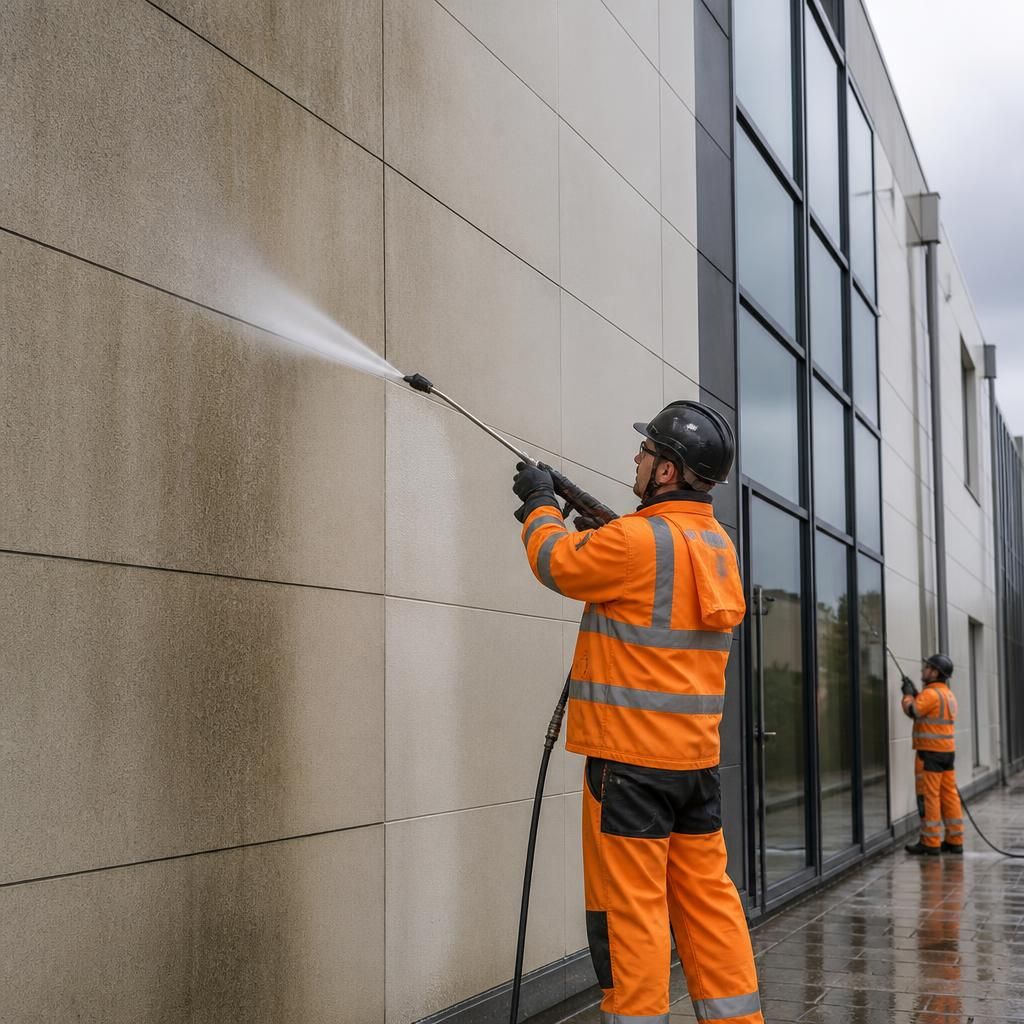
Pressure washing helps preserve façade longevity when it removes contamination using the least aggressive effective method for the surface. Matching the pressure, water temperature, nozzle, working distance and cleaning solution to the façade material reduces the risk of stripped coatings, damaged pointing, surface erosion or water being forced behind panels and seals.
A controlled process also improves appearance by removing traffic film, algae, moss, bird deposits and other staining before they become more firmly bonded to the surface. After cleaning, defects such as cracked render, failed sealant, open joints or corrosion staining are easier to identify and address. Pressure washing does not repair these problems, so inspecting the façade before and after cleaning is an important part of maintaining both its appearance and weather resistance.