
What safety precautions should be taken during commercial façade cleaning?
Commercial façade cleaning requires a documented risk assessment, suitable access planning, trained operatives, and controls for working at height, water, chemicals, equipment, traffic and members of the public. Appropriate PPE, exclusion zones, safe systems of work and environmental controls should be in place before cleaning begins and monitored throughout the project.
Commercial façade cleaning should only begin after the risks have been assessed and controlled through a documented method statement, suitable access plan and trained workforce. The main precautions are to protect operatives, building occupants and the public from falls, falling objects, pressurised water, chemicals, electrical hazards, moving equipment, traffic and contaminated run-off.
Complete a site-specific risk assessment
Before work starts, the cleaning team should inspect the façade, surrounding ground and site access. The assessment should consider the building’s height and condition, fragile surfaces, loose masonry, glazing, overhead services, nearby roads, entrances, pedestrian routes, weather exposure and any known contaminants. It should also identify how water, waste and equipment will be managed without creating additional hazards.
The findings should be reflected in a written method statement and communicated to everyone involved. Where the project falls within construction work, relevant duties under the Construction (Design and Management) Regulations should also be considered. Controls must be reviewed if the weather changes, the access arrangement is altered, the façade proves less stable than expected or the cleaning method needs to change.
Plan work at height and access equipment carefully
Work at height should be avoided where a safe ground-based method is reasonably practicable. Where access at height is necessary, the equipment should be selected according to the height, reach, façade condition, duration and nature of the work. This may include mobile elevating work platforms, towers, suspended access systems or rope access, depending on the site and task.
Access equipment must be suitable, inspected and operated by trained personnel. Operators should follow the manufacturer’s instructions and site procedures, with particular attention to ground conditions, safe loading, stabilisation, harness use and emergency lowering or rescue arrangements. Equipment used for lifting people or materials should be subject to the appropriate examination and inspection requirements, including LOLER where applicable. Work at height should be planned and carried out in line with the Work at Height Regulations.
Tools, hoses and cleaning accessories should be secured so they cannot fall onto people or property. Operatives should not overreach from platforms, stand on unsuitable surfaces or improvise access arrangements. A rescue plan is essential for any system where a worker could become suspended, trapped or unable to return safely to ground level.
Establish exclusion and protection zones
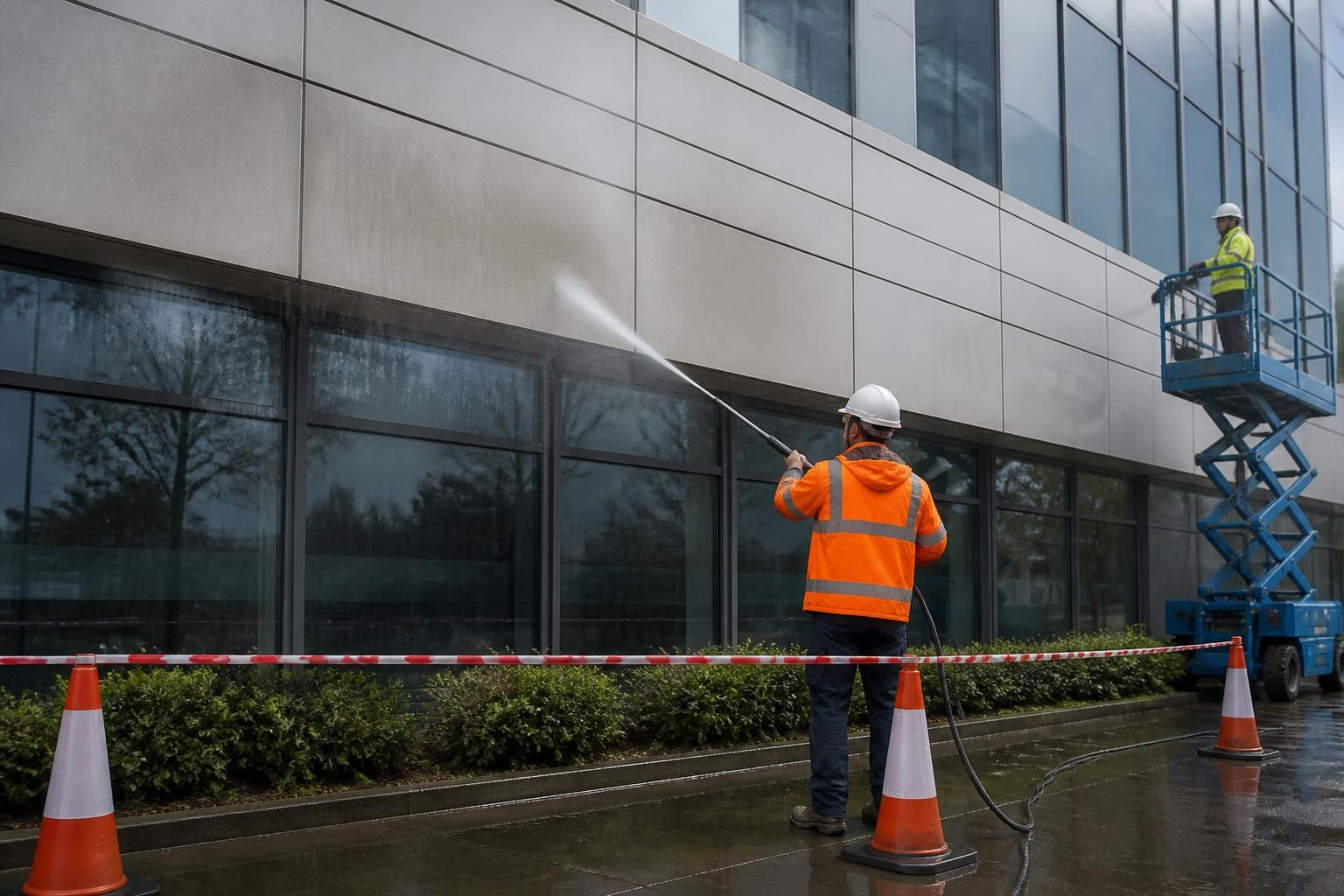
Areas beneath and around the work face should be segregated before cleaning begins. Barriers, signs and, where necessary, a banksman or dedicated marshal should prevent unauthorised access. The exclusion zone should account for the height of the work, the reach of spray, the possibility of falling debris and the movement of access equipment.
Entrances, fire exits, delivery routes and pedestrian walkways must remain safe and usable. If a route has to be diverted, the alternative should be clearly signed and agreed with the site contact. Where work takes place beside a road or in a car park, traffic management should separate vehicles from the work area and protect hoses, cables and equipment from being struck or creating trip hazards.
Windows, doors, vents, air-conditioning intakes, sensitive equipment, vehicles and nearby finishes should be protected from water, chemicals and dislodged dirt. Loose material should be removed or made safe before pressure cleaning where it could fall unexpectedly.
Use appropriate personal protective equipment
PPE should be selected through the risk assessment rather than used as a substitute for safer planning. Depending on the task, this may include safety footwear with suitable grip, gloves, eye or face protection, protective clothing, hearing protection, head protection and respiratory protection. Harnesses and lanyards are required where the access system and risk assessment specify them, but they must be correctly fitted, inspected and connected to suitable anchor points.
Respiratory protective equipment may be needed when cleaning creates airborne dust, mould, biological material or chemical vapour. It must be suitable for the hazard and used within an effective face-fit, maintenance and filter-management system. Wet clothing and gloves should be replaced when they no longer provide adequate protection, particularly during prolonged pressure washing or steam cleaning.
Control water, pressure and steam hazards
Pressure washers and steam-cleaning equipment should be operated only by trained personnel. Before use, hoses, couplings, trigger guns, lances, electrical connections and safety devices should be checked for damage and secure operation. Operators should never direct pressurised water at people, live electrical equipment, unprotected openings or unstable masonry.
Pressure and temperature should be selected for the façade material and its condition. Excessive pressure or heat can damage mortar joints, coatings, pointing, sealants, glazing and vulnerable decorative details. A controlled test area helps confirm that the selected method is safe for the surface before wider cleaning takes place.
Water can create slip hazards, obscure visibility and enter areas that were not intended to get wet. Run-off should be contained or directed safely, and work should stop if pooling, flooding or uncontrolled discharge develops. Hoses should be routed away from walkways where possible and protected with suitable covers where they must cross a route.
Manage chemicals under COSHH
Any detergents, biocides, solvents, paint removers or other treatment products should be assessed under the Control of Substances Hazardous to Health Regulations. Operatives need access to the relevant safety data, product instructions and control measures before use. Chemicals should be stored, labelled, diluted and transported safely, never mixed unless the manufacturer specifically permits it.
Suitable gloves, eye protection, protective clothing and respiratory controls should be used where required. Nearby people and vulnerable surfaces must be protected from spray, vapour and splashes. Emergency arrangements should include access to clean water or an eyewash facility, spill control materials and clear instructions for dealing with exposure. Chemical residues and contaminated water must be collected or disposed of in accordance with the product requirements and site arrangements.
Check electrical and mechanical safety
Electrical equipment used outdoors must be suitable for the conditions and protected from water. Cables, plugs, extension leads and portable equipment should be inspected before use, with suitable residual current protection and safe power supplies in place. Electrical items should be kept away from standing water and spray wherever practicable.
Machinery should be maintained and used in accordance with the Provision and Use of Work Equipment Regulations. Guards must remain in place, maintenance should be carried out by competent people and equipment should be isolated before clearing blockages or carrying out adjustments. Operatives should also be briefed on pinch points, moving platforms and vehicle movements.
Consider the building and façade condition
A façade should be checked for loose render, cracked masonry, unstable cladding, failed sealants, damaged glazing and other defects before cleaning. Cleaning can expose or worsen defects that are not visible from ground level, so operatives should report changes rather than attempting unauthorised repairs. Historical, fragile or heavily weathered surfaces may require a gentler method, specialist advice or a separate conservation assessment.
Testing should confirm that the cleaning system will not cause unacceptable damage, staining, water penetration or loss of protective coatings. Particular care is needed around joints, vents, vents and service penetrations, as well as areas where water could reach occupied rooms or electrical systems.
Monitor weather and site conditions
Wind, rain, ice, poor visibility and extreme temperatures can make façade cleaning unsafe. Wind can affect suspended or elevated access equipment, spread spray beyond the exclusion zone and make handling tools difficult. Rain can reduce grip and visibility, while freezing conditions can create ice from run-off. Work should be paused whenever conditions exceed the safe limits for the equipment, method or building.
Site supervision should continue throughout the work. The supervisor should check that barriers remain in position, PPE is being used correctly, access equipment is stable, hoses are controlled and the agreed method is being followed. Any incident, near miss, equipment defect or change in façade condition should be recorded and addressed before work resumes.
Maintain emergency and communication arrangements
Everyone on site should know who is supervising the work, how to raise an alarm and what to do in an emergency. The plan should cover falls from height, equipment failure, chemical exposure, electrical incidents, injury from falling material, fire, uncontrolled water and the need to rescue a worker from an elevated position.
There should be reliable communication between operatives, the site contact and any banksman or access-equipment controller. First-aid arrangements, emergency access and contact details should be confirmed before starting. On completion, the area should be inspected for residual hazards such as wet surfaces, loose debris, chemical containers, unsecured equipment and blocked drainage.
These precautions make façade cleaning a controlled work activity rather than simply a washing operation. A competent contractor should be able to explain the proposed method, access system, exclusion arrangements, PPE, chemical controls, emergency plan and environmental safeguards before work begins, and should adapt those controls to the building and conditions on the day.
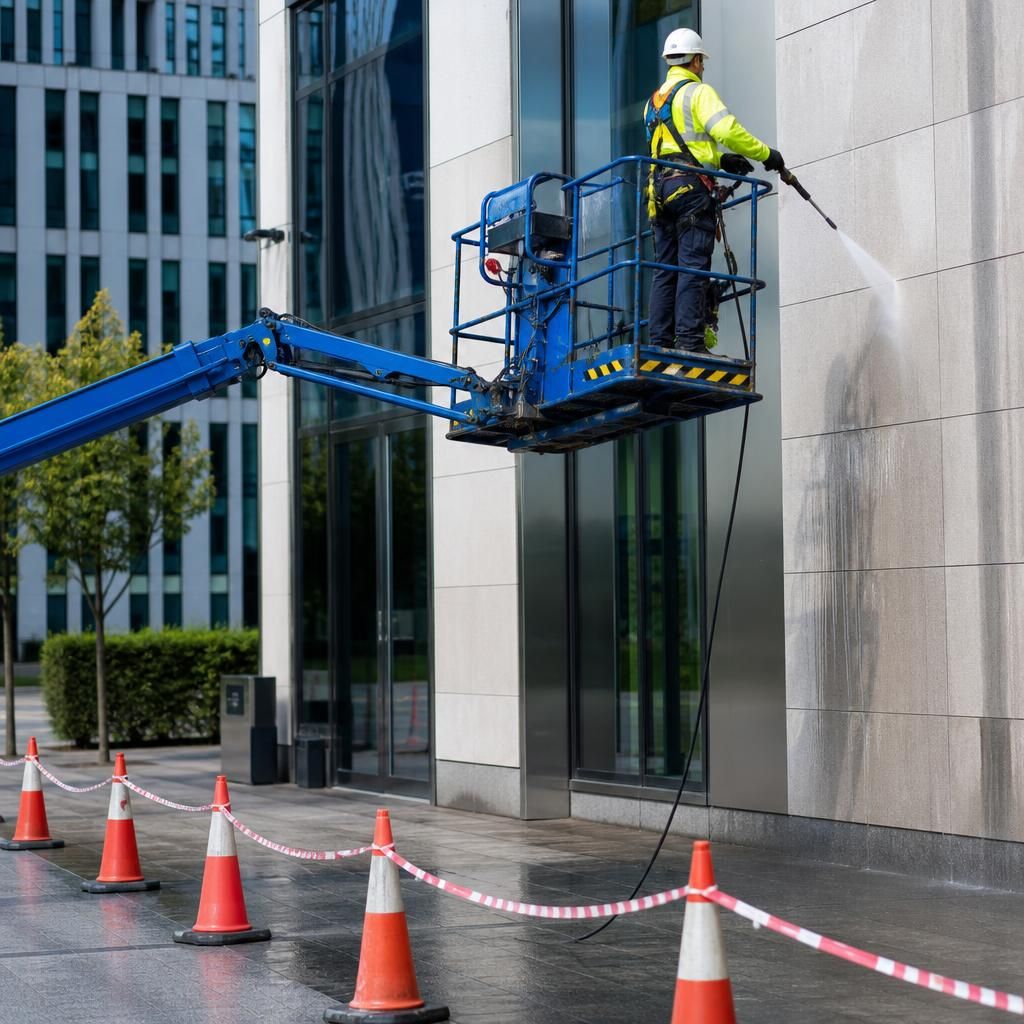
Safe commercial façade cleaning depends on controlling work at height, falling objects, pressurised water, chemicals and public access before cleaning begins. A site-specific risk assessment should determine the safest access equipment, exclusion zone, PPE, equipment checks and emergency arrangements for the building and cleaning method.
- Inspect platforms, harnesses, hoses, lances and lifting equipment before use.
- Secure tools and accessories so they cannot fall, and never overreach or improvise access arrangements.
- Use barriers, warning signs and a marshal where necessary to keep pedestrians and vehicles away from the work area.
- Protect entrances, glazing, vents, vehicles and electrical equipment from spray, chemicals and falling debris.
- Pause work if wind, rain, poor visibility, unstable surfaces or uncontrolled run-off make the agreed method unsafe.
These controls should be monitored throughout the project, with the method reviewed if site conditions or the façade condition changes.