
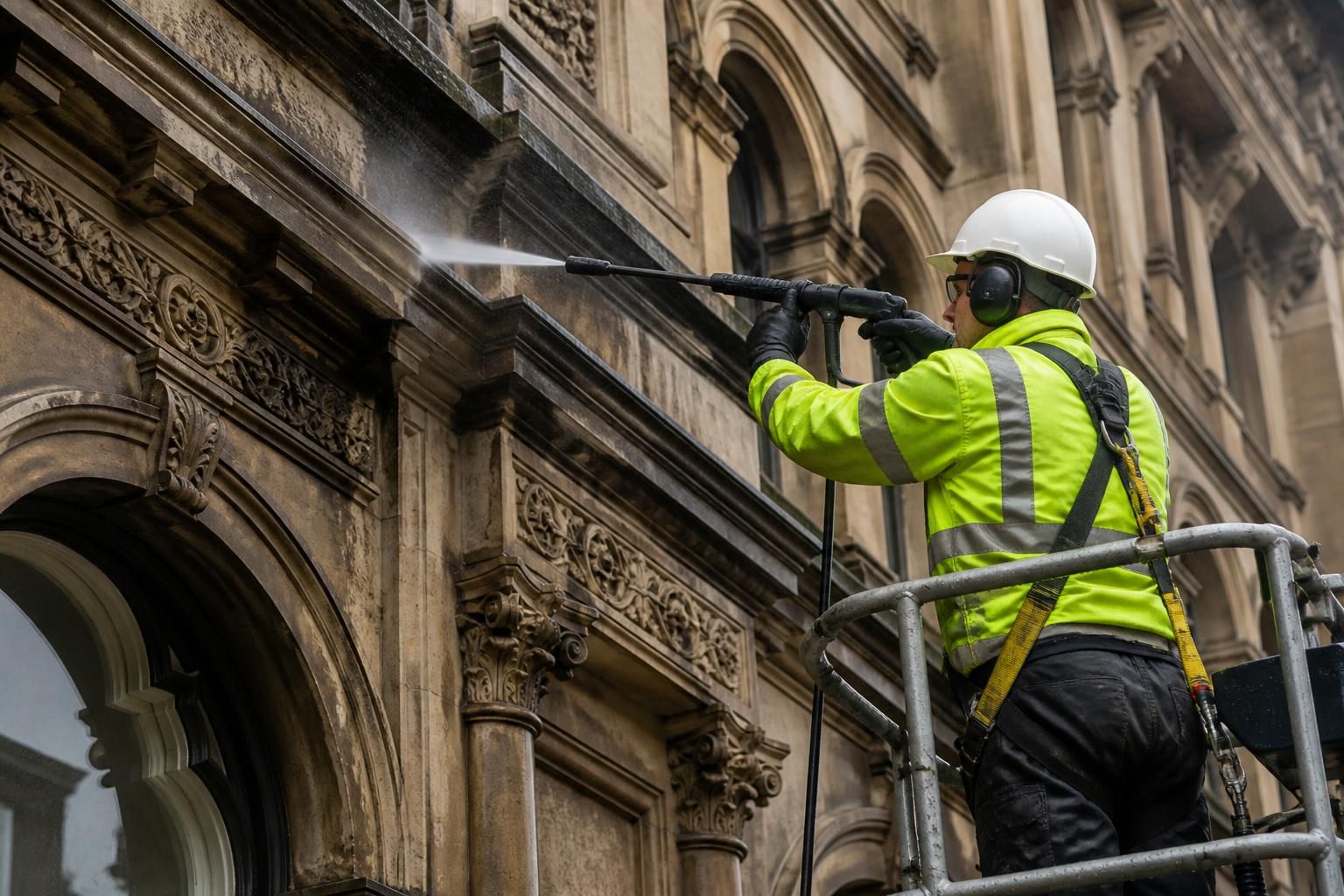
What experience do you have in dealing with historical or culturally significant building façades?
We have experience cleaning historical and culturally significant façades using low-impact, carefully controlled methods suited to the building’s materials, age and condition. Each project begins with a detailed assessment and test clean, followed by an agreed method statement designed to remove dirt, staining or graffiti without damaging historic fabric or decorative details.
We have experience cleaning historical and culturally significant façades where the priority is to remove soiling without harming historic fabric, decorative detail or vulnerable finishes. Our work is based on understanding the building’s materials, age, condition and significance before selecting a cleaning method. This includes façades constructed from brick, natural stone, terracotta, render, stucco, painted surfaces and mixed materials.
Historic buildings require a different approach from standard commercial façades. Aggressive pressure washing, abrasive cleaning or unsuitable chemical treatments can remove original surface material, open up joints, drive water into the structure or leave permanent marks. We therefore use the least aggressive method that can achieve the required result, with pressure, temperature, dwell time and chemical concentration controlled throughout the work.
Our process normally includes:
- Initial assessment: We inspect the façade to identify the construction materials, surface coatings, previous repairs, biological growth, staining, failed pointing and areas that may be unstable or particularly vulnerable.
- Review of the building’s status: Where relevant, we take account of listed-building requirements, conservation-area controls, landlord approvals and any recommendations from a conservation specialist or managing agent. Cleaning is not started until the necessary permissions and responsibilities are clear.
- Photographic records: Existing defects, weathering, staining and fragile details are recorded so that cleaning is not confused with pre-existing damage.
- Test cleaning: Small, representative areas are tested using carefully controlled techniques. The test evaluates cleaning effectiveness, colour change, surface loss, water absorption and the appearance of the cleaned area once dry.
- Agreed method statement: The findings are used to define the equipment, pressures, temperatures, products, access arrangements, protection measures and inspection points for the main works.
- Controlled cleaning and inspection: Operatives work in manageable sections, regularly checking the surface and adjusting the method where the material responds differently from the test area.
Depending on the façade, suitable methods may include low-pressure soft washing, steam cleaning, nebulous or mist cleaning, gentle rinsing and carefully selected conservation-compatible treatments. Steam can be useful for reducing atmospheric grime, biological growth and some surface deposits while limiting the mechanical force applied to the façade. Soft washing may be appropriate for organic growth when the product and application method are compatible with the substrate. Abrasive techniques are generally avoided on historic surfaces unless a specialist assessment has established that they are suitable.
Particular care is needed around carved stone, tracery, cornices, window surrounds, ornamental brickwork, leaded features, old pointing and areas of delamination. We avoid directing water into open joints, cracks, vents or behind loose coatings. Fragile elements are protected from direct spray, and nearby windows, roofs, signage, electrical equipment and pedestrian areas are isolated or covered where necessary. Cleaning does not replace structural or conservation repairs, so unstable masonry, defective pointing and loose render are reported rather than concealed through cleaning.
Different stains also require different decisions. Carbon deposits, traffic film, algae, moss, bird fouling, rust and graffiti may respond to completely different treatments. We do not assume that a product suitable for one part of a façade can be used across the whole elevation. Chemical treatments are selected for the specific contamination and substrate, applied for the minimum effective contact time, and rinsed or neutralised in accordance with the method statement and product requirements. Run-off is controlled to prevent damage to landscaping, drainage systems and adjoining materials.
For graffiti on historic façades, the objective is to remove the marking while retaining as much of the original surface and patina as possible. We assess both the graffiti medium and the underlying material before testing a removal system. On porous stone or brick, repeated harsh cleaning can create a larger, lighter patch than the original graffiti, so gradual removal and visual blending are more important than simply using the strongest available treatment.
Access and safety planning are also adapted to the building. Depending on the height, layout and surrounding environment, we may use mobile access equipment, fixed platforms or other suitable systems. Access equipment is selected to avoid overloading roofs, paving or vulnerable structures, and work areas are managed to protect occupants, visitors and the public. Water, chemicals and falling debris are contained, with appropriate controls for drainage, traffic and pedestrian movement.
Where a façade has recognised heritage value, we work with the client’s appointed surveyor, conservation professional, architect or local authority contact as required. We provide method information, test-clean findings and progress updates so that decisions can be reviewed before the full elevation is treated. On completion, the client can be provided with cleaning records, photographs and recommendations for future maintenance.
The result should be a cleaner, more legible façade without unnecessary loss of historic material. For culturally significant buildings, successful cleaning is measured not by maximum visual change, but by achieving the required improvement while preserving the character, finish and integrity of the structure.
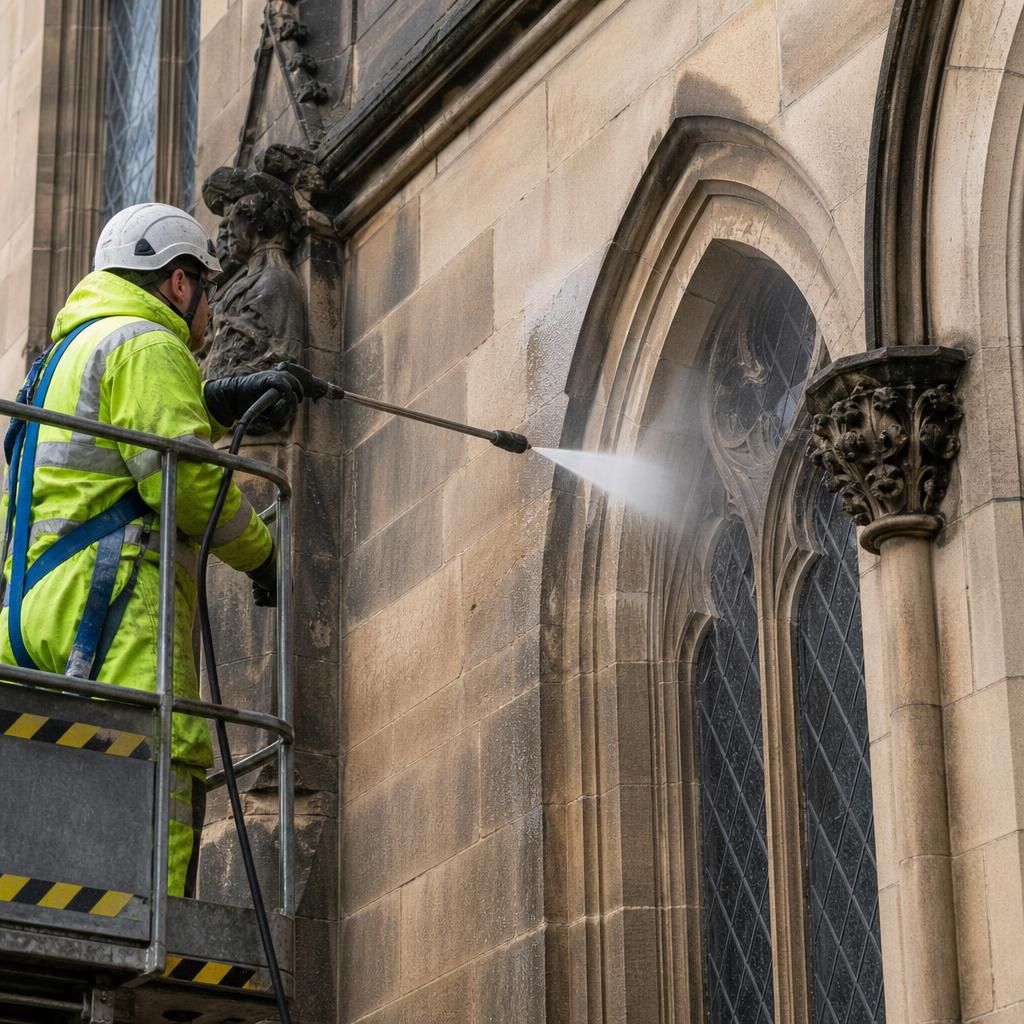
Historical façade cleaning requires a tested, low-impact method that removes soiling without unnecessarily removing original material, patina or decorative detail. Before full-scale work begins, we assess the substrate, condition, coatings, joints and type of contamination, then carry out a controlled test clean in a representative area.
The test helps establish how the surface responds to pressure, temperature, moisture and any treatment product. We check for colour change, surface loss, water penetration and differences between cleaned and uncleaned areas. The findings are recorded and used to prepare the agreed method statement, including protection for fragile features, windows, roofs, drainage and surrounding public areas.
This approach is particularly important for listed or culturally significant buildings, where a visually stronger clean is not necessarily the correct result. The aim is to improve the façade’s condition and legibility while preserving its historic character and avoiding avoidable damage.