
What safety precautions are necessary during pressure cleaning operations?
Pressure cleaning operations require a pre-work risk assessment, trained operators, suitable PPE, inspected equipment, controlled water and chemical use, and clearly managed exclusion zones to protect workers, building occupants and the public. Additional controls are needed for traffic, electrical hazards, fragile surfaces, contaminated run-off and work at height.
Safe pressure cleaning requires a documented risk assessment, competent operators, correctly maintained equipment, suitable personal protective equipment (PPE), controlled work areas and responsible management of water, chemicals and waste. The precautions must be adapted to the site, surface, cleaning method, access arrangements and risks to workers, building occupants, vehicles and the public.
Complete a site-specific risk assessment before work begins
The cleaning team should inspect the site and identify hazards before selecting equipment or starting work. This assessment should consider the condition and height of the surface, access routes, nearby pedestrians and traffic, electrical installations, fragile materials, drainage, contaminated deposits and weather conditions. It should also record who may be affected and the controls needed to keep them safe.
A suitable method statement should explain the planned sequence of work, equipment, cleaning products, access method, exclusion zones, emergency arrangements and waste-water controls. Where the work is undertaken for a commercial or industrial client, site rules and the client’s own permit or contractor-control procedures must also be followed.
Use trained and competent operators
Pressure cleaning should be carried out by people who understand the equipment, the surfaces being treated and the hazards created by high-pressure water. Operators need to know how to start, stop and isolate the system safely, manage hoses and attachments, apply chemicals in accordance with their instructions, and respond to equipment failure or an injury.
Training should cover manual handling, slips and trips, working near traffic, electrical safety, chemical exposure, water run-off and the particular access equipment used. Work at height, confined spaces and specialist industrial environments require additional competence and controls rather than relying solely on general pressure-washing experience.
Wear appropriate PPE
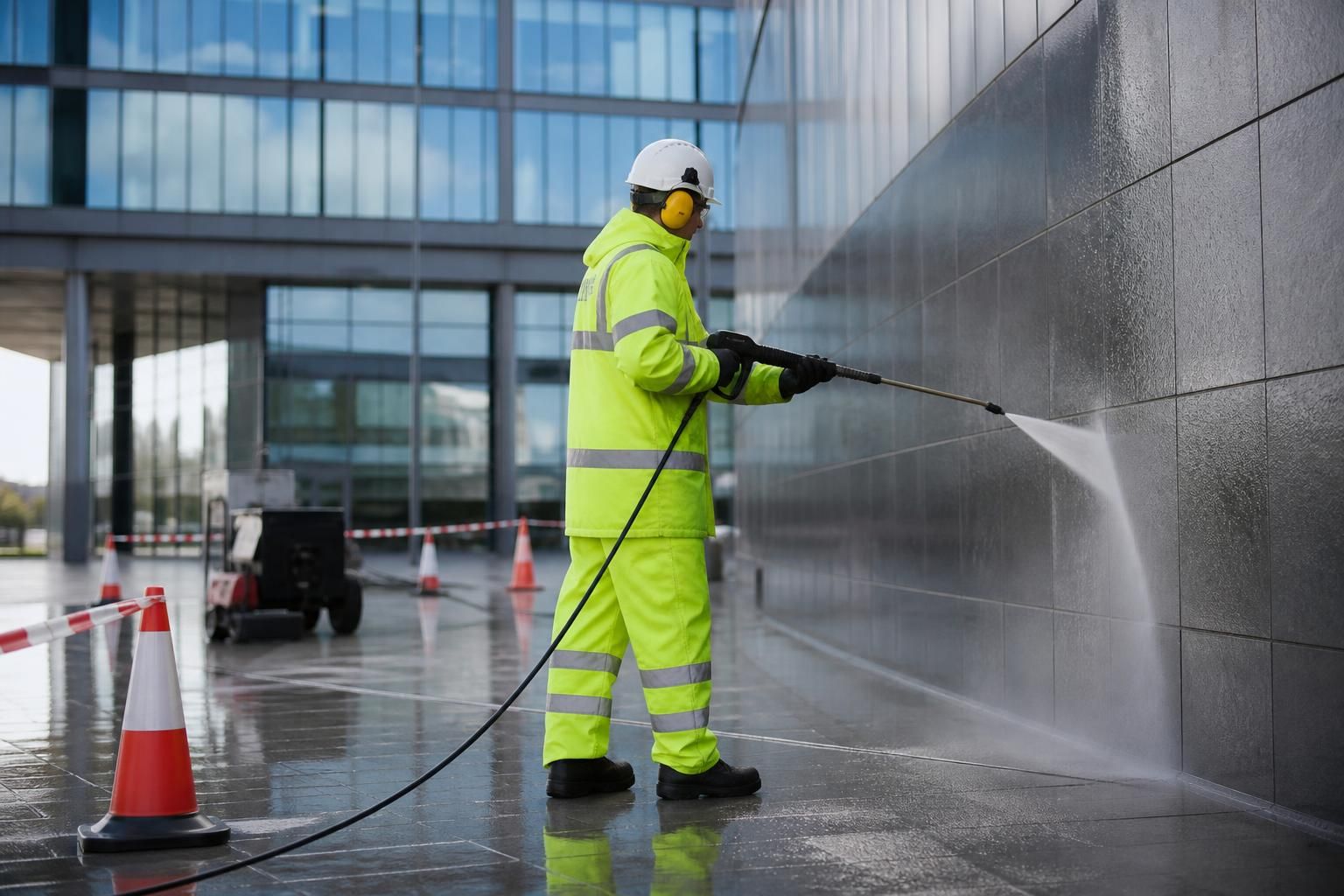
PPE should be selected following the risk assessment and kept in good condition. Depending on the work, this may include:
- Protective footwear with slip-resistant soles and suitable toe protection.
- Water-resistant protective clothing or coveralls.
- Safety goggles or a full face shield to protect against spray, debris and cleaning chemicals.
- Hearing protection where equipment creates hazardous noise levels.
- Gloves suitable for the equipment and any chemicals being handled.
- Head protection where there is a risk of falling objects or impact.
- High-visibility clothing around vehicles, plant or public areas.
- Fall-arrest or restraint equipment where required for work at height and where it can be used safely with an appropriate anchorage system.
PPE is the final layer of protection. It does not replace safe isolation, suitable access equipment, guarding, ventilation or an effective exclusion zone.
Inspect and control the pressure-cleaning equipment
Before use, operators should inspect the machine, hoses, lance, trigger, couplings, seals, electrical leads, plugs, fuel systems and safety devices. Damaged or leaking components must be removed from service and repaired or replaced by a competent person. Hoses should be routed to prevent kinks, trip hazards and accidental damage from vehicles or sharp edges.
The operating pressure and flow should be suitable for both the equipment and the surface. Operators should never point a live lance at another person, use a damaged hose, bypass a safety control or leave pressurised equipment unattended. The trigger should be released and the system isolated before changing nozzles, clearing blockages, moving equipment or carrying out maintenance.
Electrical equipment must be suitable for the environment and protected from water ingress. Leads, plugs and portable equipment should be inspected and used with appropriate residual-current protection where required. Petrol or diesel-powered equipment must not be operated in enclosed or poorly ventilated areas because of exhaust fumes and carbon monoxide risk.
Establish an exclusion zone
High-pressure spray can propel dirt, stone, paint fragments and other debris beyond the immediate work area. It can also injure people, damage vehicles and contaminate adjacent surfaces. Barriers, cones, warning signs and, where necessary, a banksman should be used to keep unauthorised people away from the operation.
Doors, entrances and pedestrian routes should be protected or temporarily diverted. Building occupants and other contractors should be told when cleaning will take place and which areas are unavailable. The exclusion zone should be extended where wind, spray rebound, falling debris or the use of chemicals increases the potential risk.
When cleaning near roads, loading bays or active car parks, the plan should address vehicle movements, visibility, reversing operations and safe hose routing. Traffic management may be required rather than relying on warning signs alone.
Manage work at height and difficult access
Ground-level cleaning should be used where practicable. If elevated areas must be reached, the safest suitable access method should be selected, such as a properly positioned mobile elevated work platform, scaffold or other approved system. Ladders should not be treated as a general work platform for sustained pressure cleaning, particularly where the operator needs both hands or must resist reaction force from the lance.
Work-at-height controls should include competent operators, inspected access equipment, secure footing, edge protection or suitable fall restraint, protection from falling objects and a rescue plan. Operators should consider the reaction force of the lance, the possibility of slippery platforms, overhead obstructions and the effect of wind. Access equipment must be used in accordance with the relevant instructions and site requirements.
Control chemicals, spray mist and contaminated deposits
Cleaning products must be selected for the surface and contaminant, supplied with appropriate safety information and used in line with the manufacturer’s instructions. COSHH controls should identify exposure risks, required PPE, safe storage, handling, dilution, first aid and spill response. Chemicals should never be mixed unless the product instructions specifically permit it.
Operators should minimise mist and overspray, particularly when using detergents, biocides, degreasers or graffiti-removal products. Ventilation and respiratory protection may be necessary in enclosed areas. Nearby people, air-intake systems, vehicles, plants and sensitive finishes should be protected from spray.
Deposits such as oil, fuel residues, mould, bird fouling, old coatings and graffiti may create additional health or environmental hazards. They should be contained and removed using a planned method rather than simply washing them into a drain.
Protect electrical systems and vulnerable surfaces
Electrical outlets, lighting, control panels, sensors, ventilation equipment and other services should be isolated, covered or kept outside the spray area. Cleaning should stop if water could enter electrical equipment or if the operator cannot confirm that the area is safe.
Pressure should be tested on an inconspicuous area before full cleaning begins. Brickwork, pointing, render, coatings, timber, membranes, sealants and aged concrete can be damaged by excessive pressure, heat or an unsuitable nozzle. The operator should work at an appropriate distance, use the least aggressive effective setting and avoid directing the jet into joints, vents, cracks or openings.
Control water, drainage and environmental risks
Run-off should be planned before cleaning starts. Drains should be identified and protected where contaminated water, detergents, oil, paint residue or sediment could enter the surface-water system. Suitable measures may include drain covers, bunding, temporary containment, wet vacuum recovery, filtration and approved disposal arrangements.
Water should be used efficiently without compromising the required cleaning result. The team should also consider spray drift, neighbouring properties, landscaping, watercourses, weather and the risk of creating slippery surfaces. Work should be paused when rain, high winds, ice or poor visibility makes the operation unsafe or undermines containment.
Maintain safe working practices throughout
Hoses and equipment should be kept organised, wet areas clearly identified and cleaned sections managed to reduce slips. Operators should take suitable breaks, use safe manual-handling techniques and avoid overreaching. A supervisor or designated responsible person should monitor changing conditions and stop the work if controls become ineffective.
Emergency arrangements should cover injury, chemical splash, electric shock, equipment failure, loss of containment and a member of the public entering the work area. First-aid provisions, emergency contact details, eye-wash facilities and access for emergency services should be available where appropriate. Any incident, near miss or property damage should be recorded, investigated and used to improve the method for future cleaning.
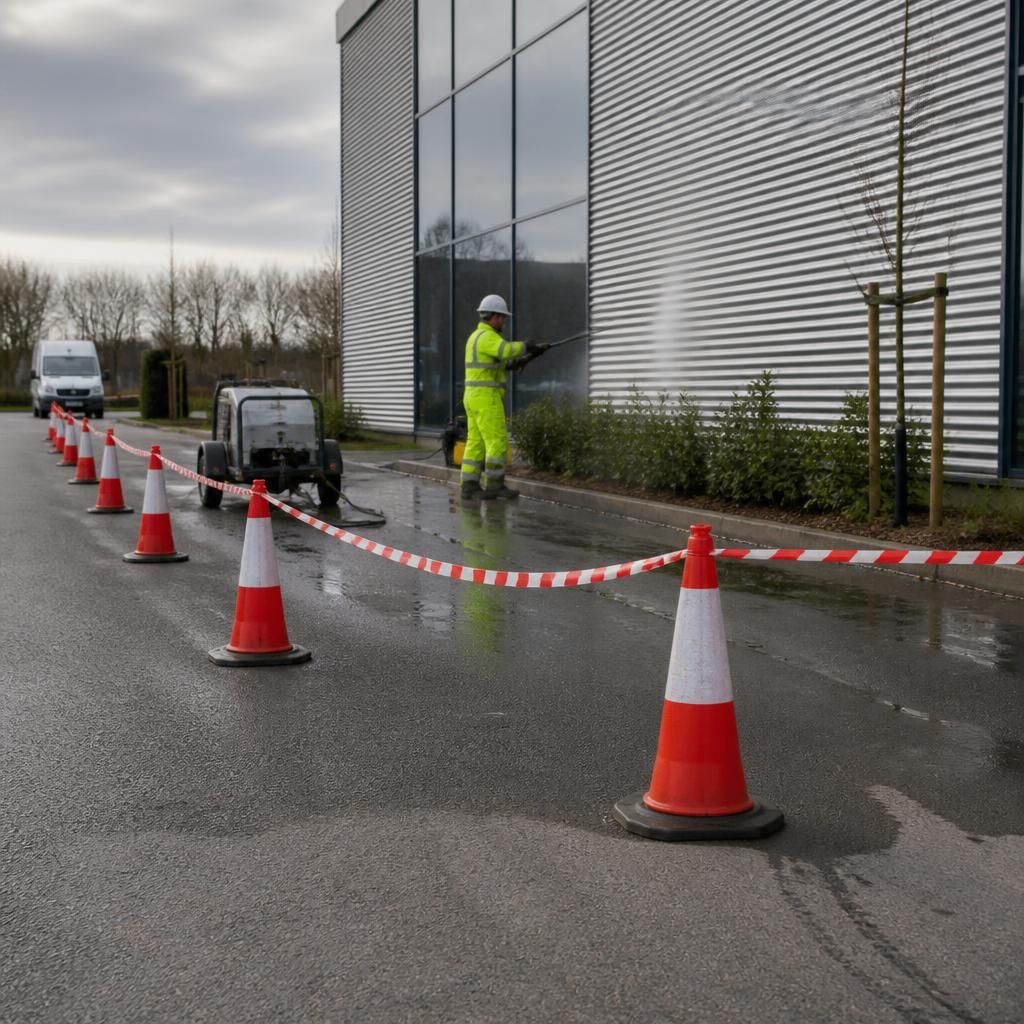
An exclusion zone is a controlled area around pressure cleaning work that prevents people, vehicles and unprotected surfaces from entering the spray, debris and run-off path. It should be established before equipment is started and sized according to the pressure, nozzle, surface, wind, spray rebound and any chemicals being used.
Barriers, cones and warning signs should clearly mark the area, while entrances and pedestrian routes may need temporary protection or diversion. When cleaning near roads, loading bays or active car parks, a responsible person may be needed to monitor vehicle movements and prevent unauthorised access. The zone should remain in place until equipment is isolated, surfaces are safe to walk on and contaminated water has been controlled.