
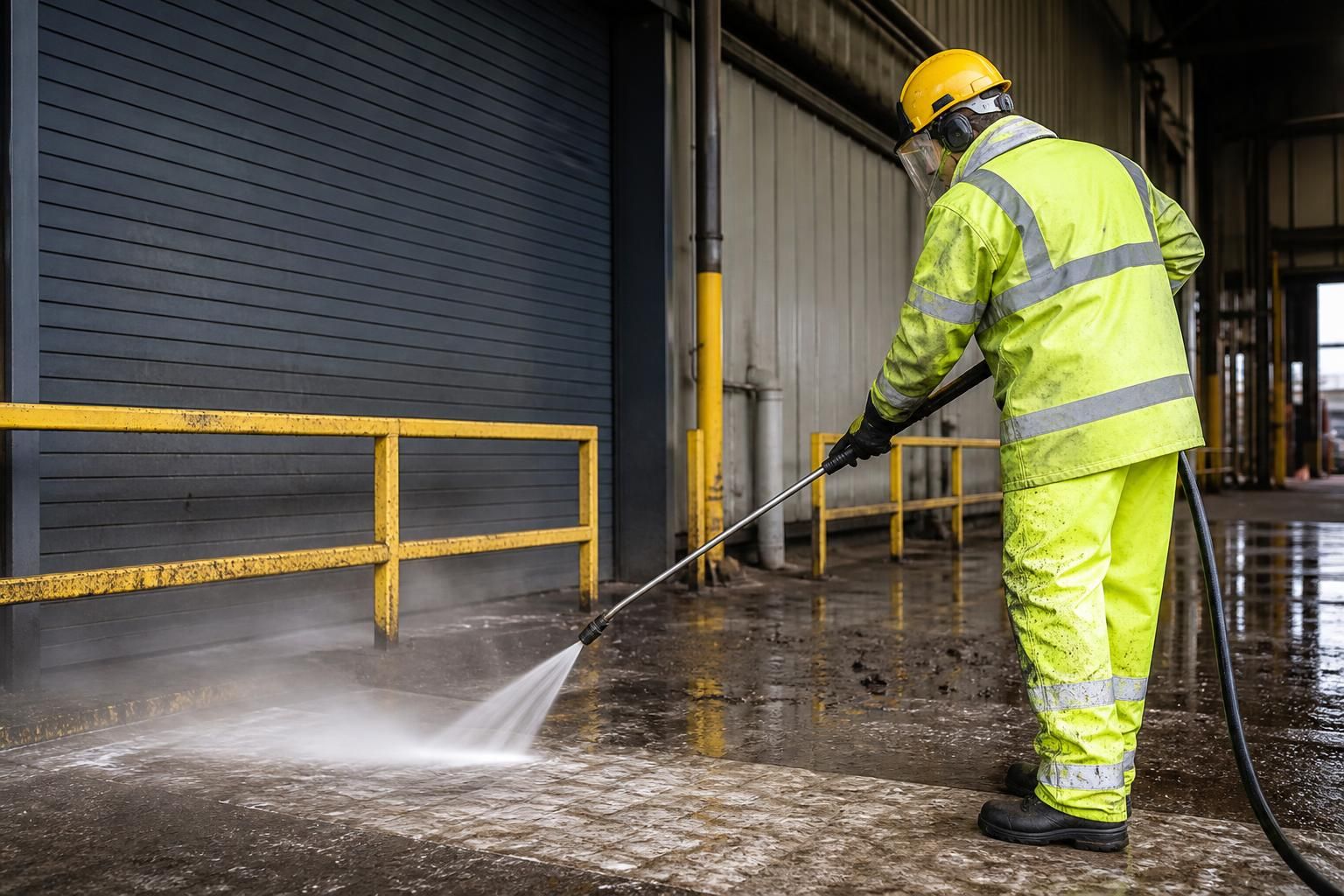
What safety measures should be taken during industrial pressure cleaning?
Industrial pressure cleaning requires a controlled risk assessment, trained operators, suitable personal protective equipment and secure exclusion zones to protect workers, visitors, the public and surrounding property. Operators should also manage water, chemicals, access equipment, electrical hazards, noise and contaminated runoff in line with site procedures and UK health and safety requirements.
Industrial pressure cleaning should be carried out under a documented risk assessment and method statement, with trained operators, suitable personal protective equipment, controlled work zones and procedures for water, chemicals, access equipment and contaminated runoff. The controls must be proportionate to the pressure, temperature, equipment, surface, contaminants and location, and should protect operatives, other contractors, visitors, members of the public and the building itself.
Complete a site-specific risk assessment
Before work begins, the cleaning contractor should inspect the site and identify hazards rather than relying on a generic procedure. The assessment should consider:
- the operating pressure, water temperature and spray pattern;
- fragile, deteriorated or poorly bonded surfaces;
- work at height, roof edges, openings and access routes;
- electrical installations, cables, plant and sensitive equipment;
- vehicle movements, pedestrians and other contractors;
- slips, trips, falling debris, flying particles and spray drift;
- chemicals, biological contamination, oils, heavy metals or other hazardous residues; and
- where wash water will flow and how it will be contained or disposed of.
The assessment should be reviewed if site conditions change, a different cleaning method is introduced or the work reveals an unexpected hazard. A clear method statement should then explain the sequence of work, equipment, controls, emergency arrangements and responsibilities.
Use trained and competent operators
High-pressure water can cause serious injection injuries, lacerations, eye injuries and damage to buildings or equipment. Operators should understand the machine’s controls, hose management, nozzle selection, safe stand-off distances, reaction forces and the limitations of each surface. They should also know how to isolate the equipment, respond to a hose failure and report defects.
Training should cover the specific equipment and conditions involved, including hot-water systems, chemical application, access equipment and contaminated environments where applicable. A competent supervisor should monitor the work, particularly on complex sites or where several contractors are working together.
Establish exclusion zones and control access
The cleaning area should be isolated with suitable barriers, signs and, where necessary, a banksman or dedicated site marshal. The exclusion zone must account for spray, rebound, falling material, loose coatings and vehicle movements; it should not be limited to the operator’s immediate position. Doors, walkways and entrances may need temporary diversion or protection, with the client and other site users informed before work starts.
Where cleaning takes place near roads, public areas or occupied premises, the controls may include traffic management, scheduled working periods, screening and protection for passers-by. Unauthorised people should not enter the work area while equipment is pressurised.
Wear task-appropriate personal protective equipment
Personal protective equipment should supplement, not replace, physical controls and safe working methods. Depending on the task, it may include:
- eye protection or a full face shield against spray, debris and chemical splashes;
- water-resistant protective clothing and suitable gloves;
- slip-resistant safety footwear with appropriate protection;
- hearing protection where equipment noise requires it;
- respiratory protective equipment where mist, dust, mould or chemical vapour cannot be adequately controlled; and
- head protection and fall-arrest equipment where the risk assessment identifies those hazards.
Protective equipment must be compatible with the chemicals and conditions in use, correctly fitted, maintained and replaced when damaged. Wet clothing and gloves can also reduce grip and increase cold-related risks, so operators should have suitable arrangements for breaks and changing when required.
Inspect and isolate the pressure-washing equipment
Before each use, operators should inspect the pump, hoses, couplings, lance, trigger, nozzle, guards and emergency shut-off controls. Hoses should be routed to prevent crushing, sharp bends, trip hazards and contact with hot surfaces or moving vehicles. Damaged or leaking components must be taken out of service rather than temporarily secured in a way that could fail under pressure.
The operator should never point a live lance at another person, attempt to clear a blockage while the system is pressurised or leave equipment unattended with the trigger engaged. The machine should be shut down and isolated before adjustments, maintenance, nozzle changes or movement between work areas. Equipment inspections and maintenance should be recorded in accordance with the manufacturer’s instructions and site requirements.
Manage chemicals and contaminated surfaces safely
Cleaning products, biocides, degreasers and other treatments should be selected for the surface and contamination involved. The contractor should follow the product label and safety data sheet, use the correct dilution and prevent incompatible products from being mixed. COSHH controls should address storage, handling, application, exposure, spill response and disposal.
Where the surface may contain bird fouling, mould, sewage residue, oils, asbestos-containing materials or other hazardous contamination, the work should be assessed before cleaning starts. Some materials require specialist removal or additional controls and should not simply be disturbed with high-pressure water. Operators should avoid creating unnecessary aerosols and should use containment, low-pressure methods or other controls where appropriate.
Control electrical, noise and environmental hazards
Water and electricity must be kept apart. Electrical supplies and equipment in the work area should be isolated, protected or confirmed as suitable for the conditions by a competent person. Leads, control panels and temporary connections should be positioned to prevent water ingress, and appropriate residual-current protection should be used where required by the site arrangements.
Noise from pumps, compressors and water impact can affect operators and nearby workers. The risk assessment should identify whether hearing protection, restricted exposure periods or advance notification is necessary. Spray drift should also be controlled so that it does not reach ventilation intakes, occupied areas, vehicles, stored goods or neighbouring properties.
Plan work at height and access equipment
Cleaning from roofs, façades, gantries or elevated platforms requires a separate assessment of falls, falling objects, unstable surfaces and rescue arrangements. Work at height should be avoided where practicable and otherwise carried out from properly selected and inspected access equipment. Mobile elevating work platforms, scaffolds, towers and ladders must be used within their limits by people with appropriate training.
Pressure reaction forces can affect balance, particularly when working from a platform or ladder. Operators should use a stable position, secure tools and hoses where necessary, maintain edge protection and avoid overreaching. Where fall-arrest equipment is required, there must be a suitable anchorage and a realistic rescue plan; simply wearing a harness is not a complete control.
Contain water, debris and runoff
Wash water should be directed and contained so that it does not create slip hazards, enter electrical areas, flood neighbouring premises or carry pollutants into surface-water drains. Drain covers, bunding, wet vacuums, collection tanks or other controls may be needed, depending on the site and contamination. Operators should know which drains lead to foul sewer, surface water or a treatment system, and must follow the client’s drainage and environmental procedures.
Paint flakes, mortar, oils, biological material and chemical residues should be collected and disposed of through the appropriate waste route. Runoff must not be discharged to ground or drainage systems without confirming that the discharge is permitted and suitably controlled.
Follow UK workplace and site-control requirements
The exact legal duties depend on the project, but relevant UK requirements may include the Health and Safety at Work etc. Act, the Provision and Use of Work Equipment Regulations (PUWER), the Control of Substances Hazardous to Health Regulations (COSHH), the Work at Height Regulations and, where applicable, the Lifting Operations and Lifting Equipment Regulations (LOLER). Construction projects may also fall under the Construction (Design and Management) Regulations.
In practice, this means coordinating with the site controller, following permit-to-work arrangements, completing required equipment checks, communicating emergency procedures and keeping evidence of training, inspections and maintenance. The cleaning team should know how to stop work safely, raise an alarm, provide first aid and report an incident or near miss.
Before authorising industrial pressure cleaning, the client should be able to confirm that the contractor has provided a site-specific risk assessment and method statement, identified the required access and environmental controls, and demonstrated that operators and equipment are suitable for the task. These measures reduce the likelihood of injury, uncontrolled runoff, property damage and disruption while allowing the cleaning to be completed in a controlled and compliant manner.
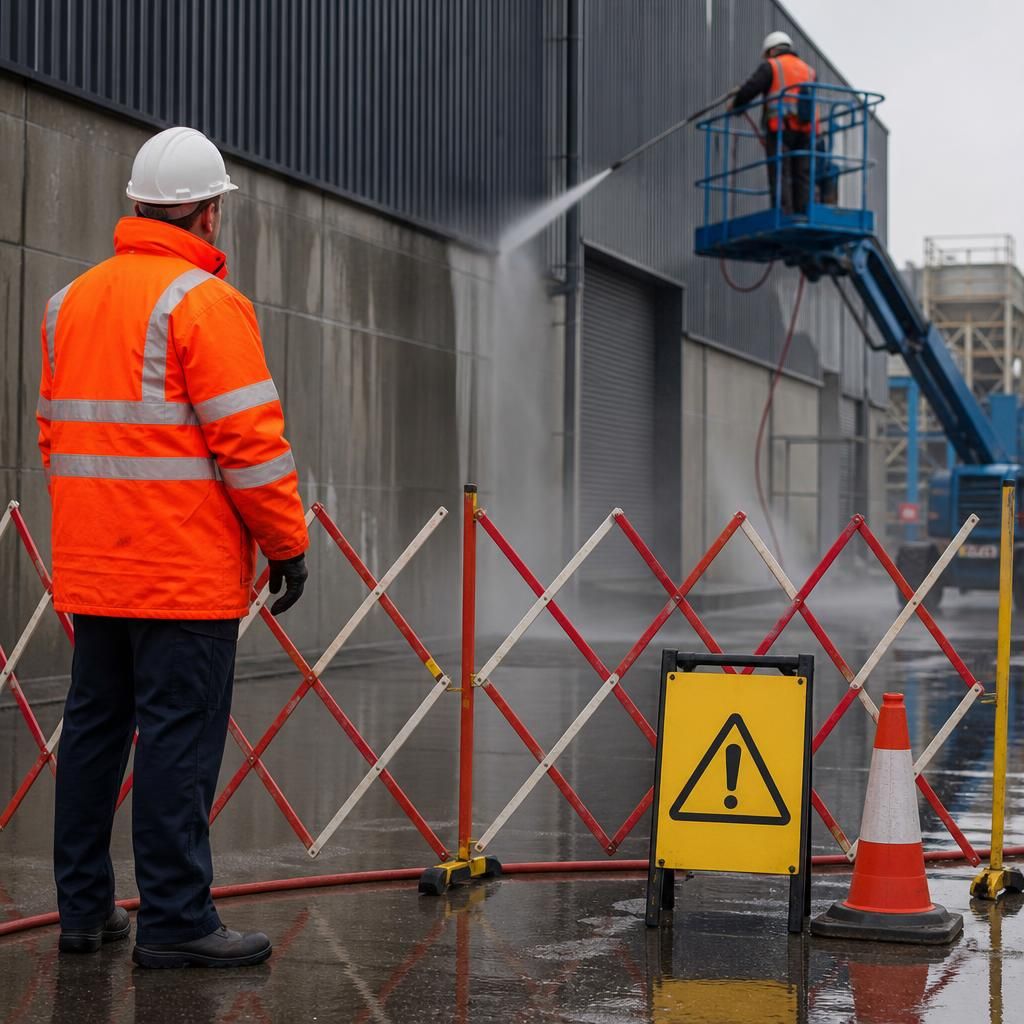
A secure exclusion zone is essential during industrial pressure cleaning because high-pressure spray, rebound, loose debris and contaminated runoff can affect people beyond the operator’s immediate position. Use barriers and clear warning signs, and keep doors, walkways, vehicles and nearby work areas outside the controlled zone.
Where the work is near public routes or occupied premises, arrange a suitable marshal, traffic controls or temporary diversions. No unauthorised person should enter while the equipment is pressurised, and the operator should stop work if the exclusion zone cannot be maintained.