
What safety measures should be in place during industrial pressure cleaning?
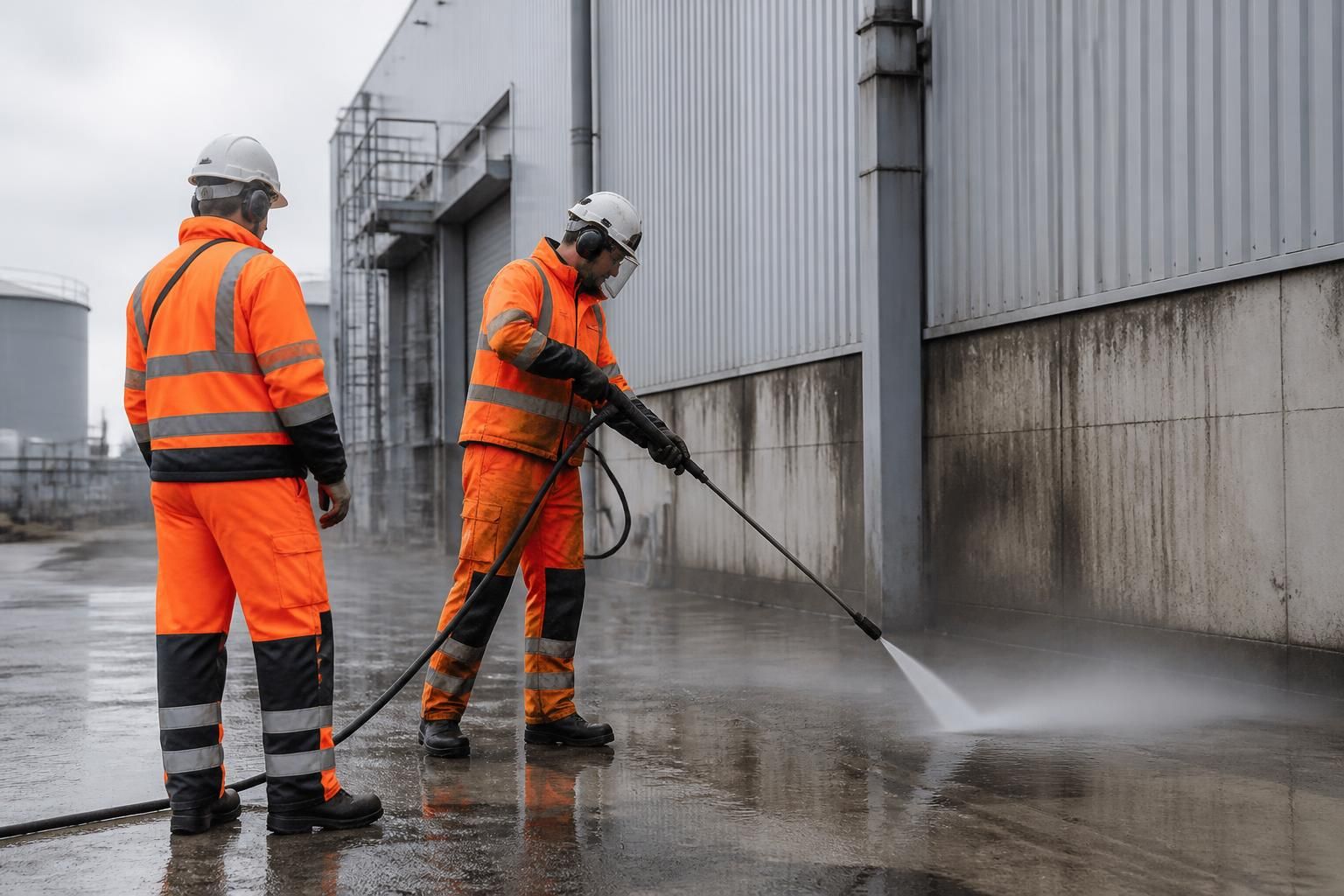
Industrial pressure cleaning should be controlled through a site-specific risk assessment, trained operators, suitable PPE, secured work areas and safe management of water, chemicals, equipment and access routes. Operators should also follow equipment instructions, control pressure and spray direction, protect nearby people and property, and comply with relevant health and safety and environmental requirements.
Industrial pressure cleaning should be controlled through a site-specific risk assessment and method statement, competent operators, suitable personal protective equipment (PPE), secure work areas, correctly maintained equipment and effective control of water, chemicals, access and nearby activities. These measures reduce the risk of injection injuries, slips, falls, chemical exposure, electric shock, flying debris, property damage and pollution.
Complete a site-specific risk assessment
Before work starts, the cleaning contractor should inspect the site and identify hazards associated with the building, surfaces, equipment and surrounding activities. The assessment should consider:
- Pedestrian and vehicle movements, including deliveries and emergency access.
- Unstable surfaces, loose masonry, fragile cladding, damaged roofs and overhead obstructions.
- Electrical installations, temporary supplies, lighting, cables and equipment near the cleaning area.
- Work at height, restricted areas, confined spaces and difficult access routes.
- Water run-off, drainage systems, nearby watercourses and the possibility of contaminated discharge.
- Cleaning agents, biological contamination, dust, mould, oil, fuel residues, paint and other hazardous substances.
- Weather conditions, wind, temperature, visibility and the effect of spray on adjacent premises.
The findings should be recorded in a suitable risk assessment and supported by a clear method statement. This should explain the cleaning sequence, equipment and pressure settings, access arrangements, exclusion zones, waste-water controls, emergency procedures and responsibilities on site. The controls should be reviewed if the work changes or new hazards are identified.
Use trained and competent operators
Pressure cleaning should only be carried out by people who understand the equipment, surface risks and site controls. Operators need practical instruction in safe start-up and shutdown, nozzle selection, hose management, pressure control, chemical handling, access equipment and emergency response. They should also understand that a higher pressure is not automatically a better cleaning method. The lowest effective pressure and the most appropriate technique should be selected to avoid damaging joints, coatings, seals, insulation or vulnerable substrates.
Where relevant, the work should be planned in line with applicable UK requirements, including the Provision and Use of Work Equipment Regulations (PUWER), the Control of Substances Hazardous to Health (COSHH) Regulations and the Work at Height Regulations. Lifting and access equipment may also require appropriate inspection and control under the Lifting Operations and Lifting Equipment Regulations (LOLER).
Wear task-appropriate PPE
PPE should be selected after assessing the risks rather than treated as a substitute for safer methods. Depending on the task, this may include:
- Waterproof or chemical-resistant gloves suitable for the cleaning agent being used.
- Safety footwear with slip-resistant soles and appropriate protection against wet conditions.
- Eye protection or a suitable face shield to protect against spray, debris and chemical splashes.
- Waterproof protective clothing, with additional chemical protection where COSHH assessment requires it.
- Hearing protection when noise levels from pumps, vehicles or other equipment require it.
- Respiratory protective equipment where the risk assessment identifies airborne contaminants that cannot be adequately controlled by other means.
- Head protection and high-visibility clothing where there is a risk from falling objects or moving vehicles.
PPE must be compatible with the task, kept clean and inspected before use. Wet or damaged gloves, boots and protective clothing should be replaced, as their effectiveness can be reduced during prolonged work.
Control the work area
The cleaning zone should be clearly identified and separated from employees, members of the public, visitors and other contractors. Barriers, cones, warning signs and, where necessary, a banksman or traffic marshal can help prevent people entering the spray area. Vehicle routes and pedestrian walkways should be diverted or controlled rather than relying only on warning signs.
Doors, windows, air intakes, vents, machinery, stock, vehicles and sensitive equipment should be closed, covered or otherwise protected from water and overspray. The operator should check the spray direction before starting and maintain control of the lance and hose at all times. No lance should be pointed at a person, animal, electrical installation or unsecured object.
Inspect and operate equipment safely
Pressure washers, hoses, couplings, lances, nozzles, pumps, generators and access equipment should be checked before use. Operators should look for damaged hoses, worn connections, leaks, exposed wiring, faulty guards and defective trigger mechanisms. Equipment should be isolated before maintenance, adjustment or nozzle changes, and pressure should be released safely before disconnecting any component.
Hoses should be routed to prevent trip hazards, crushing and contact with hot surfaces or sharp edges. They should not obstruct fire exits, access routes or drainage channels. Electrical equipment used in wet areas must be suitable for the environment, protected by appropriate residual current protection where required and kept away from standing water. Petrol or diesel-powered equipment should only be used where ventilation is adequate and exhaust fumes cannot accumulate.
Manage work at height and difficult access
Work at height should be avoided where a safe ground-level method is practicable. If elevated cleaning is necessary, the access method should be selected during the planning stage and used by trained personnel. MEWPs, towers, scaffolds, cradles and other equipment should be suitable for the task, positioned on stable ground and inspected as required.
Operators should use the correct fall-prevention or fall-restraint arrangements, keep tools and hoses controlled and account for the additional force created by the water jet. Ladders are generally not suitable for prolonged pressure cleaning or tasks requiring significant force. Work should be postponed or adapted if wind, rain, ice or poor visibility makes the access method unsafe.
Handle chemicals and contaminated surfaces correctly
Cleaning products should be selected for the surface and contamination, used in accordance with the manufacturer’s instructions and assessed under COSHH. Safety data sheets should be available, and incompatible products must never be mixed. Operators should use the required dilution, application method, contact time and rinsing procedure.
Where surfaces may contain biological contamination, bird fouling, mould, oils, fuels, lead-based coatings or other hazardous residues, the risk assessment should specify suitable containment, PPE, hygiene and waste arrangements. Eating, drinking and smoking should be prohibited in the treatment area, and workers should wash their hands before breaks and at the end of the task.
Control water, run-off and pollution
Waste water should not be allowed to enter surface-water drains, soil or watercourses unless it is confirmed to be safe and authorised. Drain covers, bunds, collection systems, wet vacuums, filters or temporary containment may be needed to prevent contaminated discharge. Run-off containing oil, chemicals, paint residues or other pollutants should be collected and disposed of through an appropriate waste route.
The team should also control overspray and prevent water from entering occupied areas, electrical systems, ventilation intakes or neighbouring premises. Any discharge requirements set by the site owner, water authority or local authority should be confirmed before cleaning begins.
Provide emergency arrangements
The site team should know how to stop the pump, isolate power, deal with a burst hose, contain a chemical spill and summon assistance. A suitable first-aid provision should be available, including arrangements for serious spray or injection injuries. A high-pressure injection injury can appear minor while causing severe internal damage, so it requires urgent medical assessment and the operator should tell medical staff that a pressure washer was involved.
Emergency contacts, site addresses, access points, fire procedures and the location of first-aid equipment should be confirmed during the briefing. Incidents, near misses, equipment defects and accidental discharges should be reported and investigated before work resumes.
Brief the site and check controls during the work
Before cleaning starts, the supervisor should brief the team and coordinate with the client’s representative and other contractors. Controls should be checked throughout the job, particularly when moving between elevations, changing chemicals, opening previously protected areas or working near traffic and public access.
On completion, equipment should be shut down safely, hoses and barriers removed from access routes, standing water dealt with and waste transferred appropriately. A final inspection should confirm that the area is safe for normal use and that no damage, residual chemical or uncontrolled run-off remains. For complex industrial sites, the risk assessment and method statement should be provided for review before mobilisation so that access, drainage, operating hours and site-specific hazards can be agreed in advance.
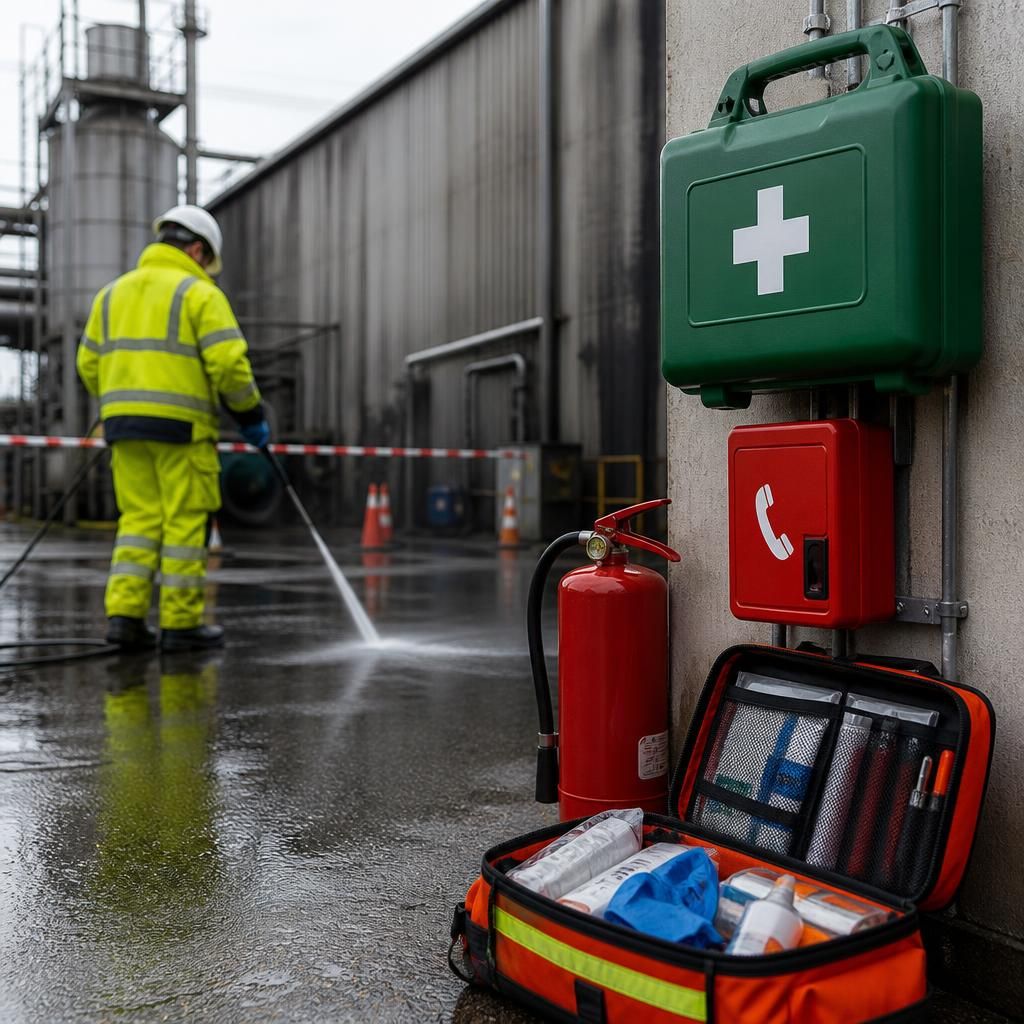
Emergency arrangements are an essential part of industrial pressure cleaning safety because high-pressure water, chemicals and contaminated run-off can cause serious injury or pollution if control is lost. Before work begins, the team should know how to stop the equipment, isolate power, contain spills and summon assistance.
- Keep first-aid equipment and emergency contact details readily available.
- Treat any suspected high-pressure injection injury as urgent, even if the wound appears minor.
- Report burst hoses, chemical exposure, near misses and uncontrolled discharge before cleaning resumes.
- Confirm the site address, access points and arrangements for guiding emergency services to the work area.