

What qualifications and experience should I look for in an industrial pressure cleaning service provider?
Look for a provider with documented experience in industrial and commercial cleaning, appropriate public and employers’ liability insurance, trained operators, and robust health and safety procedures. Relevant evidence may include method statements and risk assessments, COSHH awareness, safe use of pressure-washing equipment, and IPAF or PASMA training where powered access or scaffolding is required, supported by references for comparable projects.
The right industrial pressure cleaning provider should be able to demonstrate relevant commercial and industrial experience, competent operators, suitable insurance, and a documented approach to health and safety. Look for evidence that they have completed comparable work on similar surfaces and premises, can produce a site-specific risk assessment and method statement, and understand the access, chemical, wastewater and environmental controls your site requires.
Check their experience against your requirements. Industrial cleaning is not the same as domestic pressure washing. Ask whether the provider has worked on facilities of a similar scale and type, such as warehouses, manufacturing sites, distribution centres, construction sites, car parks, public buildings or multi-occupancy commercial premises. Relevant experience should include the particular surfaces involved, which may include cladding, concrete, brickwork, masonry, roofs, hardstanding, loading bays or plant areas.
Request examples of comparable projects and, where appropriate, references from existing business clients. The most useful evidence describes the cleaning method, access arrangements, operational constraints and how the contractor protected the building and surrounding areas. Experience should also cover working around vehicles, pedestrians, machinery, electrical installations, stored goods and live business operations.
Verify insurance and business documentation. A professional contractor should provide current evidence of:
- Public liability insurance appropriate to the work and the locations being serviced.
- Employers’ liability insurance where they employ staff.
- Any additional cover required by the contract, such as cover for work on particular sites or damage to property in their care.
- Company details, written quotations and clear terms covering the scope of work, exclusions and responsibilities.
Insurance does not prove that a contractor is competent, but missing or unsuitable cover is a significant warning sign. Check that the certificates are current and that the level and type of cover match the risks of the proposed work.
Assess operator competence. Operators should be trained in the safe use of pressure-washing equipment, including the risks from high-pressure water, hot water or steam systems, hoses, electrical equipment, noise, slips and flying debris. They should understand how pressure, temperature, flow rate and cleaning products affect different materials. Competence may be demonstrated through internal training records, recognised training, supervised experience and a clear system for assessing operators before they work independently.
Where cleaning chemicals are used, operatives should understand the relevant COSHH requirements. This includes reading safety data sheets, following dilution and handling instructions, selecting appropriate personal protective equipment, controlling exposure and storing products securely. They should also know how to prevent chemicals or contaminated wash water entering surface-water drains, watercourses or unprotected ground.
Check access and equipment qualifications where relevant. If the work involves powered access, the operator should hold appropriate IPAF training for the type of mobile elevating work platform being used. PASMA training may be relevant where mobile access towers are erected and used. These qualifications should match the equipment and task rather than being treated as a general substitute for site-specific planning.
The provider should also be able to show that equipment is inspected, maintained and suitable for the work. This includes pressure washers, hoses, lances, electrical leads, generators, water tanks and access equipment. Equipment used at work should be managed in line with applicable requirements such as PUWER, while lifting equipment and accessories may require thorough examination under LOLER. Ask how pre-use checks, maintenance defects and examination records are controlled.
Expect a clear health and safety process. Before work starts, the contractor should assess hazards and provide suitable documentation, normally including:
- A site-specific risk assessment and method statement, often referred to as RAMS.
- Details of the equipment, pressure, temperature and cleaning products to be used.
- Controls for pedestrians, vehicles, traffic routes and other contractors.
- Arrangements for work at height, falling objects and access equipment.
- Controls for electrical risks, plant, machinery, noise, spray and contaminated surfaces.
- Required personal protective equipment and welfare arrangements.
- Emergency procedures, incident reporting and a method for stopping work if conditions become unsafe.
- Arrangements for collecting, containing and disposing of wastewater and debris.
RAMS should be specific to your premises and the planned task. Generic documents with the wrong site name, unsuitable equipment or no reference to the surfaces being cleaned do not provide meaningful assurance. A competent provider should be willing to discuss the documents with your responsible person and revise them when site conditions change.
Consider recognised contractor and site-safety schemes carefully. Membership of a pre-qualification or safety assessment scheme can provide additional evidence that a business has documented systems. However, a scheme, badge or certificate should not replace checking the provider’s actual experience, insurance, training records and site-specific controls. Ask what the accreditation covers, whether it is current and whether it applies to the staff and services being proposed.
For work on construction or contractor-controlled sites, confirm whether the client requires particular site cards, inductions or training, such as CSCS-related requirements. These requirements vary by site and role, so they should be agreed before mobilisation rather than assumed.
Check the provider’s approach to surface protection. A suitable contractor should inspect the surface before choosing a cleaning method. They should identify weak mortar, damaged coatings, failed sealants, corroded metal, loose render, fragile roof materials, staining that may not be removable, and areas where pressure could force water into the building. They should be prepared to carry out a test clean or agree a small trial area where the substrate or coating is uncertain.
Be cautious of providers who recommend the same pressure setting or chemical treatment for every material. Industrial cleaning may involve low-pressure washing, controlled steam cleaning, soft washing, rotary equipment or manual treatment rather than maximum pressure. The method should be selected to remove the contamination without etching concrete, driving water behind cladding, damaging coatings or loosening masonry.
Ask how environmental responsibilities are managed. A responsible provider should explain how it will control detergent use, recover solids, protect drains and manage wastewater. They should identify whether water may contain oil, silt, paint residue, biological contamination or other substances requiring controlled collection and disposal. Where a trade effluent or discharge agreement is needed, the contractor should clarify who obtains permission and who remains responsible for compliance.
Environmental competence also includes avoiding unnecessary chemical use, preventing overspray, reducing water waste where practicable and selecting cleaning products suitable for the surface and drainage arrangements. The provider should not make unsupported claims that a product is environmentally friendly; ask for the product information and the proposed controls instead.
Review communication and contract management. A reliable service provider should carry out a meaningful pre-start survey, identify any information needed from your team and provide a written scope. The quotation should state what is included, the areas to be cleaned, access requirements, working hours, preparation, protection, wastewater handling, remedial limitations and any exclusions.
For ongoing maintenance, ask how inspections, photographs, completion reports, defects and follow-up work are recorded. You should know who the site contact is, how changes are approved and how incidents or damage are reported. Good communication is particularly important where cleaning takes place around members of the public, tenants, production activities or restricted-access areas.
Before appointing the contractor, request and check:
- Evidence of comparable industrial or commercial projects.
- Current public and employers’ liability insurance certificates.
- Operator training and competence records relevant to pressure cleaning, chemicals and access equipment.
- A sample or draft site-specific risk assessment and method statement.
- Details of equipment inspection, maintenance and examination arrangements.
- COSHH information and safety data sheets for proposed cleaning products.
- The planned method for protecting surfaces, people, property, drains and the wider environment.
- References or other evidence from clients with similar premises and requirements.
- A written scope, quotation and reporting process.
Warning signs include reluctance to provide insurance or RAMS, pressure-only cleaning recommendations without a surface inspection, untrained staff operating access equipment, vague answers about wastewater, unusually low quotations with no defined scope, and claims that qualifications or safety documentation are unnecessary for a high-risk site. The strongest provider is not simply the one with the most certificates; it is the one that can connect its qualifications, experience and procedures to the specific risks and outcomes of your facility.
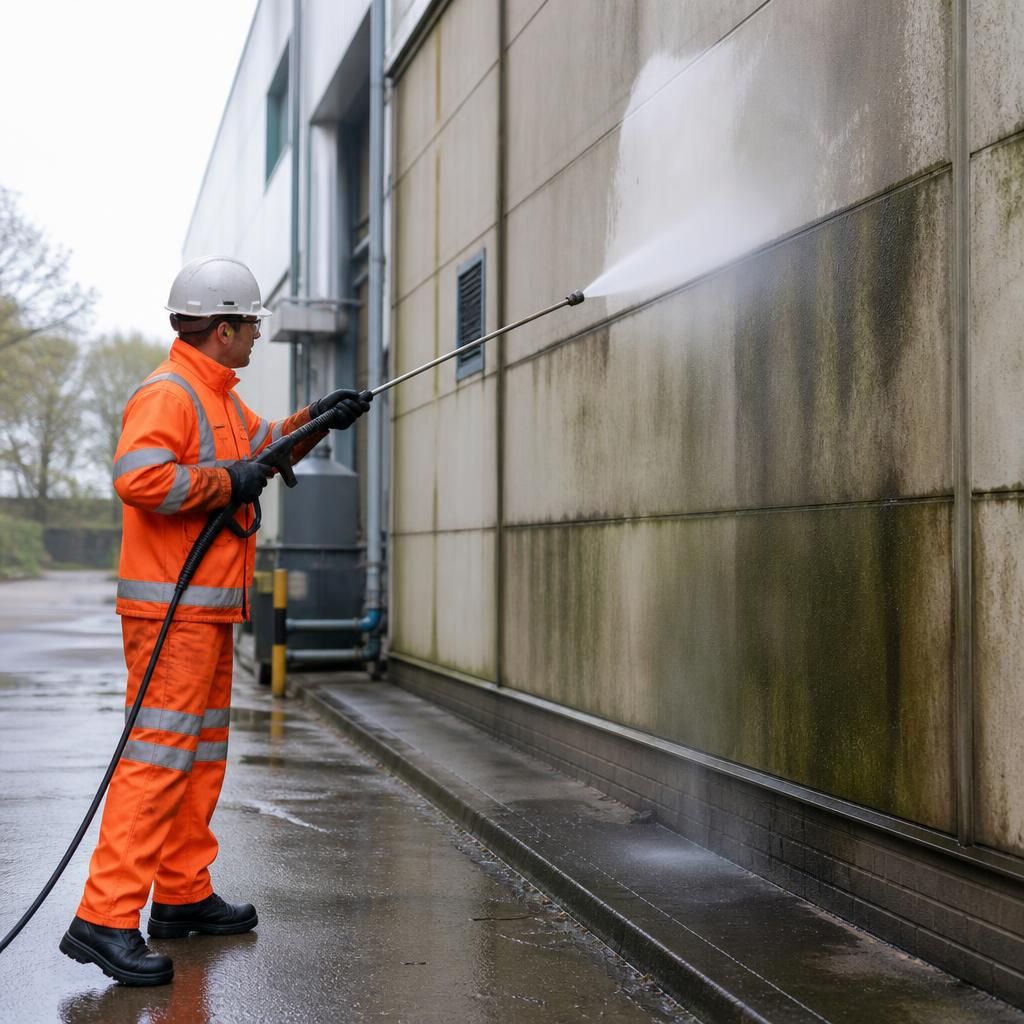
A suitable industrial pressure cleaning provider should be able to demonstrate that its operators are trained for the equipment, surfaces and risks involved, rather than relying on pressure-washing experience alone. Ask for evidence of relevant commercial projects, current public and employers’ liability insurance, and competence in handling high-pressure water, steam, cleaning chemicals and wastewater.
Where the work involves powered access or access towers, check that training matches the equipment being used, such as IPAF or PASMA where appropriate. The provider should also prepare a site-specific risk assessment and method statement covering surface protection, pedestrians, vehicles, work at height, drainage and emergency procedures. These documents, supported by comparable references and equipment inspection records, provide stronger assurance than certificates or scheme memberships alone.