
What safety protocols do you have in place during the pressure washing process to ensure the protection of both property and people?
We protect people and property during pressure washing through site-specific risk assessments, trained operators, controlled work zones, suitable protective equipment and careful selection of pressure, temperature and cleaning methods. Before work begins, we identify vulnerable surfaces, nearby hazards, access requirements, pedestrians, vehicles and drainage routes, then use barriers, signage and appropriate equipment to keep the area controlled throughout the clean.
Our pressure washing safety protocols are designed to control the risks to people, buildings, equipment and surrounding areas before, during and after cleaning. They combine a site-specific risk assessment, a written method statement, competent operators, controlled work areas, suitable personal protective equipment and careful selection of pressure, temperature, chemicals and access equipment.
Site assessment and documented planning
Before work starts, we inspect the areas to be cleaned and identify hazards that could affect operatives, building users, visitors, vehicles or neighbouring property. The assessment considers the surface material and condition, access points, overhead obstructions, fragile features, electrical installations, glazing, roof edges, drainage, water-sensitive areas and the likely movement of pedestrians and traffic.
We use the findings to prepare suitable risk controls and a method of work. Where the site changes, conditions deteriorate or an unexpected hazard is found, the work is paused and the controls are reviewed. This is particularly important on large commercial sites where several contractors, public access routes or changing construction activities may be present.
Competent and appropriately equipped operators
Pressure washing is carried out by operatives who understand the equipment, cleaning methods and risks associated with the surfaces being treated. They are instructed in safe operating procedures, manual handling, chemical use, access equipment, emergency arrangements and the need to protect members of the public.
Before use, equipment is checked for damage, leaks, worn hoses, loose connections, damaged electrical cables and faulty safety controls. Hoses and power cables are routed to minimise trip hazards and are kept away from sharp edges, moving vehicles and areas where they could be damaged. Equipment is operated within its intended limits and is not modified in a way that could compromise its safety.
Controlled work zones
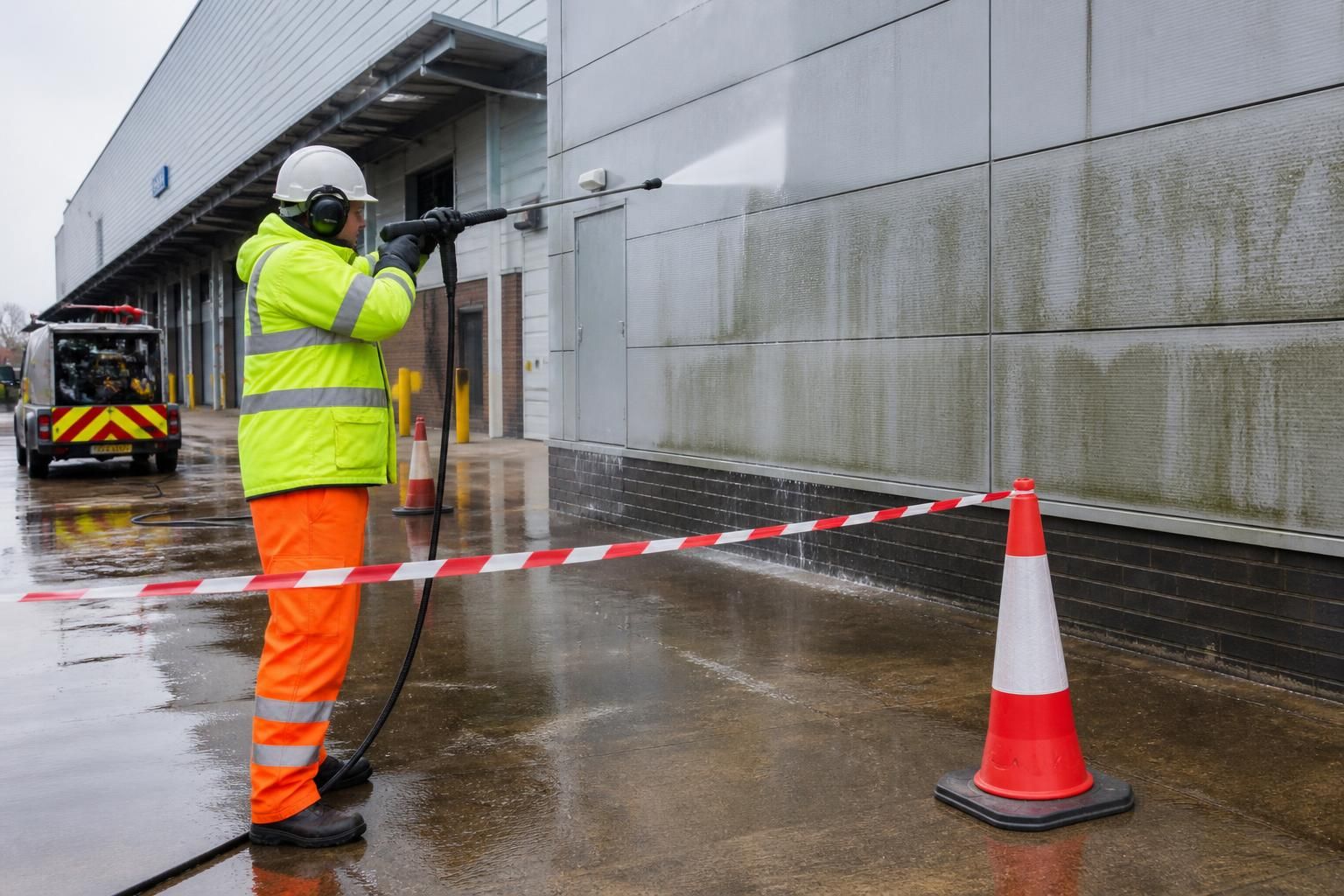
We establish an exclusion zone around the cleaning area wherever spray, debris, noise, wet surfaces or moving equipment could create a risk. Barriers, cones and clear warning signs help separate the work from pedestrians, site staff and vehicles. On busy premises, we coordinate the work with the client so that entrances, walkways, loading areas and car parks can be temporarily managed or diverted where necessary.
The exclusion zone is maintained for as long as the hazard remains. It is not removed simply because the visible cleaning has finished; wet surfaces, pooled water and displaced debris must also be dealt with. A banksman or other suitable control may be used where vehicles, restricted visibility or reversing movements create additional risk.
Personal protective equipment
Required protective equipment is selected according to the task and the hazards identified on site. This may include eye or face protection against high-pressure spray and loosened debris, waterproof protective clothing, gloves suited to the equipment and cleaning products, slip-resistant footwear, hearing protection and suitable head protection.
Personal protective equipment is an additional control, not a substitute for barriers, safe distances, equipment safeguards or good working practices. Operatives also check that protective equipment remains in good condition and is suitable for the substances and conditions involved.
Safe control of pressure, temperature and chemicals
There is no single pressure setting that is safe for every commercial surface. We select the lowest effective pressure and an appropriate nozzle, spray pattern, distance and working angle for the material and its condition. Delicate masonry, render, coatings, pointing, timber, seals and older surfaces may require a gentler method, while more robust hard surfaces can often tolerate a different approach.
Where suitable, steam cleaning or a lower-pressure process may reduce the risk of abrasion, surface erosion and water penetration. We carry out a discreet test area when the material, coating or level of soiling warrants it, checking the result before continuing across the full elevation or surface.
Cleaning chemicals are assessed and handled in accordance with their instructions and the relevant control measures. They are stored securely, labelled correctly and kept away from incompatible substances. Operatives use the required protective equipment and prevent unnecessary overspray. Chemicals are not allowed to enter drainage systems, watercourses, planted areas or neighbouring property without suitable control and approval.
Protection of buildings and contents
Before cleaning, we identify openings and vulnerable features such as doors, windows, vents, grilles, lighting, sockets, signage, alarms, expansion joints and damaged seals. These areas are protected or avoided where necessary. Water is directed away from openings and internal spaces, and we take care around façades, roof coverings, cladding joints and areas showing signs of deterioration.
We do not assume that a surface is sound because it appears intact from ground level. Loose coatings, failed pointing, cracked render, unstable masonry and damaged fixtures may become more apparent once cleaning begins. If the process reveals a condition that could make continued work unsafe or cause damage, we stop and report it to the client before proceeding.
Vehicles, stored goods, machinery, furniture and other nearby assets are moved or covered where appropriate. Overspray and run-off are controlled to reduce the risk of staining, corrosion, contamination or damage to adjacent surfaces.
Working at height and access equipment
Where cleaning cannot be completed safely from ground level, access requirements are assessed in advance. The safest practical access method is selected for the task, taking account of ground conditions, reach, wind, overhead hazards, proximity to traffic and the force created by the pressure-washing lance.
Access equipment is checked before use and operated by people who are trained and authorised to use it. Work-at-height controls include suitable edge protection, stable positioning, safe access and prevention of dropped tools or materials. Pressure-washing equipment is managed so that the operator remains stable and does not overreach or work from an unsuitable platform.
Slip, trip, spray and noise controls
Pressure washing creates wet surfaces, run-off and sometimes loosened dirt or biological growth. We manage water flow, keep hoses organised and remove deposits that could create a slipping hazard. Where possible, cleaned areas are isolated until they are sufficiently dry, and the client is advised of any residual restrictions.
Spray is controlled to prevent contact with people, vehicles, glazing, electrical equipment and adjacent properties. Noise and vibration are considered when planning the work, particularly near occupied offices, residential areas, hospitals or other noise-sensitive premises. Work may be arranged to reduce disruption while retaining safe operating conditions.
Traffic, pedestrians and site coordination
Commercial cleaning often takes place around active car parks, service yards and public entrances. We agree the working area and timing with the client, maintain communication with site contacts and use signs or physical controls to make changing hazards clear. Deliveries, contractor movements and emergency access routes are considered before equipment and hoses are positioned.
Where the public could enter the work area unexpectedly, the controls are strengthened rather than relying on people to notice spray or warning signs. Work is stopped if a person, vehicle or activity enters an unsafe zone.
Environmental and drainage protection
Run-off is assessed before cleaning begins. We use suitable containment, diversion, collection or filtration measures where dirt, oils, paint residues, chemicals or other contaminants could enter surface-water drains or nearby ground. Wastewater is handled in line with the site requirements and applicable environmental controls.
Particular care is taken around planted areas, watercourses, drainage channels, fuel storage and sensitive neighbouring premises. Cleaning products and water use are selected with the surface, level of contamination and disposal arrangements in mind.
Emergency arrangements and final inspection
The site team knows how to isolate equipment, deal with a hose or chemical incident, report an injury and contact the relevant site representative. First-aid and emergency arrangements are considered as part of the work planning, and access routes are kept clear.
After cleaning, we inspect the area for remaining hazards, displaced debris, damaged fixtures, standing water, overspray and unsecured equipment. Barriers are only removed when the area is safe for normal use. We also communicate any defects discovered during cleaning, any areas requiring further attention and any temporary precautions the client should maintain.
These controls allow us to adapt the cleaning method to the actual site rather than treating pressure washing as a standard process. The objective is a clean result achieved without exposing people to avoidable risk or compromising the condition, operation or surrounding environment of the property.
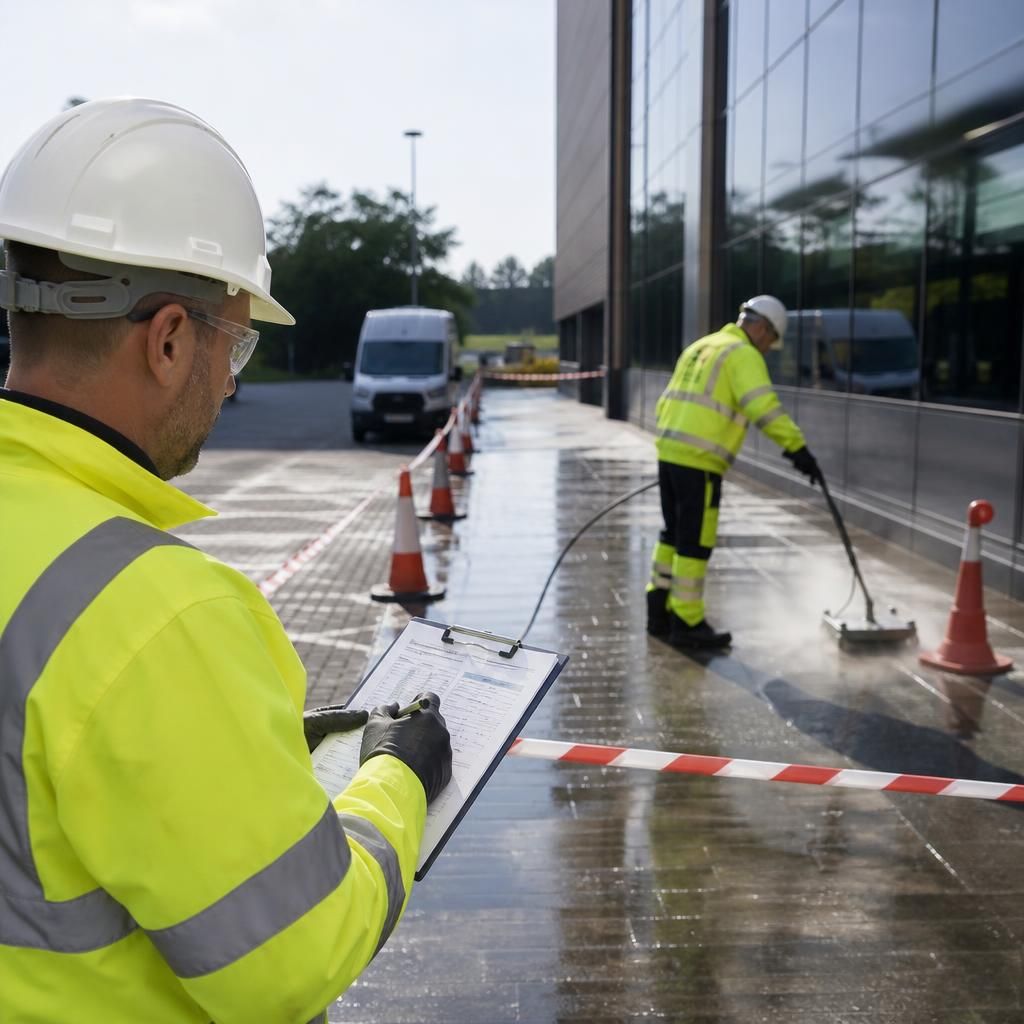
A site-specific risk assessment is the starting point for safe pressure washing. Before work begins, we identify hazards such as pedestrians, vehicles, overhead obstructions, electrical equipment, fragile surfaces, roof edges, drainage routes and water-sensitive areas. The findings inform the method statement, equipment selection, exclusion zones and any access or traffic controls required.
These controls are reviewed if site conditions change or an unexpected defect is uncovered. Work is paused where necessary so the cleaning method can be adapted without exposing people or property to avoidable risk. This is particularly important on active commercial premises, where entrances, loading areas, car parks and contractor routes may remain in use throughout the cleaning process.