
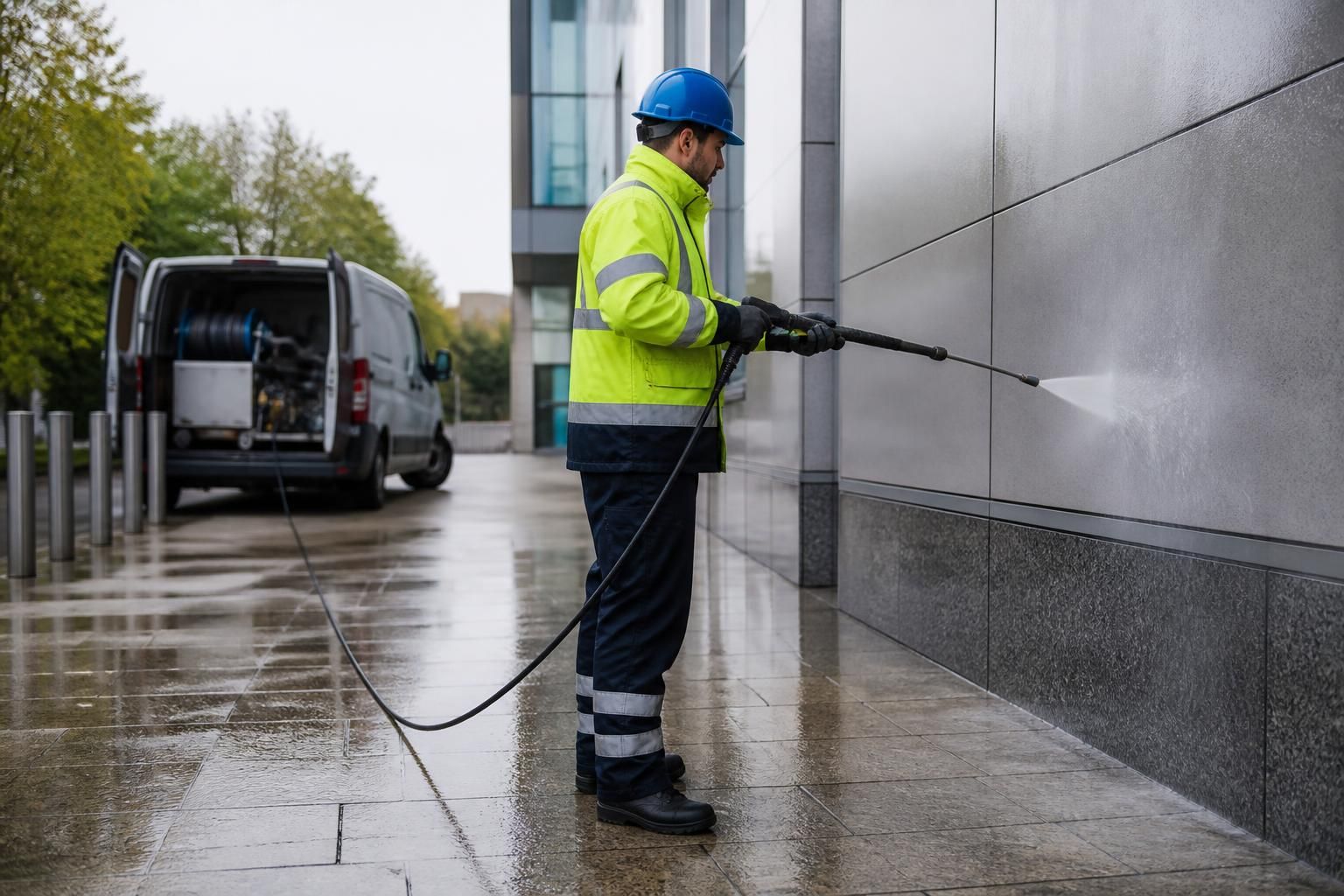
What are the key factors to consider when selecting a pressure washing contractor for commercial outdoor cleaning?
When selecting a commercial pressure washing contractor, assess their relevant experience, insurance, health and safety procedures, equipment, environmental controls, pricing transparency and ability to work around your operational requirements. A suitable contractor should provide a clear method statement and risk assessment, demonstrate competence on the surfaces involved, and offer reliable scheduling and follow-up support.
Selecting a commercial pressure washing contractor involves checking whether the company can deliver the required cleaning safely, legally and with minimal disruption to your site. The main factors are relevant experience, competence with the surfaces and contaminants involved, suitable equipment, insurance, health and safety controls, environmental procedures, clear pricing, reliable scheduling and the ability to provide ongoing support.
Relevant commercial experience
Choose a contractor with experience of work comparable to your premises rather than relying solely on general domestic cleaning experience. Commercial and industrial sites often involve larger areas, sensitive materials, restricted access, public interfaces and operational constraints. Ask whether the contractor has worked on the relevant building type, such as retail units, warehouses, offices, schools, housing developments, transport facilities, car parks or industrial estates.
Experience should also cover the surfaces and contaminants requiring treatment. Brickwork, concrete, paving, render, cladding, roofs and painted surfaces can each require different pressures, temperatures, detergents and working methods. Oil, algae, moss, chewing gum, traffic film, carbon deposits, bird fouling and graffiti may also need different treatments. A competent contractor should inspect the site and explain how the proposed process will avoid damage, staining or unnecessary deterioration.
Site survey and method statement
A proper assessment should take place before work begins. The contractor should identify the areas to be cleaned, surface condition, drainage arrangements, water and power availability, access restrictions, nearby vehicles and vulnerable features such as electrical equipment, air intakes, doors, windows and landscaping.
For substantial or higher-risk work, request a written method statement and risk assessment. These documents should describe the equipment, cleaning products, access methods, exclusion zones, personal protective equipment, traffic and pedestrian controls, emergency arrangements and waste-water management. They should be specific to your site rather than generic documents with no clear connection to the work.
Competence, training and insurance
Ask who will carry out the work and whether operatives are trained for pressure washing, chemical handling, work at height and the access equipment being used. Where mobile elevated work platforms, scaffolding or other access systems are required, the operator should have appropriate training and authorisation. The contractor should also understand how pressure, heat and chemicals can affect different construction materials.
Check that the business holds suitable public liability insurance and, where relevant, employers’ liability insurance. You may also need evidence of cover for work at height, treatment of third-party property or specialist activities. Your procurement or facilities team may require current certificates, risk assessments, method statements and other contractor documentation before approval.
Equipment and cleaning methods
Equipment should be matched to the work, not selected simply because it produces the highest pressure. Commercial contractors may use pressure washing, soft washing, steam cleaning, hot-water systems, rotary surface cleaners, vacuum recovery and specialist access equipment. The correct combination can improve cleaning results while reducing overspray, water use, surface damage and disruption.
Ask how the contractor will test the method. A small trial area can confirm the effect on the surface and establish suitable pressure, temperature, dwell time and detergent concentration before the full clean begins. This is particularly important for painted finishes, render, natural stone, aged brickwork, coated metal and other surfaces where aggressive cleaning may cause permanent damage.
Health, safety and public protection
Commercial outdoor cleaning can create risks from high-pressure water, slips, falling debris, chemicals, electrical connections, vehicle movements and work at height. The contractor should explain how these risks will be controlled, including barriers, warning signs, segregated work areas, controlled access and safe routing for pedestrians and vehicles.
Consider how the work will affect staff, visitors, tenants and neighbouring properties. A suitable contractor should be able to schedule noisy or disruptive activities at an appropriate time, protect entrances and sensitive equipment, and maintain safe access wherever the premises must remain operational. They should also have a clear process for reporting incidents, damage or unexpected site conditions.
Environmental and waste-water controls
Pressure washing can mobilise oil, silt, detergents, paint residues and other contaminants. These materials must not be allowed to enter surface-water drains or nearby watercourses where they could cause pollution. Ask how run-off will be contained, collected, filtered, treated or disposed of, and whether the proposed detergents are suitable for the surface and location.
The contractor should identify drainage routes during the site survey and use appropriate measures such as drain covers, bunding, wet vacuums or recovery systems where needed. Responsible planning may also include efficient water use, controlled chemical application, protection of planted areas and lawful disposal of collected waste.
Pricing and scope of work
Obtain a written quotation that explains exactly what is included. It should identify the areas and surfaces covered, preparation, stain treatment, access equipment, detergents, water, waste-water recovery, traffic management, reinstatement and any post-clean inspection. Clarify whether the price is fixed or subject to additional charges if access is restricted, contamination is heavier than expected or repairs are required.
Be cautious of quotations that give a low price without describing the method or exclusions. A cheaper service may omit essential controls, specialist access, waste-water management or appropriate preparation. Comparing quotations is more useful when each contractor has priced the same specification and site conditions.
Scheduling, communication and service support
Reliability is particularly important where cleaning must be coordinated with tenants, deliveries, construction programmes, events or public access. Confirm lead times, working hours, weather contingencies, expected duration and the contractor’s arrangements if conditions prevent safe completion.
Agree who will provide site access, approve changes and receive completion information. For larger or recurring projects, ask for progress updates, photographs, service records and recommendations for future maintenance. A contractor who can provide planned cleaning visits may help you manage appearance, slip risks and the build-up of contaminants more consistently than one-off reactive work.
Practical checks before appointment
- Request evidence of relevant commercial projects or client references where appropriate.
- Check insurance certificates and any required procurement or safety accreditations.
- Ask for a site-specific method statement, risk assessment and environmental plan.
- Confirm the proposed equipment and cleaning method for each surface.
- Check how run-off, chemicals and contaminated waste will be controlled and disposed of.
- Confirm access arrangements, working hours, exclusion zones and arrangements for protecting the public.
- Obtain a detailed written quotation with clear inclusions, exclusions and payment terms.
- Agree inspection, reporting and remedial arrangements before work starts.
The most suitable contractor is therefore not necessarily the one offering the lowest initial quotation. It is the contractor that can demonstrate competence for the specific site, provide a safe and environmentally controlled method, communicate clearly and deliver the required standard without compromising people, property or normal operations.

A site-specific survey and method statement are essential when appointing a commercial pressure washing contractor because they show how the work will be completed safely and without damaging the property. The assessment should identify the surfaces, contaminants, access limitations, drainage routes, nearby equipment and areas used by staff, visitors or vehicles.
The method should explain the proposed pressure, temperature, detergents, access equipment and run-off controls for each area. It should also cover exclusion zones, protection for doors, windows, air intakes and landscaping, along with arrangements for working at height and maintaining safe access. A small test area can help confirm that the cleaning process is suitable before work proceeds across the full site.
Ask for documentation that relates specifically to your premises rather than relying on generic paperwork. This gives you a clearer basis for checking competence, coordinating the work with site operations and confirming that wastewater, chemicals and public safety will be managed responsibly.
Request a Site Survey and Commercial Cleaning Quote
Arrange a site survey and commercial cleaning quote with Encanto Exterior Cleaning to confirm the right equipment, safety controls, access arrangements and wastewater management for your premises.
Contact us to discuss your requirements and receive a clear, site-specific proposal.