
How can the use of advanced equipment enhance the effectiveness of commercial outdoor cleaning services?
Advanced equipment improves commercial outdoor cleaning by combining controlled pressure, high-temperature steam, specialist cleaning systems and access equipment to remove dirt, staining, biological growth and graffiti more effectively. It can also reduce cleaning time, limit disruption, improve safety and achieve consistent results across façades, cladding, roofs, car parks and other large or difficult-to-reach areas.
Advanced equipment enhances commercial outdoor cleaning by giving operators greater control over pressure, temperature, water flow, cleaning method and access. This makes it possible to remove ingrained dirt, oil, biological growth, atmospheric staining and graffiti more effectively while reducing disruption to the site. The right equipment also helps protect façades, cladding, roofs, paving and other surfaces from damage caused by unsuitable pressure or cleaning techniques.
Commercial sites rarely have a single cleaning requirement. A retail park may have oil-contaminated car parks, stained signage, chewing gum and heavily trafficked entrances, while an industrial building may require cladding cleaning, roof maintenance and high-level access. Advanced systems allow the cleaning method to be adjusted for each surface and contaminant rather than relying on one pressure-washing setting across the whole site.
Variable-pressure and high-flow pressure washing provide a more controlled way to clean large areas. Operators can use lower pressure for delicate surfaces, such as painted finishes, older masonry or certain cladding systems, and increase the working pressure only where the material can safely withstand it. Water flow helps carry loosened soil and debris away from the surface, which is particularly useful on large façades, loading areas and car parks.
Using controlled pressure is important because excessive force can strip coatings, drive water into joints, damage pointing or mark softer materials. Professional equipment is therefore selected according to the substrate, its condition and the type of contamination present. A competent operator will normally test a discreet area before starting a full clean and will alter the nozzle, pressure, distance and angle as necessary.
Hot-water pressure washing and steam cleaning improve the removal of substances that cold water may struggle to break down. Heat helps soften grease, oil, traffic film, chewing gum and some organic deposits, making them easier to lift from concrete, paving and other robust surfaces. Steam cleaning uses lower water volumes and high temperatures, which can be useful where a more delicate or targeted approach is required, including certain façade treatments, signage and sensitive areas.
Heat is not suitable for every material. Some plastics, coatings, sealants and painted surfaces may soften or become discoloured if exposed to inappropriate temperatures. The equipment must therefore be matched to the surface and used by someone who understands the likely response of the material. Advanced equipment improves control, but it does not remove the need for inspection and practical judgement.
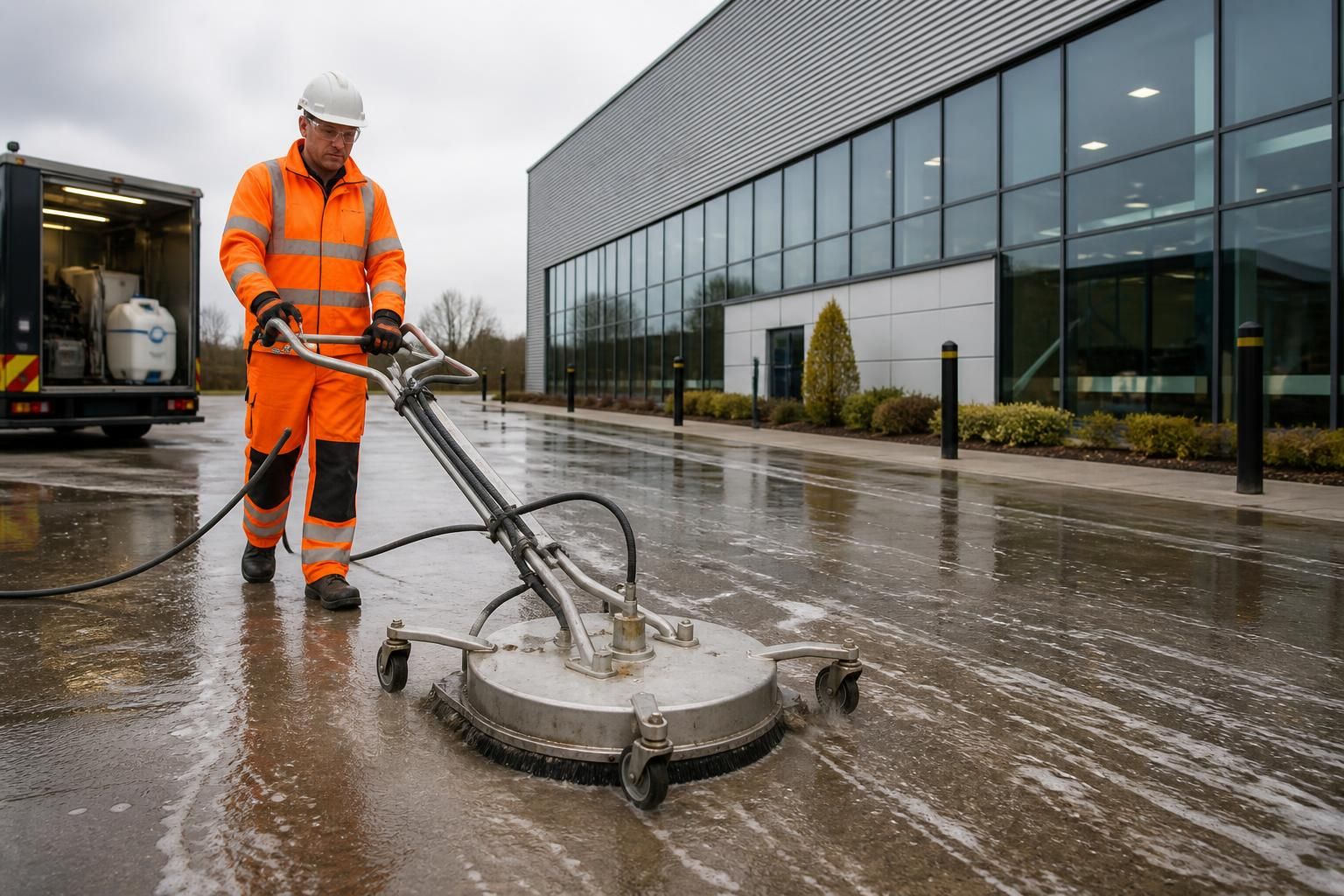
Specialist surface-cleaning attachments can improve consistency across expansive horizontal areas. Rotary surface cleaners enclose rotating jets beneath a protective housing, helping to distribute cleaning action more evenly than a hand-held lance. They can reduce streaking and overspray when cleaning suitable hard surfaces such as concrete, block paving and some stone areas. They also help keep spray closer to the working area, which can be valuable around entrances, vehicles and occupied premises.
Other attachments assist with edges, joints, steps, narrow access routes and textured surfaces. Rotary tools can help remove stubborn deposits from appropriate masonry, while controlled lance work remains necessary around corners, fixtures, drainage points and vulnerable details. Selecting the correct attachment improves the result without treating every part of a building in the same way.
Softwashing and chemical application systems provide an alternative where high pressure would be unsuitable or ineffective. A low-pressure application can distribute a carefully selected treatment across algae, moss, lichen and other biological growth. The treatment is then allowed to work before the surface is rinsed using a method appropriate to the material. This can be useful for roofs, rendered façades, delicate cladding and areas where aggressive agitation could cause damage.
Cleaning solutions must be chosen for the contaminant and surface, applied at the correct concentration and prevented from reaching sensitive landscaping, watercourses, vehicles or occupied areas. Advanced dosing and application equipment can improve coverage and reduce unnecessary chemical use, but proper containment, controlled rinsing and responsible wastewater management remain essential.
Vacuum recovery and water-management equipment help control dirty water produced during commercial cleaning. Recovery systems can collect wastewater, sludge and loosened contaminants from hard surfaces before they spread across the site or enter drainage systems. This is particularly relevant when removing oil, fuel residues, heavy silt, paint or other pollutants from car parks, service yards and industrial areas.
Water recovery can reduce disruption and support compliance with site drainage requirements. Before work begins, the cleaning plan should identify where water will go, whether drains may be used and how contaminated water will be contained or disposed of. Equipment should be selected according to the volume and character of the wastewater rather than simply the size of the cleaning area.
Access equipment improves the safe cleaning of high and difficult-to-reach areas. Water-fed poles, telescopic systems, mobile elevated work platforms, scaffolding and other access solutions can provide reach without relying on improvised ladders or unsafe overextension. The appropriate option depends on building height, ground conditions, obstructions, wind exposure, pedestrian movement and the need to work near traffic or other operations.
Access equipment does not replace planning. Operators need to assess the structure, establish exclusion zones, protect people below and follow the relevant inspection, training and operating requirements. Where powered access is required, the site should also consider ground bearing capacity, overhead hazards, nearby electrical services and emergency arrangements.
Advanced equipment can shorten working time and improve consistency, but the benefit depends on correct specification and operation. A high-output machine may be efficient on a broad concrete yard but unsuitable for a fragile façade. Similarly, a powerful cleaning system will not provide a reliable result if the operator uses an incorrect nozzle, ignores dwell time or fails to rinse thoroughly. Equipment should support a defined method rather than determine the method on its own.
A professional commercial cleaning process normally includes a site survey, identification of surfaces and contaminants, a risk assessment, selection of equipment, a discreet test clean and an agreed method statement. The team can then set controls for pressure, temperature, chemical use, access, wastewater, public protection and working hours. This approach is especially important for live business premises, listed or older buildings, construction sites and locations with multiple contractors.
For Birmingham, the West Midlands and other UK sites, advanced equipment is most valuable when it is combined with experienced operators and realistic planning. It can improve the appearance and hygiene of external areas, extend the serviceable condition of surfaces by removing damaging deposits and reduce avoidable interruption to normal operations. The safest and most effective solution is not necessarily the most powerful machine; it is the combination of equipment, technique and site controls that achieves the required result without harming the building, people or environment.
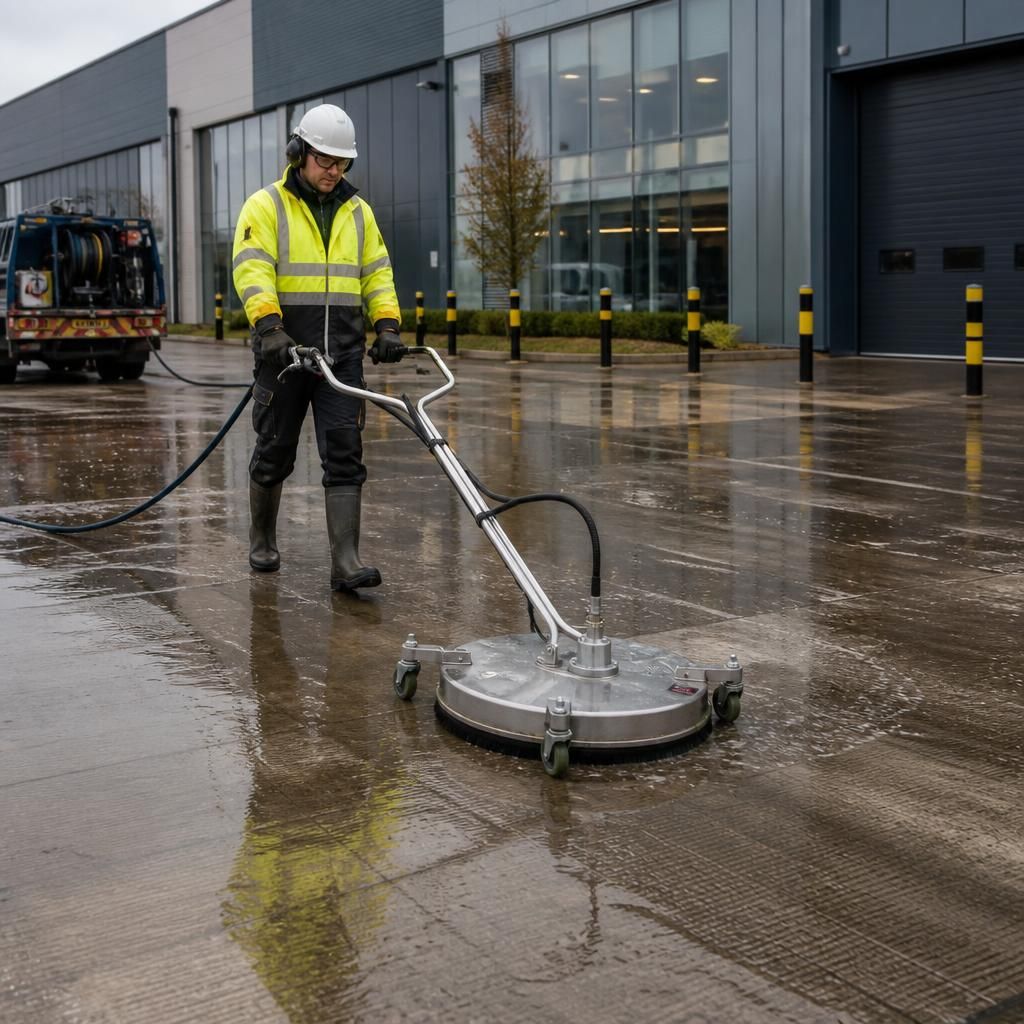
Advanced surface-cleaning equipment improves commercial outdoor cleaning by applying water and cleaning action more evenly across large, hard surfaces. Rotary surface cleaners, for example, enclose rotating jets beneath a protective housing, helping to reduce streaks, overspray and inconsistent results when cleaning suitable concrete, paving and stone areas.
This equipment is particularly useful for car parks, service yards, loading areas and pedestrian approaches. Operators can adjust pressure, water flow, nozzle selection and cleaning speed to suit the surface and contamination. Delicate or damaged areas still require controlled lance work and testing, while heavily soiled surfaces may benefit from hot water or a suitable pre-treatment. Used correctly, advanced equipment improves efficiency without relying on excessive pressure that could damage paving, coatings, pointing or drainage details.