
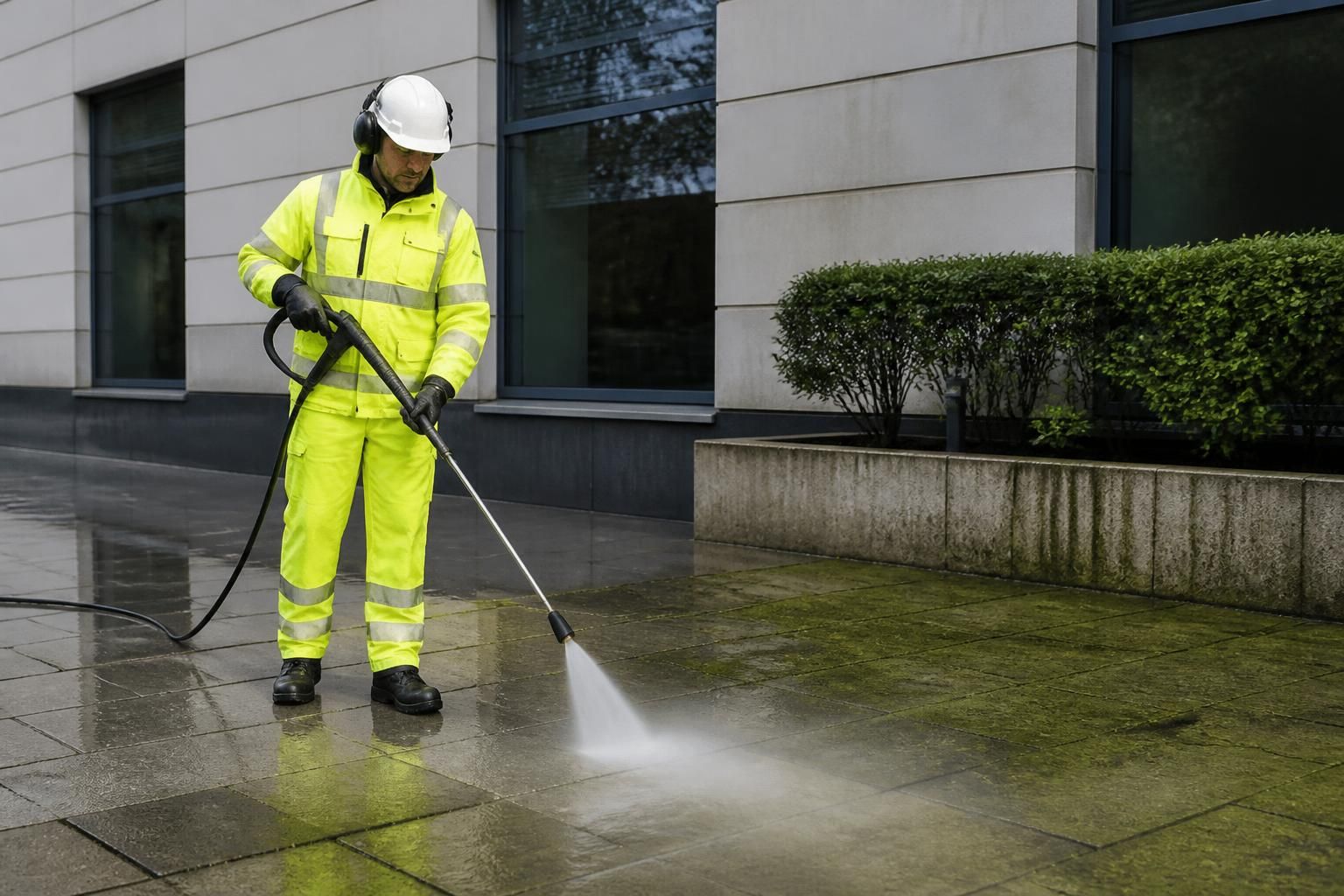
What qualifications and certifications should a professional pressure cleaning company have to effectively handle moss and algae removal on various surfaces?
A professional pressure cleaning company should be able to demonstrate trained operators, appropriate health and safety competence, and relevant certifications such as IPAF or PASMA for access equipment, alongside COSHH training for cleaning chemicals and work-at-height training where required. For moss and algae removal across roofs, façades, cladding and paving, they should also show practical experience with pressure, soft-washing and steam-cleaning methods, suitable surface assessment, environmental controls and documented risk assessments and method statements.
A professional pressure cleaning company handling moss and algae removal should be able to demonstrate trained operators, appropriate health and safety competence, suitable access qualifications and documented procedures for protecting surfaces, people and the environment. There is no single UK certificate that authorises every type of pressure cleaning. The relevant qualifications depend on the equipment used, the height and location of the work, the cleaning chemicals involved and the surfaces being treated.
Access and working-at-height competence are essential when cleaning roofs, elevated façades, canopies, cladding or other inaccessible areas. Depending on the equipment, operators may need:
- IPAF training for powered access equipment such as mobile elevating work platforms, including the appropriate category for the machine being operated.
- PASMA training for the safe assembly, alteration and use of mobile access towers.
- Recognised working-at-height training covering inspections, fall prevention, harnesses, anchor points, rescue arrangements and the requirements of the Work at Height Regulations.
- Training in the safe use of ladders, roof access systems, edge protection and any specialist access equipment used for the project.
IPAF or PASMA is not automatically required for every cleaning job. It becomes relevant when that particular form of access is used. A competent contractor should also confirm that equipment is inspected, maintained and suitable for the ground conditions, working height and reach required. For roof cleaning, the method statement should address fragile surfaces, rooflights, unprotected edges, weather conditions and how operatives will avoid transferring moss and contaminated water to lower areas.
Pressure-washing and surface-cleaning training should cover more than simply operating a machine. Operators need to understand how pressure, flow rate, temperature, nozzle selection, dwell time and working distance affect different materials. Moss and algae can be removed from paving, concrete, brickwork, render, stone, roof tiles, metal cladding and painted surfaces, but the safest method is not the same for each one.
A competent operator should be able to assess whether a surface is weathered, loose, cracked, porous, painted, coated or already damaged before cleaning begins. They should know when high-pressure cleaning is unsuitable and when a lower-pressure soft-washing or steam-cleaning approach is more appropriate. Practical experience is particularly important on roof tiles, historic masonry, delicate render, pointing and coated cladding, where excessive pressure or unsuitable chemicals can cause permanent damage.
COSHH competence is required where biocides, detergents, fungicidal treatments or other hazardous substances are used. COSHH means the Control of Substances Hazardous to Health. It is not simply a product certificate; the contractor must assess how each substance will be stored, diluted, applied and disposed of, and how workers, occupants, visitors and the surrounding environment will be protected.
Ask whether the company can provide current COSHH assessments and product safety data sheets for the treatments proposed. Operatives should be trained in correct dilution, application, personal protective equipment, spill response, first aid and the restrictions that apply near drains, watercourses, planting, animals and occupied premises. A reputable contractor will not apply a chemical treatment without considering wind, rainfall, runoff and the possibility of overspray.
Health and safety management should be supported by documented risk assessments and method statements, often referred to as RAMS. These should be specific to the site rather than generic paperwork. For moss and algae removal, they may need to cover:
- Slips and trips caused by wet surfaces, loose growth and cleaning hoses.
- Pressurised water, hot water and steam hazards.
- Falling debris and the exclusion of people from the work area.
- Traffic, plant and vehicle movements in car parks or service yards.
- Electrical equipment, overhead services and temporary power supplies.
- Work at height, fragile roofs and emergency rescue arrangements.
- Exposure to cleaning chemicals, contaminated deposits and biological material.
- Water runoff, blocked drains, neighbouring property and sensitive landscaping.
Operators should also have appropriate training in manual handling, personal protective equipment, emergency procedures and basic first aid. Where pressure washers, steam cleaners, pumps or generators are used, the contractor should provide evidence that staff understand the particular equipment and that pre-use checks are completed.
Environmental and waste-management competence is important because moss, algae, silt, chemical residues and wash water can enter drainage systems or nearby watercourses. The company should have a documented plan for containing, collecting or filtering runoff and should understand whether discharge to a surface-water drain, foul drain or sewer is permitted. Consent may be required from the relevant drainage or environmental authority, particularly for commercial premises and larger projects.
If contaminated sludge, removed growth or other controlled waste is taken away, the contractor should use the appropriate waste documentation and, where applicable, hold the required waste-carrier registration. Waste must be handled and disposed of in accordance with its classification and the conditions applying in the relevant part of the UK. Operators should not assume that heavily contaminated wash water can be released into any convenient drain.
Building and material awareness is also a qualification in practical terms. Formal certificates do not replace experience with the surfaces being cleaned. The contractor should be able to identify when moss or algae is a symptom of poor drainage, persistent damp, defective pointing, leaking gutters or failed coatings. They should know when cleaning alone is inappropriate and when the issue should be referred to a roofer, building surveyor, drainage specialist or other qualified professional.
On older buildings, operatives should be alert to the possibility of asbestos-containing materials, particularly on certain roof sheets, soffits, panels and textured coatings. Asbestos awareness training helps workers avoid disturbing suspect materials, but it does not authorise asbestos removal. If asbestos is suspected, work should stop until the material has been assessed and any necessary work is arranged through a suitably competent asbestos professional.
Company-level accreditations can provide additional assurance but should not be treated as a substitute for site-specific competence. A contractor may hold independently assessed management-system certifications for quality, environmental management or occupational health and safety. Membership of a recognised safety pre-qualification scheme can also indicate that insurance, policies and basic procedures have been reviewed. These credentials are useful, particularly for commercial procurement, but they do not prove that an individual operative can safely clean a fragile roof or select the correct treatment for a historic façade.
Before appointing a contractor, request evidence that is relevant to the proposed work. This should normally include:
- Operator training records for pressure washing, steam cleaning, soft washing and any access equipment to be used.
- Current RAMS and COSHH assessments prepared for the site and proposed treatment.
- Inspection and maintenance records for access equipment, pressure washers, hoses, pumps and fall-protection equipment.
- Evidence of suitable public liability and employers’ liability insurance, where applicable.
- Examples of comparable work on the same or similar surfaces.
- A clear explanation of how runoff, removed growth, chemicals and waste will be controlled.
- Confirmation of who will carry out the work if subcontractors are used, including checks on their qualifications and insurance.
The most reliable assessment is therefore a combination of qualifications, practical experience and good documentation. For straightforward ground-level paving, the access requirements may be limited, whereas a roof, high façade or sensitive historic surface requires more specialist competence. The contractor should explain which certificates apply to the proposed method, identify any qualifications that are not relevant, and provide a safe cleaning plan rather than relying on a generic claim of being “certified”.
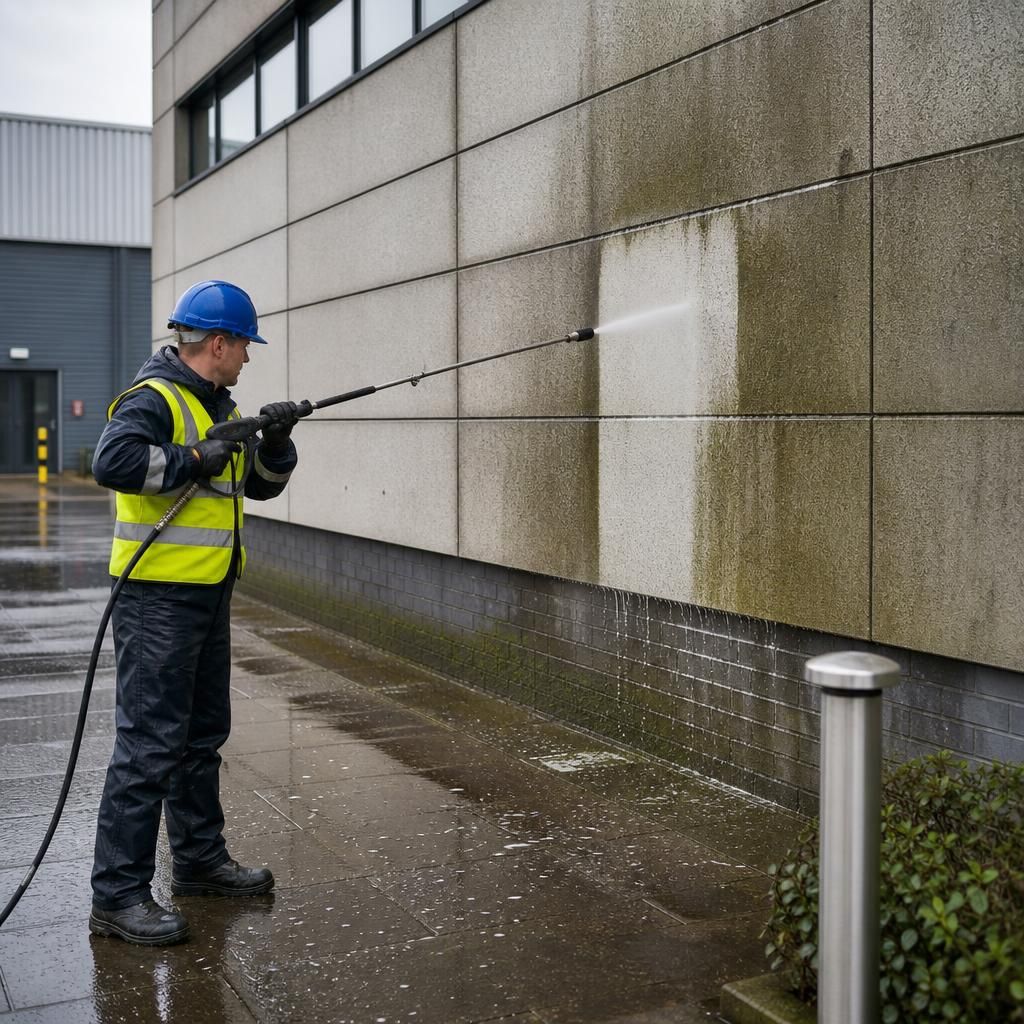
The right qualifications for moss and algae removal depend on the surface, cleaning method, chemicals and access equipment involved. A competent contractor should provide evidence that its operatives are trained for the specific work rather than relying on a general claim of being “certified”.
For roof or high-level cleaning, check for relevant working-at-height training and, where applicable, IPAF or PASMA competence. If biocides or detergents are used, the contractor should have current COSHH assessments, product safety data sheets and procedures for dilution, protective equipment and runoff control. Pressure-washing or steam-cleaning training should also cover pressure, temperature, flow and nozzle selection for materials such as tiles, masonry, render, cladding and paving.
Before work starts, request site-specific risk assessments and method statements, equipment inspection records, insurance details and examples of comparable projects. These documents should explain how fragile surfaces, falling debris, slips, traffic, drainage, chemicals and surrounding landscaping will be protected.