
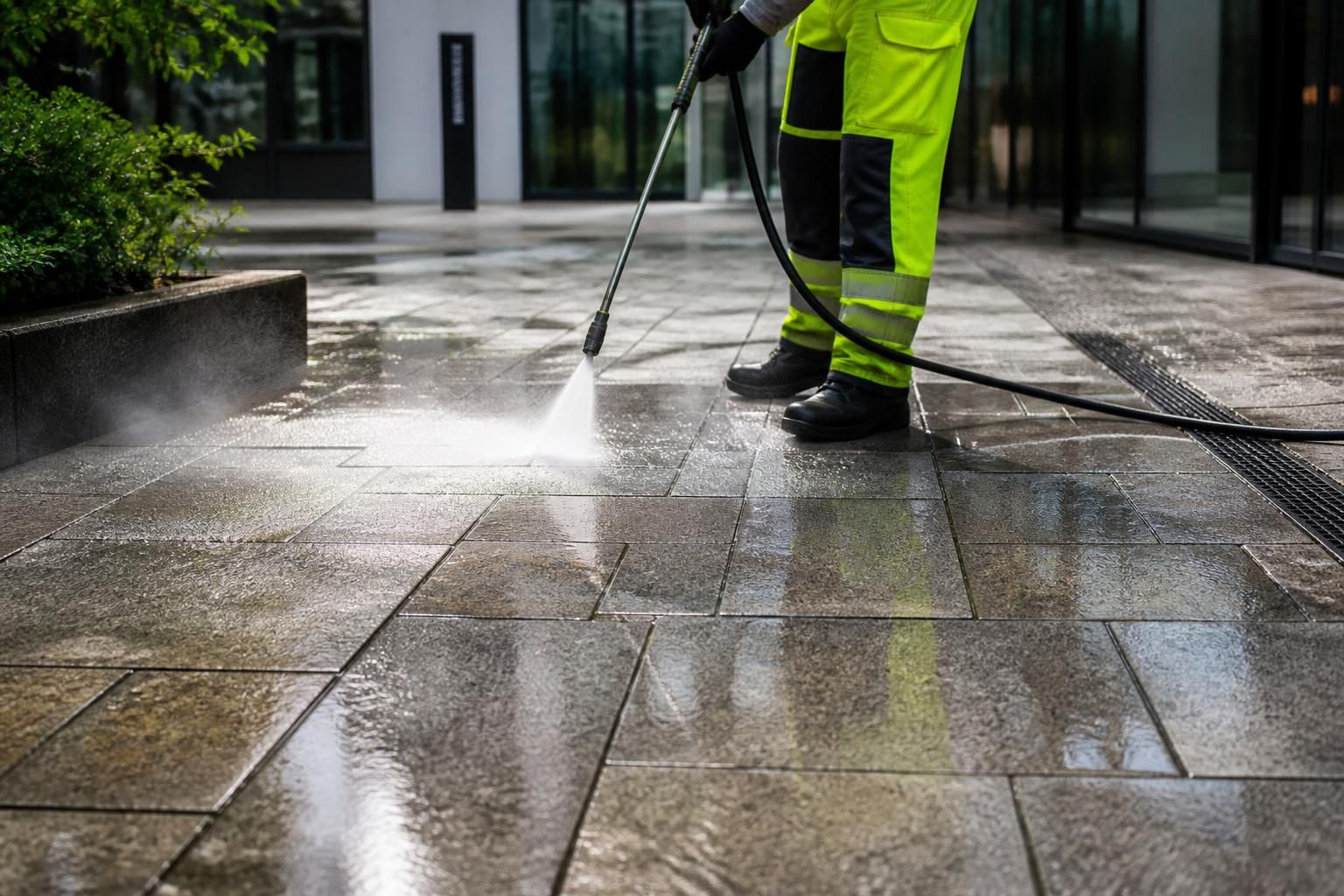
How often should concrete and paving slabs be cleaned to maintain their condition?
Concrete and paving slabs should generally be professionally cleaned at least annually, with high-traffic, shaded or heavily soiled areas requiring more frequent attention. Inspect the surface regularly and arrange cleaning when algae, moss, staining or built-up dirt appears, as prompt treatment helps preserve the surface and maintain safe, presentable outdoor areas.
Concrete and paving slabs should generally be professionally cleaned at least annually to maintain their condition, with more frequent cleaning where surfaces are heavily used, shaded, exposed to pollution or affected by persistent damp. Regular inspection is more useful than relying on a fixed timetable alone: arrange cleaning when algae, moss, ingrained dirt, oil, staining or slippery deposits begin to develop.
For commercial and industrial sites, an annual clean is often a sensible minimum because outdoor surfaces are exposed continuously to foot traffic, vehicle movements, weather and airborne pollution. However, the appropriate interval depends on the site and how the surface is used:
- High-traffic areas: Entrances, pedestrian routes, loading areas, service yards and car parks may need cleaning more frequently because dirt is tracked across the surface and spills are more likely.
- Shaded or damp areas: Surfaces beneath trees, beside buildings and in areas with poor drainage can retain moisture, encouraging algae and moss growth. These locations may require additional treatment between scheduled cleans.
- Areas exposed to vehicles: Car parks, forecourts and service yards can accumulate oil, diesel, rubber deposits and traffic film. Prompt spot treatment helps prevent contaminants becoming more difficult to remove.
- Polluted or urban locations: Soot, dust and airborne residues can build up more quickly near busy roads, construction activity and industrial operations.
- Newly installed or repaired paving: Cleaning should be planned around the condition of the surface, jointing material and any curing or sealing requirements. Aggressive cleaning too soon after installation can disturb joints or affect the finish.
- Public-facing premises: Retail, office, educational, healthcare and managed residential sites may benefit from cleaning before important inspections, seasonal periods or planned events, in addition to routine maintenance.
Cleaning should not be delayed until the surface is heavily soiled. Light organic growth is usually easier to remove than established moss with extensive root growth, while fresh spillages are generally more manageable than old oil or rust staining. Early treatment can also reduce the need for stronger chemicals, prolonged pressure or repeated cleaning passes, helping to protect the concrete, paving finish and jointing.
A practical maintenance programme combines routine inspections with planned cleaning. Inspect paved areas for visible discolouration, slippery films, organic growth, blocked drainage points, worn joints and areas where water is standing. Following wet or cold periods, pay particular attention to shaded sections and locations beneath vegetation. After building work, landscaping or repairs, remove construction dust, mortar residue and other debris using a method suited to the surface rather than allowing it to become embedded.
Different areas of the same site may need different frequencies. A frequently used entrance could be cleaned as part of a regular planned programme, while a lightly used service area may only need annual treatment unless staining or biological growth appears. Dividing the site into zones allows high-risk areas to receive attention without unnecessarily cleaning surfaces that remain in good condition.
The cleaning method should be selected according to the slab or paving type, its age, surface finish, joint condition and the nature of the contamination. Pressure washing can be effective when the pressure, nozzle, distance and water flow are controlled correctly, but excessive pressure or an unsuitable technique can mark concrete, remove surface material or displace jointing. Steam cleaning and low-pressure methods may be more appropriate for sensitive areas, delicate finishes or situations where chemical use and water run-off need to be carefully managed.
Where algae or moss is present, cleaning should address both the visible growth and the conditions allowing it to return. Improving drainage, reducing persistent shade where practical, clearing leaves and maintaining nearby vegetation can extend the time between cleans. Any treatment used should be compatible with the surface and managed so that run-off does not enter drains, watercourses or planted areas without appropriate controls.
After cleaning, inspect the surface once it has dried. Check for remaining staining, loose or missing jointing, cracks, failed sealant and areas where water continues to collect. Cleaning does not correct structural defects or drainage problems, so these should be recorded and addressed separately. A suitable sealant may help some concrete and paving surfaces resist future staining, but it should only be applied to a clean, dry and compatible surface.
For most commercial sites, the best approach is to schedule a thorough professional clean annually and review the frequency after observing how quickly contamination returns. Increase the cleaning interval where there is rapid algae growth, repeated staining, heavy traffic or a clear safety risk. Arrange an earlier clean whenever the surface becomes slippery, visibly degraded or unsuitable for customers, staff, vehicles or members of the public.
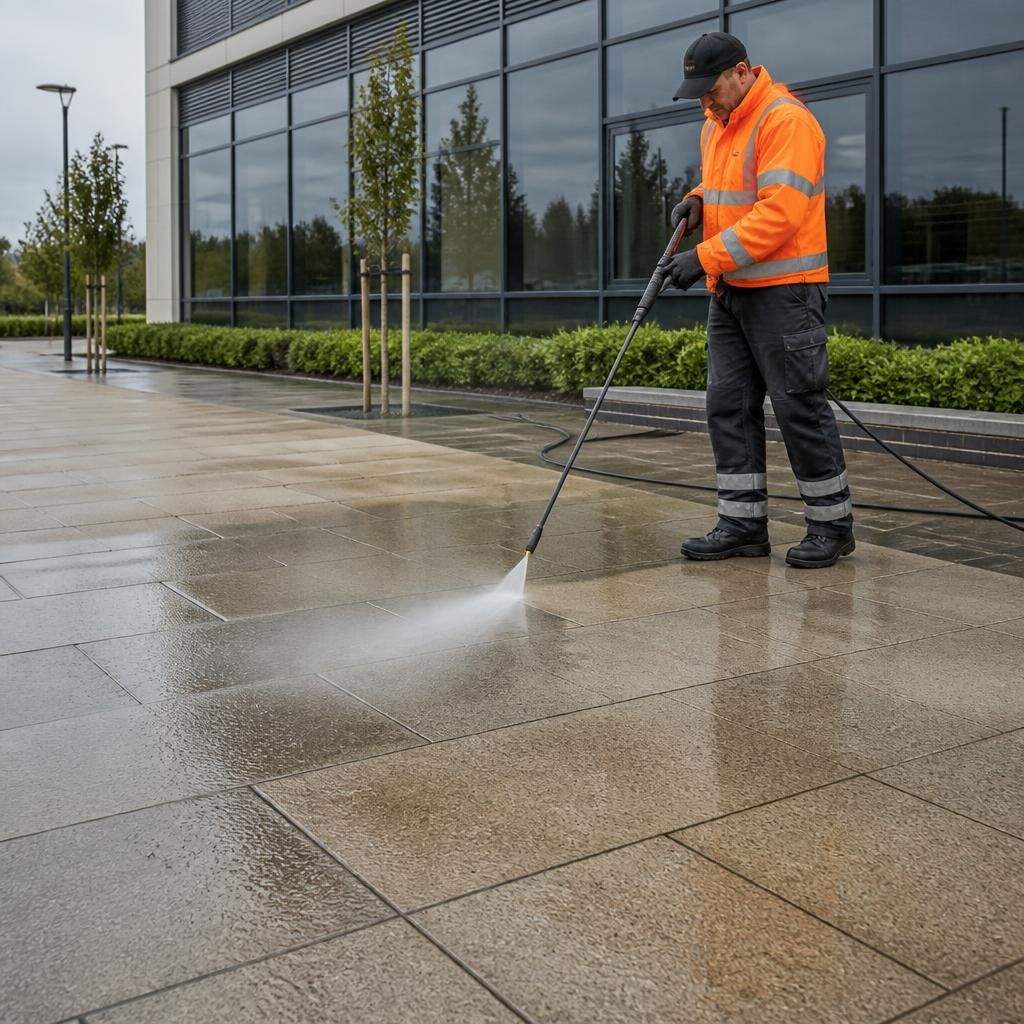
Concrete and paving slabs should usually receive a professional clean at least annually, but the correct frequency depends on traffic, moisture, shade, pollution and the type of contamination present. High-use entrances, car parks, service yards and shaded areas may need cleaning sooner if dirt, algae, moss, oil or slippery deposits return quickly.
Regular inspections help identify when cleaning is needed rather than relying on a fixed timetable alone. Arrange treatment before organic growth becomes established or fresh spillages develop into persistent stains. Cleaning should also be planned after construction work, landscaping or repairs, using a method suitable for the surface, jointing and drainage arrangements.