
What are the specific safety measures and certifications required for performing industrial jet washing on high-rise buildings?
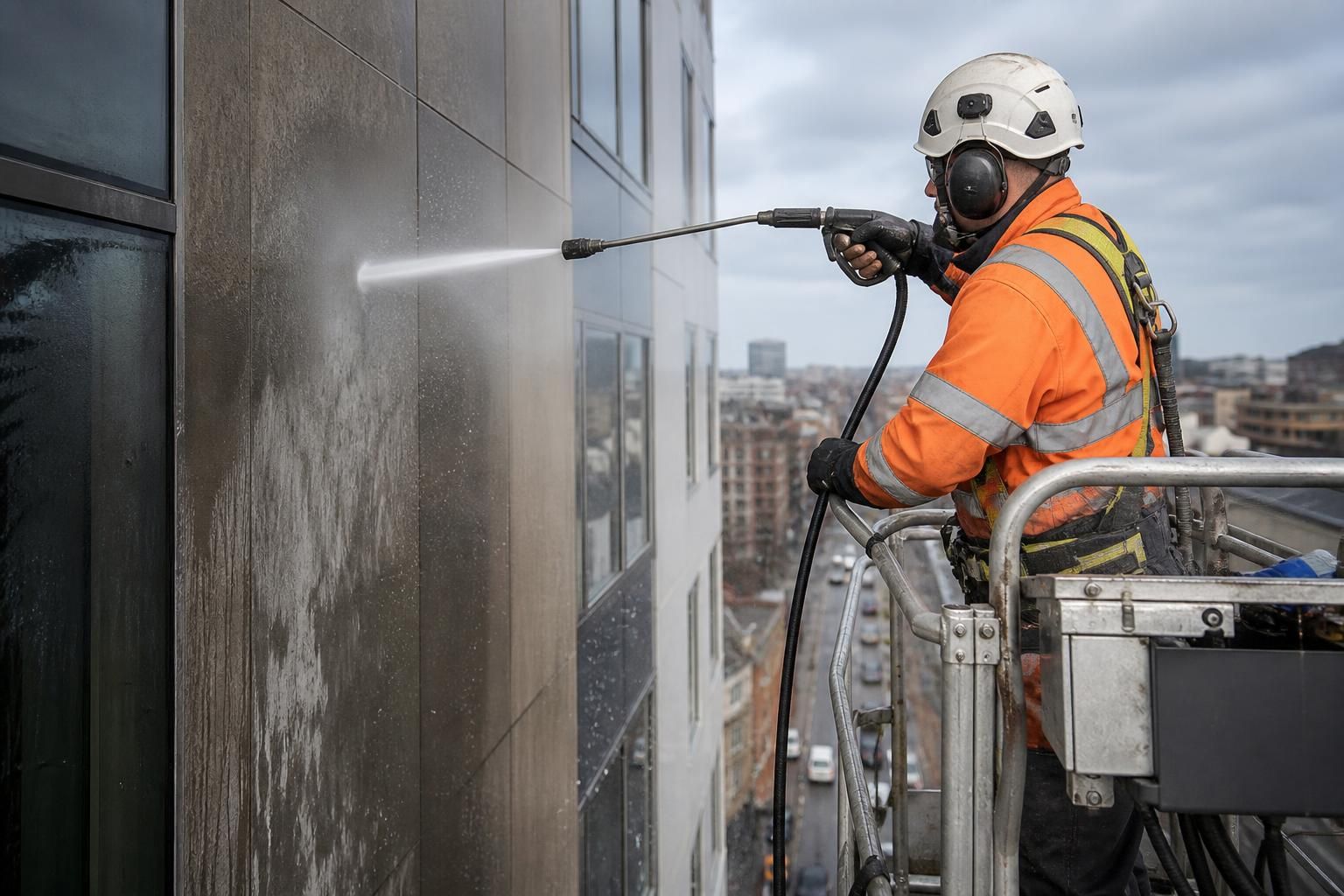
High-rise industrial jet washing requires a documented risk assessment and method statement, work-at-height controls, exclusion zones, suitable PPE, secure access and rescue arrangements, equipment inspections, and safeguards for water, electricity, falling objects and chemical exposure. Operatives should be demonstrably competent, with relevant training and certification for pressure-washing equipment and any access method used, such as IPAF for powered access, IRATA for industrial rope access, and LOLER and PUWER compliance for lifting and work equipment.
High-rise industrial jet washing must be planned as work at height and as a high-pressure water operation. The required controls normally include a documented risk assessment and method statement, competent operatives, suitable access and rescue arrangements, inspected equipment, exclusion zones, task-specific personal protective equipment, and controls for water, electricity, chemicals, traffic and falling objects. The exact qualifications depend on the building, equipment, access method and site conditions; there is no single certificate that covers every high-rise cleaning project.
Risk assessment and method statement
Before work starts, the contractor should survey the building and prepare a site-specific risk assessment and method statement (RAMS). These documents should explain:
- the areas to be cleaned, the surface condition and any fragile or damaged elements;
- the selected cleaning method, pressure and temperature settings, detergents and application process;
- how operatives will reach and leave each work position;
- the risks from falling people, tools, hoses, debris and contaminated water;
- the location of pedestrians, vehicles, tenants, public rights of way and neighbouring property;
- weather limits, wind exposure, visibility and conditions that require work to stop;
- isolation of electrical services and protection of windows, vents, alarms and building systems;
- water supply, drainage, wastewater containment and any environmental controls; and
- the emergency arrangements, including communication, first aid and rescue from height.
Where the work forms part of a construction or refurbishment project, the duties and planning requirements under the Construction (Design and Management) Regulations may also apply. RAMS should be shared with the site manager and revised if the equipment, access arrangement, weather or site conditions change.
Work-at-height controls
The Work at Height Regulations require employers to avoid work at height where reasonably practicable and, where it cannot be avoided, to plan and supervise it using suitable equipment. A high-rise cleaning plan should prioritise collective protection, such as a properly designed platform, scaffold or edge protection, before relying on individual fall-arrest equipment.
Every access system must be appropriate for the building and the jet-washing task. A powered access platform must have adequate working load, reach, stability and room for hoses and equipment. Scaffold and temporary platforms must be properly erected, inspected and altered only by competent people. Ladders are generally unsuitable for sustained high-pressure cleaning because both hands may be needed to control the lance and reaction force.
Where rope access is selected, the system should use appropriately trained rope-access personnel, independent fall protection where required, secure anchor arrangements, controlled rope lines and a documented rescue plan. Operatives must not work from a suspended position without considering the additional effects of hose drag, jet reaction, overspray and possible contamination.
Access-related training and certification
Evidence of competence should match the access equipment being used. Depending on the method, this may include:
- IPAF training for operators of relevant powered access equipment, with the category matching the specific machine;
- PASMA training where mobile access towers are used, provided the tower and site conditions are suitable for the task;
- IRATA training or an equivalent recognised rope-access competence framework for industrial rope access work, together with site-specific supervision and rescue capability;
- scaffold inspection competence for the person responsible for required scaffold inspections; and
- manufacturer or equipment-specific training for specialist cradles, suspended platforms, water-fed systems and other access equipment.
These certificates do not replace a site induction, task briefing, medical suitability assessment where relevant, or practical confirmation that the operative can carry out the particular cleaning method safely.
Inspection of lifting and work equipment
The Lifting Operations and Lifting Equipment Regulations (LOLER) apply to lifting equipment and accessories used for lifting people or loads. This can include certain suspended access systems, hoists, lifting accessories and powered access equipment. Equipment must be suitable, properly planned and examined at the required intervals by a competent person, with examination records available.
The Provision and Use of Work Equipment Regulations (PUWER) apply to work equipment, including pressure washers, pumps, hose reels, generators and access machinery. Equipment should be suitable for the intended pressure, flow, temperature and environment. Guards, emergency stops, controls and safety devices must be present and functional. Operators should complete pre-use checks and report defects immediately.
Pressure hoses, couplings, lances, trigger guns and safety valves require particular attention. The team should check for abrasion, cuts, bulges, damaged fittings, leaks and signs of excessive wear. Hoses should be routed and secured so that they cannot snag on the platform, strike people below or place additional load on an access system. Damaged components must be removed from service rather than temporarily improvised.
High-pressure water and chemical controls
Jetting equipment can cause serious injection injuries, lacerations, eye injuries, hearing damage and loss of control through gun recoil. Operators should use the lowest effective pressure and flow for the surface, maintain a stable stance, keep both hands on the lance or gun where required, and never point the jet at a person, opening or unprotected surface. The trigger should be released before moving, adjusting equipment or clearing a blockage.
Personal protective equipment should be selected after the risk assessment and may include a suitable helmet with eye and face protection, waterproof protective clothing, gloves that provide appropriate protection without reducing control, safety footwear with suitable grip, and hearing protection. Respiratory protection may be necessary where the process creates hazardous mist or where chemicals are applied. PPE must be compatible with the access system, communication equipment and rescue harness.
Detergents, biocides, degreasers and other treatments must be assessed under the Control of Substances Hazardous to Health Regulations. Operatives should follow the product safety data sheet, use the correct dilution and application method, prevent incompatible chemical mixing, and understand storage, spill response and disposal requirements. Chemical-resistant PPE may differ from the gloves and clothing used for water jetting.
Exclusion zones and falling-object protection
A controlled exclusion zone must be established below and around the work area. Its size should reflect the height, building layout, wind, water spray, equipment used and likelihood of loose material becoming detached. Barriers and warning signs should be visible, and a trained person should control access where pedestrians or vehicles could enter the zone.
Tools, hoses, lances and accessories should be secured against dropping. Where there is a risk to people or property below, additional measures may include toe boards, debris netting, overhead protection, a controlled lifting system or temporary closure of the area. Cleaning should not proceed until loose façade materials, insecure signs, damaged masonry and other hazards have been assessed.
Electrical, water and building-protection measures
Water and electricity must be kept apart. Electrical supplies, temporary distribution equipment and leads should be suitable for the environment, protected from water ingress and positioned to avoid trip and shock hazards. Services on or near the façade may need to be isolated by an authorised person. Operatives should not direct water towards electrical equipment, ventilation openings, façade penetrations or unsealed joints.
A pre-cleaning inspection should identify vulnerable windows, seals, render, coatings, cladding joints, vents, sensors, cameras and alarms. A small test area can confirm that the selected pressure, nozzle, temperature and detergent will not damage the substrate. Water ingress risks should be discussed with the building representative before full-scale cleaning.
Rescue and emergency arrangements
A telephone number alone is not an adequate rescue plan for high-rise work. The method statement should set out how an incapacitated operative will be recovered from a platform, cradle, scaffold or rope-access position, who will lead the rescue, what equipment is available, and how emergency services will gain access. Rescue equipment must be compatible with the access system and readily available rather than stored remotely.
The team should also have procedures for burst hoses, loss of power, equipment failure, sudden weather changes, chemical splashes, electric shock, falling debris and uncontrolled wastewater. All operatives need a briefing on the arrangements, reliable communication and a clear stop-work process. First-aid provision should reflect the hazards, including the possibility of serious high-pressure injection injury, which requires urgent medical assessment even when the wound appears minor.
Environmental and public-safety controls
Run-off from façades, roofs and industrial surfaces can contain oils, detergents, paint residues, metals, biological growth and other contaminants. The contractor should identify drainage routes, prevent polluted water entering surface-water drains, use containment or recovery equipment where necessary, and dispose of collected wastewater in accordance with site and local requirements. Chemicals should be selected and used at the minimum effective concentration, without compromising the cleaning result or legal controls.
Public areas may require temporary traffic management, pedestrian diversions, delivery coordination and liaison with the building manager or local authority. Noise, overspray, visibility and falling water should be considered, particularly where work is close to roads, occupied offices, residential entrances or neighbouring premises.
What certification should be checked before appointing a contractor?
- Current training records for high-pressure water or industrial jetting operations, with competence appropriate to the equipment and task. Industry-recognised water-jetting training, such as relevant Water Jetting Association courses, may provide useful evidence, but the certificate should be checked for scope and currency.
- Access-equipment qualifications relevant to the planned method, such as IPAF, PASMA or IRATA credentials where applicable.
- LOLER examination reports for lifting equipment and accessories, where LOLER applies.
- PUWER inspection and maintenance records for pressure-washing and access equipment.
- Evidence of suitable work-at-height, rescue, first-aid, COSHH and site-specific training.
- Public liability and employers’ liability insurance appropriate to the work, together with any principal-contractor or site-specific pre-qualification requirements.
It is important to distinguish legal duties from optional membership schemes and general training certificates. Competence depends on the complete combination of training, practical experience, supervision, equipment knowledge and site-specific planning. Before mobilisation, the client should receive the RAMS, relevant inspection records and a clear description of the proposed access and rescue arrangements. This provides a practical basis for confirming that the high-rise jet-washing operation can be carried out safely and in accordance with UK requirements.
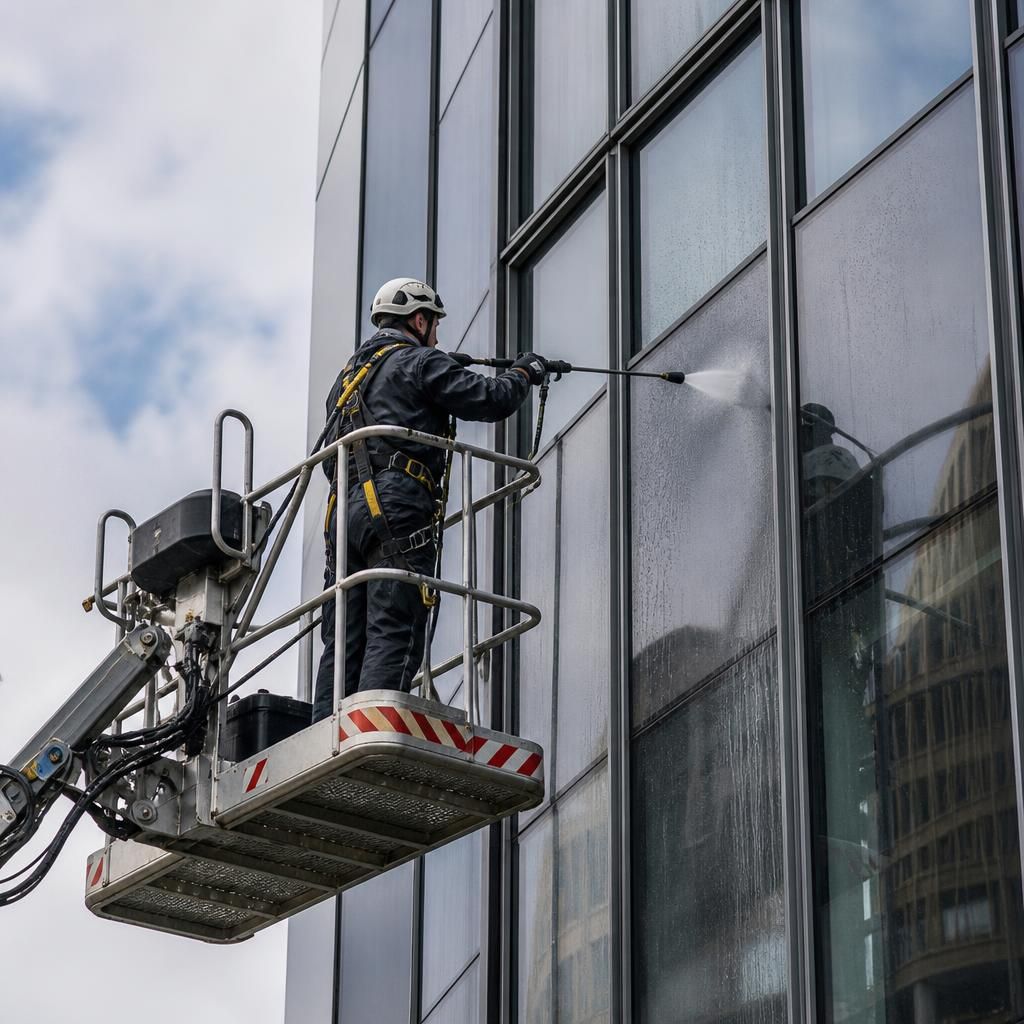
High-rise industrial jet washing requires task-specific competence rather than one universal certificate. The contractor should provide evidence that operatives are trained for high-pressure water work and qualified for the planned access method, such as IPAF for powered access, PASMA for suitable access towers or IRATA for rope access.
These qualifications must be supported by site-specific RAMS, equipment inspections, work-at-height controls and a practical rescue plan. Check that LOLER examination reports and PUWER inspection records are available where applicable, and confirm that training remains current and relevant to the equipment and building being cleaned.
Discuss your high-rise jet washing requirements
Discuss your high-rise jet washing requirements with Encanto Exterior Cleaning, including access arrangements, RAMS, equipment and rescue planning. We can help establish the appropriate safety controls and documentation for your building and site conditions.