
What are the key safety considerations when performing industrial jet washing?
Industrial jet washing safety depends on competent operators, suitable PPE, controlled water pressure, and a documented assessment of site-specific hazards. Operators must also manage electrical and chemical risks, prevent slips and water contamination, secure exclusion zones, and use properly inspected equipment and access systems.
Industrial jet washing is safe only when the work is planned around the pressure, water temperature, equipment, chemicals, access arrangements and conditions at the site. A competent operator should complete a task-specific risk assessment and method statement, use correctly maintained equipment, wear suitable personal protective equipment (PPE), control the work area and manage contaminated water before cleaning begins.
Carry out a site-specific risk assessment
The risk assessment should consider the surface being cleaned, the required pressure and temperature, nearby people and vehicles, access restrictions, weather, drainage, electrical installations, hazardous substances and the possibility of falling objects. It should also identify fragile surfaces, concealed services, open edges, confined spaces and areas where water could enter buildings or damage plant.
A method statement should explain the cleaning sequence, equipment to be used, control measures, emergency arrangements and responsibilities. Operators should be briefed before work starts, and the assessment should be reviewed if conditions change, such as deteriorating weather, unexpected surface damage or a change in cleaning chemicals.
Use trained and competent operators
High-pressure water can cause serious injection injuries, lacerations, eye injuries and loss of balance. Operators need practical training in pressure-washing equipment, nozzle selection, hose management, chemical handling, surface response and emergency procedures. They should understand that a jet can remain dangerous at a distance and that reflected spray or debris may travel beyond the immediate cleaning area.
Competence should match the task. Work involving traffic, roofs, elevated platforms, scaffolding, confined areas, hazardous substances or high-rise façades requires additional training and suitable supervision. Operators should never direct a jet towards another person, use damaged equipment or attempt to clear a blocked nozzle while the system is pressurised.
Wear task-appropriate PPE
PPE should be selected following the risk assessment rather than treated as a substitute for safer planning. Depending on the equipment and site, this may include:
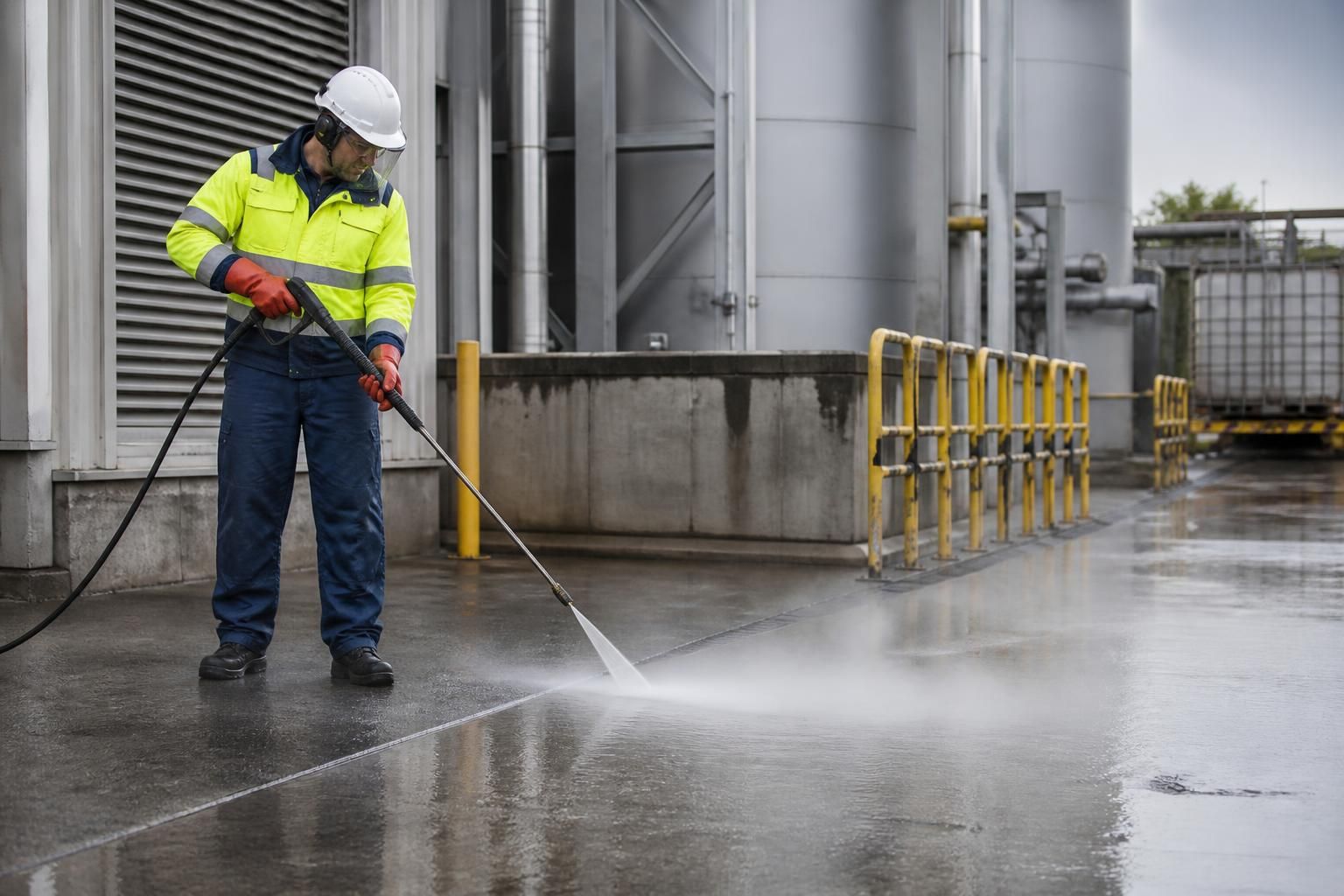
- water-resistant protective clothing or a suitable jet-washing suit;
- chemical-resistant gloves where detergents, biocides or other substances are used;
- eye protection or a full-face visor to protect against spray, debris and chemical splashes;
- protective footwear with slip-resistant soles and suitable toe and penetration protection;
- hearing protection where noise levels require it; and
- hard hats, high-visibility clothing, respiratory protection or fall-arrest equipment where the site assessment identifies those risks.
PPE must be compatible with the cleaning chemicals and the pressure-washing method. It should be inspected before use, kept clean and replaced when damaged or contaminated. Respiratory protective equipment requires an appropriate face-fit process and proper maintenance.
Control pressure, temperature and nozzle selection
Pressure should be set at the lowest effective level for the surface and contamination. Excessive pressure can damage masonry, pointing, coatings, cladding, membranes, joints, seals and painted finishes. It can also increase spray-back and the risk of injury. The operator should test the chosen setting and nozzle on an inconspicuous area before proceeding across the full surface.
Jet-washing lances should be held securely with a stable stance and both hands where required by the equipment design. Operators should allow for kickback when triggering the lance, avoid working from unstable positions and keep hoses routed away from walkways, edges and moving vehicles. Hot-water systems introduce additional burn risks, so hoses, fittings and exposed surfaces must be treated as hot until confirmed otherwise.
Inspect and maintain the equipment
Before use, operators should check the pump, hoses, lance, trigger, couplings, seals, guards, nozzle, fuel system and emergency shut-off arrangements. Hoses must be suitable for the operating pressure and free from cuts, bulges, abrasion and damaged end fittings. Couplings should be secured and any hose restraint required by the equipment manufacturer should be fitted.
Pressure washers, generators, boilers, access equipment and associated lifting accessories should be maintained in accordance with the manufacturer’s instructions and the site’s inspection regime. The Provision and Use of Work Equipment Regulations (PUWER) are relevant to work equipment, while lifting equipment and accessories may fall within the requirements of the Lifting Operations and Lifting Equipment Regulations (LOLER). Records of inspections, servicing and defects should be retained, and defective equipment should be isolated until repaired by a competent person.
Manage electrical and fuel-related hazards
Water and electricity create a particularly serious risk. Electrical supplies, cables, sockets and temporary connections should be suitable for the environment and protected from spray, standing water and mechanical damage. Equipment should be connected and operated in line with the manufacturer’s instructions, with appropriate residual-current protection where required. Electrical systems should be isolated or protected before washing near them, and operators should not use electrical equipment with wet hands or damaged leads.
Diesel, petrol and gas-fired hot-water equipment also requires ventilation, safe fuel storage and control of ignition sources. Exhaust gases must not accumulate in enclosed or poorly ventilated areas. Operators should know the location of fire extinguishers and the procedure for dealing with fuel or chemical spills.
Control chemicals under COSHH
Detergents, degreasers, biocides and other treatments should be selected for the surface and used only at the specified concentration. The Control of Substances Hazardous to Health (COSHH) assessment should cover storage, dilution, application, PPE, exposure controls, spill response and disposal. Safety data sheets should be available to the team.
Chemicals must never be mixed unless the manufacturer specifically permits it. In particular, incompatible products can release hazardous gases or generate heat. Containers should be clearly labelled, kept secure and transported upright. Operators should prevent mist and spray from reaching other workers, occupants, air intakes or sensitive materials.
Establish an exclusion zone
The work area should be separated from pedestrians, staff, residents, visitors and vehicles using barriers, signs and, where necessary, a banksman or dedicated traffic marshal. The exclusion zone must account for overspray, ricochet, falling debris, hose movement and the likely travel of contaminated water. Access points should be controlled rather than relying on warning signs alone.
Where cleaning takes place near roads, loading areas or active construction sites, the traffic management plan should define vehicle routes, stopping arrangements and safe crossing points. Work should be paused if unauthorised people enter the area or if visibility, lighting or communication becomes inadequate.
Take additional precautions at height
High-level jet washing should be planned to avoid unnecessary work at height. Suitable access equipment may include properly erected scaffolding, mobile elevating work platforms or other systems selected for the surface, reach and ground conditions. Ladders are generally unsuitable where the operator needs both hands to control a pressurised lance.
Access equipment must be inspected, used by trained personnel and positioned on stable ground. Operators should be protected from falls and from falling tools, fittings, debris and equipment. A work-at-height plan should include rescue arrangements; relying solely on emergency services may not be sufficient where a worker could be suspended or trapped.
Prevent slips, flooding and uncontrolled discharge
Jet washing creates large volumes of water and can make hard surfaces slippery. Operators should control the direction of flow, use suitable drainage protection and remove standing water promptly where practicable. Hoses should be routed to reduce trip hazards, and wet areas should remain within the exclusion zone until safe for normal use.
Run-off may contain oil, detergents, paint particles, biological growth, heavy metals or other pollutants. It should not be allowed to enter surface-water drains, watercourses or neighbouring premises without appropriate controls. Drain covers, bunding, wet vacuums, containment systems and approved disposal arrangements may be needed. The site plan should identify whether trade effluent or environmental permissions apply.
Consider the weather and surrounding conditions
Wind can carry spray, chemicals and debris towards people, roads, air-conditioning intakes or adjacent properties. Cold conditions can create ice, while rain can increase slip risks and reduce visibility. High winds, lightning, poor visibility and unstable ground may make elevated or exposed work unsafe. The supervisor should set clear stop-work conditions and record any changes to the planned controls.
Have an emergency procedure in place
The team should know how to stop the pump, isolate electrical or fuel supplies, summon assistance and report an incident. First-aid arrangements must reflect the hazards, including eye contamination, chemical exposure, burns, impact injuries and high-pressure injection injuries. An injection injury can appear minor while causing severe internal damage, so it requires urgent medical assessment and the product or equipment details should be provided to clinicians.
Any near miss, equipment failure, uncontrolled discharge or exposure should be recorded and investigated. The findings can require changes to the risk assessment, equipment selection, training or site controls before work resumes.
Maintain legal and operational records
Depending on the work, relevant UK duties may include the Health and Safety at Work etc. Act, the Management of Health and Safety at Work Regulations, PUWER, COSHH, the Work at Height Regulations, the Electricity at Work Regulations and environmental requirements governing waste and water discharge. The exact obligations depend on the site and task.
Useful records include risk assessments, method statements, operator training, PPE checks, equipment inspections, chemical assessments, access-equipment examinations, waste-transfer documentation and incident reports. Reviewing these documents with the client before mobilisation helps ensure that site rules, permits, isolation procedures and emergency contacts are understood by everyone involved.
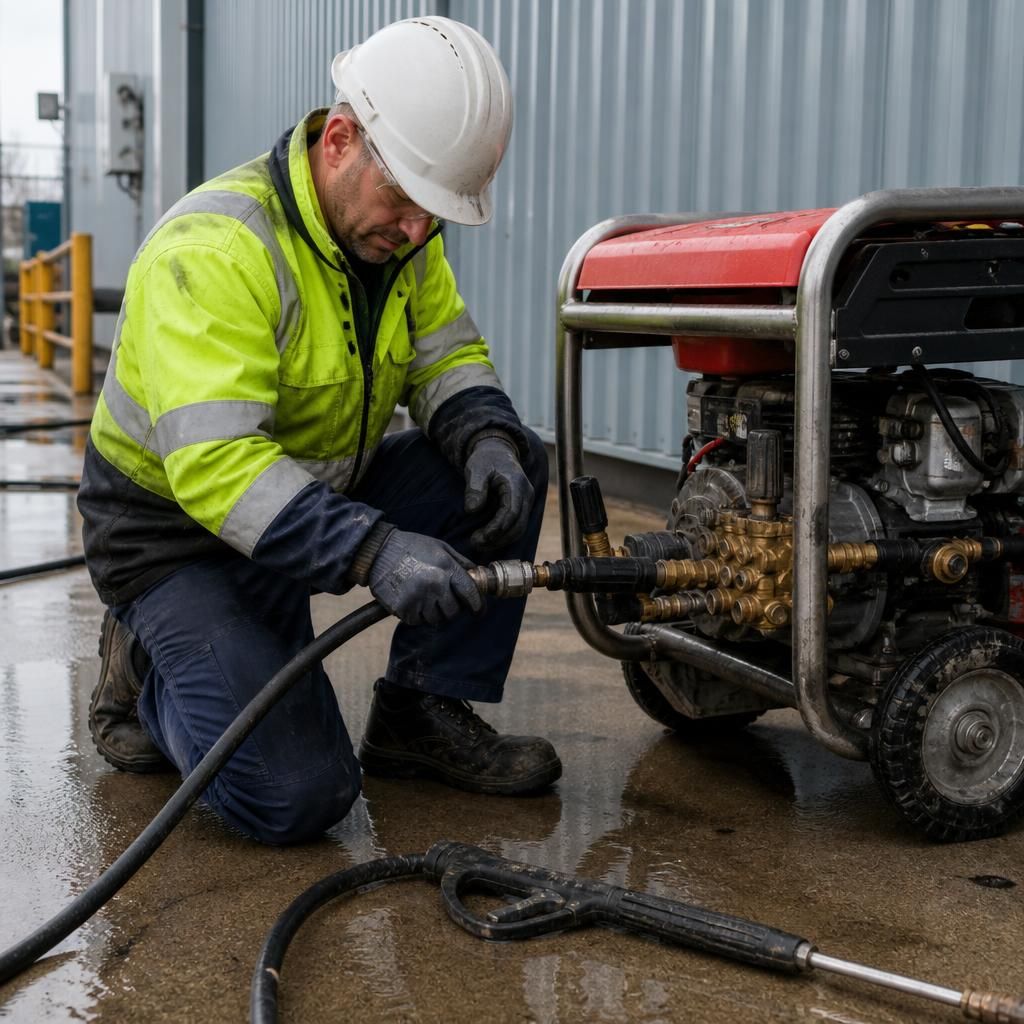
Pre-use equipment checks are a key industrial jet washing safety control because damaged hoses, couplings, lances or triggers can fail suddenly under pressure. Before work starts, the operator should inspect the pump, hose, fittings, nozzle, guards and emergency shut-off, confirming that each component is suitable for the planned pressure and temperature.
Hoses must be free from cuts, bulges, abrasion and damaged end fittings, with couplings secured and any required hose restraints correctly fitted. Defective equipment should be taken out of service immediately rather than temporarily repaired on site. Inspection and maintenance records should be retained in line with the manufacturer’s instructions and relevant UK work-equipment requirements.