
What safety measures are in place during industrial water jet cleaning operations?
Industrial water jet cleaning operations are controlled through site-specific risk assessments, trained operators, inspected equipment, suitable personal protective equipment (PPE) and clearly defined exclusion zones. Operators also manage hose routing, water containment, electrical hazards, nearby people and site access to reduce the risk of injury, property damage and environmental harm.
Industrial water jet cleaning operations are controlled through a documented risk assessment, competent operators, inspected equipment, appropriate personal protective equipment (PPE) and a managed exclusion zone. The controls are planned around the pressure and flow of the equipment, the surface and contaminants being removed, the site layout, nearby activities and the consequences of a hose failure, uncontrolled spray or contact with electrical equipment.
Site-specific planning and risk assessment
Before work starts, the cleaning team assesses the work area and identifies hazards associated with the structure, equipment, substances and surrounding activities. The assessment normally considers:
- the operating pressure, water volume and type of lance, nozzle or rotary tool being used;
- the risk of injection injury, flying debris, ricochet and falling material;
- fragile surfaces, access points, openings, edges and overhead structures;
- oil, paint, chemical residues, biological contamination or other hazardous substances;
- electrical installations, cables, machinery and temporary power supplies;
- slip hazards caused by water, silt, cleaning residues and overspray;
- nearby workers, members of the public, vehicles and other contractors; and
- the collection, containment and disposal of contaminated water and debris.
The findings are translated into a method statement and site controls. Where conditions change, such as a change in the surface, weather, access arrangement or nearby work, the operation should be paused and the controls reviewed rather than continuing under an unsuitable plan.
Competent operators and clear responsibilities
Water jetting is carried out by trained personnel who understand the equipment, the hazards of high-pressure water and the limits of the cleaning method. Operators should be able to select suitable nozzles and accessories, recognise unsafe conditions, maintain control of the lance and respond correctly to an emergency.
Responsibilities are agreed before work begins. This includes identifying who controls the pump, who authorises start-up and shutdown, who manages the exclusion zone and who acts as the emergency contact. For larger or more complex projects, a dedicated supervisor or spotter can help maintain communication between the operator, pump operator and site management.
Operators should never work alone where the risk assessment identifies a need for assistance, and no unauthorised person should operate the pump, lance or associated equipment.
Exclusion zones and communication
A clearly marked exclusion zone keeps people away from the jet, spray, debris and contaminated water. Its size and arrangement depend on the equipment, nozzle, surface and potential for ricochet or falling material. Barriers, signs, guards and, where necessary, a banksman or dedicated marshal are used to prevent accidental entry.
Access routes are kept separate from hose runs and the active cleaning area. Other contractors are informed when water jetting is taking place, and work is stopped if a person, vehicle or unexpected obstruction enters the controlled area. Radios, agreed hand signals or direct line-of-sight communication are used where noise, distance or protective equipment makes normal conversation difficult.
Personal protective equipment
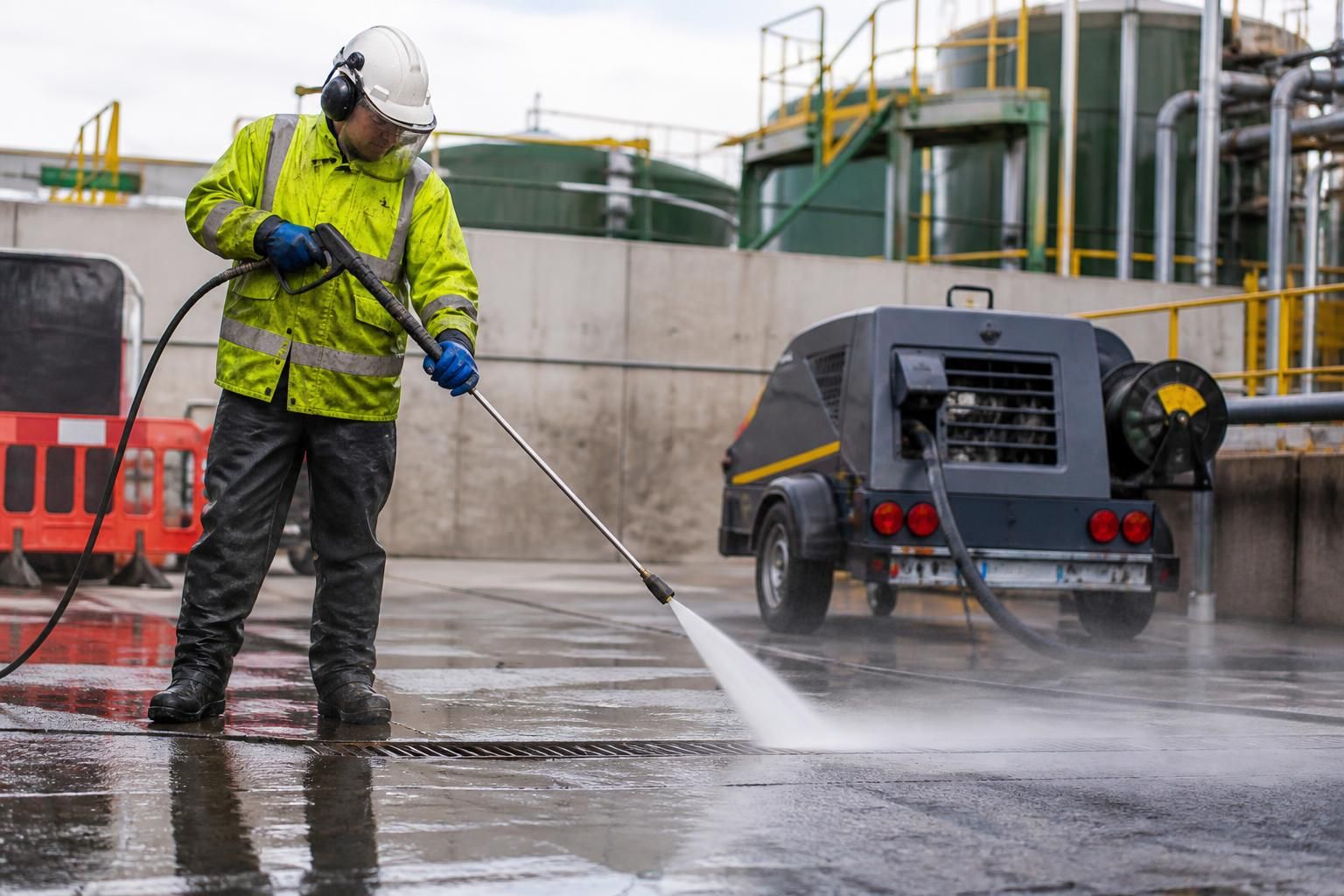
PPE is selected from the risk assessment and is used alongside, not instead of, physical and procedural controls. Depending on the task, this can include:
- water-jet-resistant protective clothing or suitable waterproof outerwear;
- protective gloves selected for the equipment and substances involved;
- water-jet-resistant safety footwear with effective grip and suitable toe protection;
- eye protection or a full face shield to guard against spray and flying particles;
- hearing protection where pump and jetting noise creates a risk; and
- respiratory protection where the process or contaminant creates an airborne hazard that cannot be adequately controlled by other means.
Protective clothing must be in good condition, correctly fitted and compatible with the task. Ordinary workwear is not a substitute for equipment designed for water jetting, particularly where there is a risk of the jet contacting the body. PPE is inspected, maintained and replaced when damaged or contaminated.
Safe equipment selection, inspection and operation
The pump, hoses, couplings, lances, guns, nozzles and safety devices are selected for the intended duty and used within the manufacturer’s stated limits. Before use, the equipment is checked for damage, wear, loose connections, blocked nozzles, damaged hose coverings and signs of leakage. Particular attention is given to couplings, whip checks or restraint systems, trigger controls, dead-man devices and pressure-relief arrangements where fitted.
Equipment is not modified in an unapproved way, and incompatible components are not connected. The pump is started and stopped in accordance with the operating procedure. The operator maintains a stable stance, keeps both hands in the correct position where required and never points the lance at another person, even when the trigger is released.
Pressure is not treated as a substitute for correct technique. The nozzle, stand-off distance, angle and movement are adjusted to suit the material so that unnecessary damage, ricochet and loss of control are avoided. Hoses are routed to reduce trip, crush and abrasion risks, protected from vehicle movements and kept away from sharp edges and hot surfaces.
Control of electrical and mechanical hazards
Water and electricity are a dangerous combination. Electrical supplies, equipment and cables within the work area are identified before cleaning. They are isolated, protected or kept outside the spray and splash zone in accordance with the site control arrangements. Electrical equipment is not assumed to be safe simply because it is described as water-resistant.
Moving plant and machinery is isolated where spray, water ingress or access to the cleaning area could create a risk. Lockout and isolation procedures are followed where necessary, and equipment is not returned to service until it has been inspected and is confirmed safe.
Managing contaminants, spray and debris
Cleaning can dislodge coatings, rust, scale, oil, biological growth and other residues. The team identifies the substance before work begins and applies suitable controls, including COSHH arrangements where hazardous substances are present. Safety data and site information help determine the necessary PPE, containment, cleaning method and waste route.
Suitable sheeting, bunding, drain protection, extraction or temporary collection systems may be used to control overspray and contaminated water. Debris is prevented from entering occupied areas, watercourses or drainage systems unless its discharge is authorised and safe. The work area is checked for residual contamination after cleaning, and waste is handled according to its classification and the agreed site procedure.
Access, weather and surface conditions
Safe access is provided for the operator, hoses and equipment. Platforms, scaffolds, powered access equipment and roof areas are used only where they are suitable for the task and controlled under the relevant site arrangements. Work at height controls remain necessary because water jet reaction, wet surfaces and hose movement can affect balance.
Rain, wind, freezing conditions, poor visibility and excessive spray can make the operation unsafe or extend the exclusion zone. Work is suspended when weather or surface conditions prevent stable footing, effective communication, safe access or proper containment.
Emergency arrangements
Before starting, the team establishes how to stop the pump quickly, summon assistance and reach first aid. Everyone involved understands that a suspected injection injury is a medical emergency, even if the wound appears small or pain is limited. The affected person should receive urgent medical assessment and the medical team should be told that a high-pressure water injury may be involved.
Arrangements also cover hose failure, loss of control, eye injuries, slips, falls, electrical incidents, exposure to contaminants and uncontrolled discharge. Emergency access is kept clear, and incidents, near misses and equipment defects are reported and reviewed before work resumes.
Inspection, maintenance and compliance
Jetting equipment is maintained, inspected and, where applicable, examined in line with the manufacturer’s instructions and the site’s legal and operational requirements. Work equipment controls under the Provision and Use of Work Equipment Regulations (PUWER) may apply, while hazardous substances are managed under the Control of Substances Hazardous to Health Regulations (COSHH). The specific duties depend on the equipment, workplace and substance involved.
Records of training, inspections, maintenance, risk assessments and method statements provide evidence that the operation has been planned and controlled. Good practice also includes following relevant water jetting guidance, manufacturer instructions and the principal contractor’s site rules. These measures do not remove every hazard, but they reduce exposure and ensure that work is stopped whenever the agreed safety controls cannot be maintained.
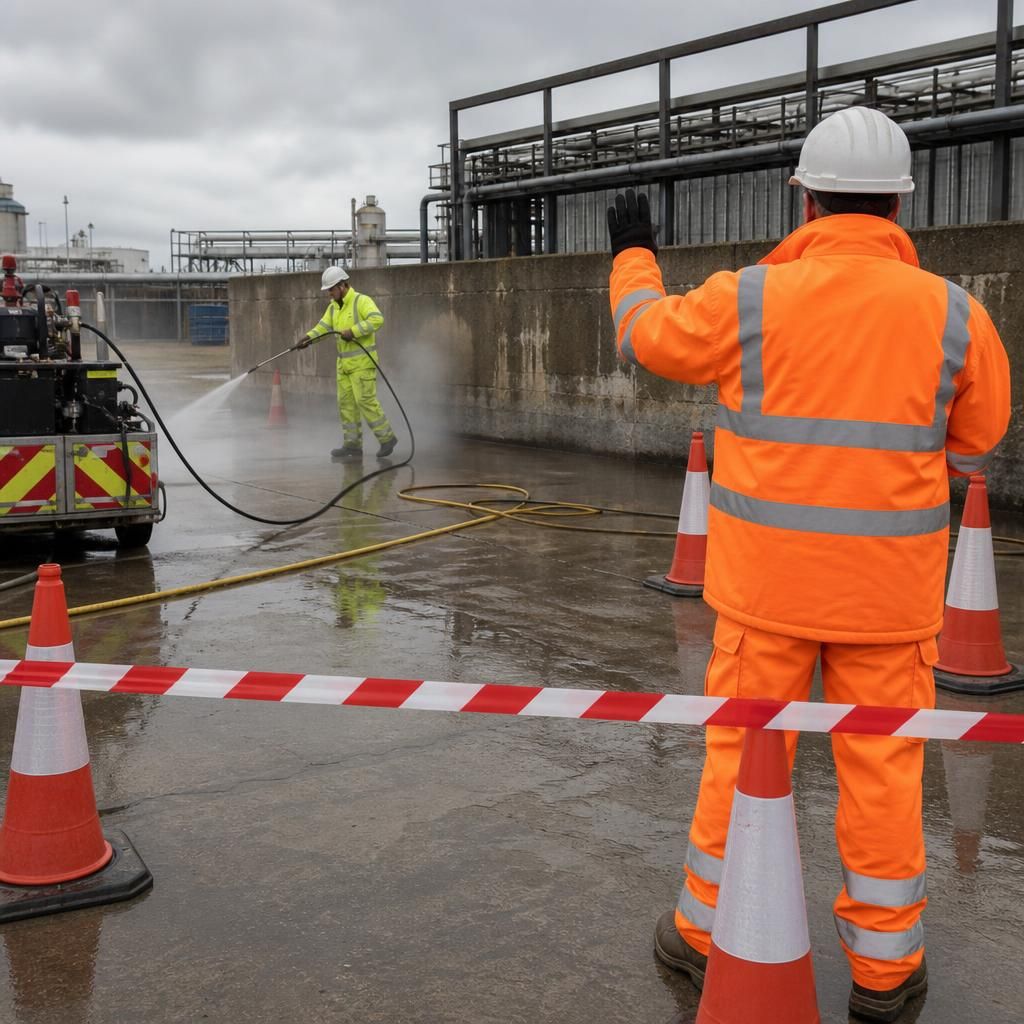
A controlled exclusion zone is one of the main safeguards during industrial water jet cleaning. It separates the operator and equipment from workers, visitors and vehicles that could be exposed to high-pressure spray, ricochet, dislodged debris or contaminated water.
The zone is set according to the equipment, nozzle, surface and site conditions. Barriers and warning signs are supported by a trained marshal where access cannot be fully restricted. Hose routes are kept clear of walkways and vehicle movements, and cleaning stops immediately if an unauthorised person enters the area or communication with the team is lost.