
How do industrial water jet cleaning techniques address safety and compliance concerns?
Industrial water jet cleaning addresses safety and compliance through documented risk assessments, trained operators, suitable PPE, controlled exclusion zones and equipment checks before work begins. Pressure selection, safe access arrangements, wastewater containment and responsible waste disposal help protect people, property and the environment while supporting UK health, safety and environmental requirements.
Industrial water jet cleaning addresses safety and compliance concerns through a planned combination of risk assessment, competent operation, equipment controls, site segregation, suitable personal protective equipment and responsible wastewater management. The method can remove difficult deposits efficiently, but the water stream has enough force to cause serious injury, damage surfaces and mobilise contaminants unless the work is properly specified and controlled.
Risk assessment and method statements
Before cleaning starts, the contractor should assess the surface, contaminant, access arrangements, surrounding activities and likely hazards. The resulting risk assessment and method statement (RAMS) should explain the cleaning method, equipment, pressure and flow settings, operator responsibilities, exclusion zones, emergency arrangements and waste controls. It should also identify hazards such as injection injuries, flying debris, slips, falls from height, noise, vibration, electrical equipment, chemical residues and unstable or fragile materials.
RAMS should be suitable for the actual site rather than copied from a generic template. They should be reviewed if the work area, contamination, weather, access equipment or cleaning technique changes. Where the work forms part of a construction project, the arrangements should be coordinated with the principal contractor and other duty holders under the Construction (Design and Management) Regulations where applicable.
Competent operators and clear responsibilities
High-pressure and water jet cleaning should be carried out by operators who have been trained and assessed as competent for the equipment and task. Competence includes understanding pressure hazards, nozzle reaction, hose management, surface limitations, chemical exposure, emergency procedures and the correct use of access equipment. Operators should know how to stop the system safely and how to report defective equipment, changing site conditions or an uncontrolled release of wastewater.
Site managers should agree who is responsible for isolating plant, controlling access, providing welfare facilities, checking permits and communicating with other contractors. A pre-start briefing helps ensure that everyone understands the work area, exclusion arrangements, emergency contacts and any restrictions imposed by the client or site rules.
Equipment selection and pre-use checks
Safety depends on matching the pump, hose, lance, nozzle and accessories to the job. The operating pressure should be no higher than necessary to achieve the required result. Excessive pressure can erode concrete, remove coatings, damage pointing, force water behind cladding or affect seals and electrical components. A controlled test area is useful for confirming that the chosen technique will clean effectively without damaging the substrate.
Before use, operators should inspect hoses, couplings, trigger controls, guards, lances, nozzles and safety devices. Leaks, damaged hose coverings, worn fittings, blocked nozzles and malfunctioning controls should be taken out of service. Equipment should be maintained in line with the manufacturer’s instructions and applicable UK requirements, including the Provision and Use of Work Equipment Regulations (PUWER) where they apply. Inspection and maintenance records provide evidence that the equipment was kept in a safe working condition.
Exclusion zones and control of the work area
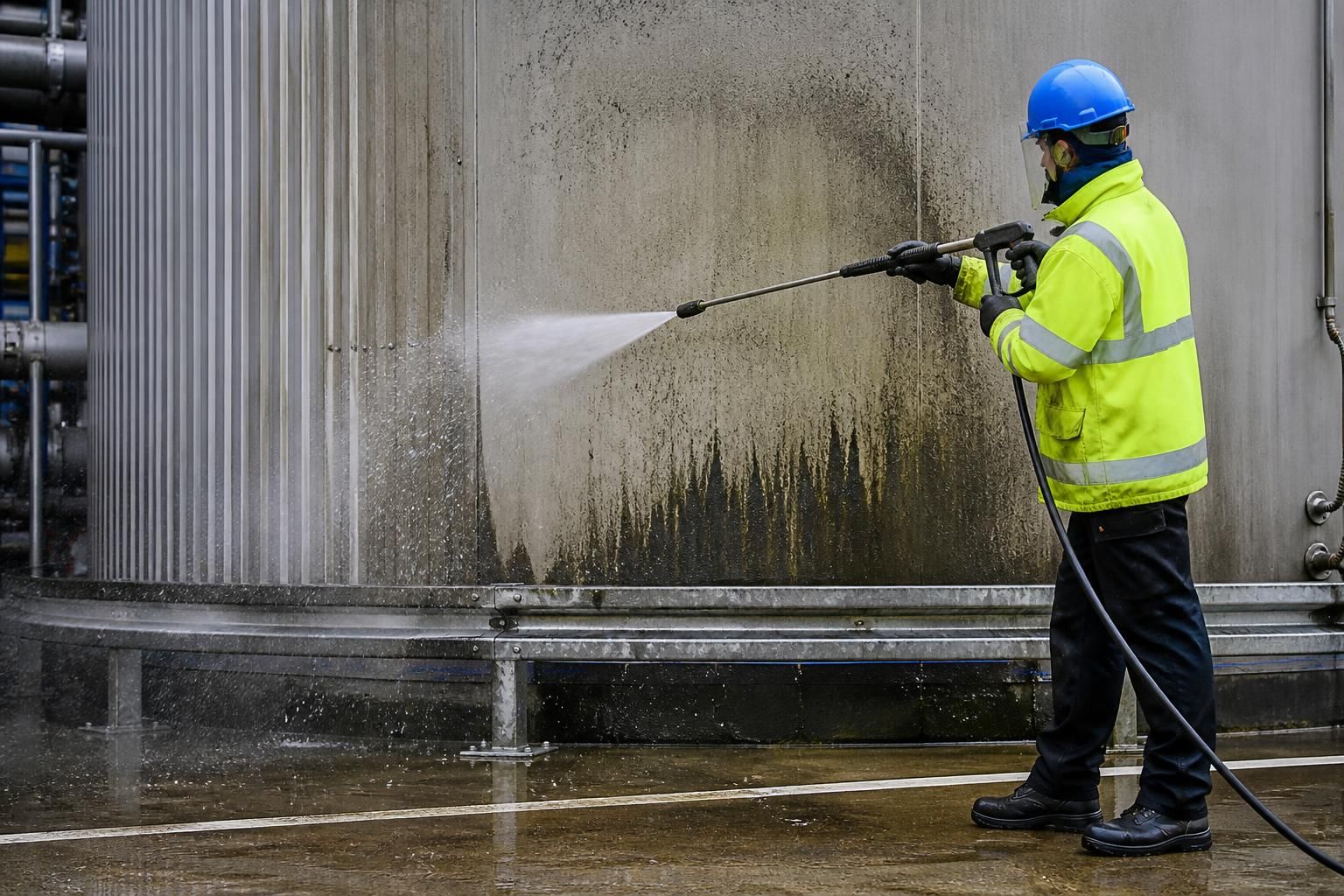
A water jet can propel grit, paint flakes, scale, fragments and contaminated water beyond the immediate cleaning point. Barriers, signage and a supervised exclusion zone keep pedestrians, vehicles and other workers away from the hazard. The size and arrangement of the zone should reflect the equipment, nozzle, surface and potential for debris or spray to travel.
Where practical, the work area should be screened to contain overspray and prevent contamination of adjacent façades, vehicles, stock, ventilation intakes and public areas. Traffic routes may need temporary diversion, and cleaning should be coordinated with loading operations, customer access and other site activities. A dedicated attendant or banksman may be required where visibility is restricted or vehicles and pedestrians share the area.
Personal protective equipment and exposure controls
Personal protective equipment is selected from the risk assessment and is used alongside engineering and site controls, not as a substitute for them. Depending on the task, this may include waterproof protective clothing, safety footwear with suitable slip resistance, gloves, eye and face protection, hearing protection and head protection. Respiratory protection may be necessary where the process creates a harmful mist or disturbs hazardous deposits, but the requirement depends on the contaminant and assessment.
Water jetting can create noise and mist, particularly in enclosed or reflective areas. The method should therefore consider noise exposure, ventilation, drainage and the possibility of contaminant inhalation. COSHH controls may be required where oils, coatings, biological deposits, cleaning chemicals or other hazardous substances are present. The substance should be identified where possible, and the control measures should cover handling, containment, decontamination and disposal.
Safe access, isolation and electrical precautions
Work at height should be planned to avoid unnecessary exposure and should use suitable access equipment operated by trained personnel. The choice between a mobile elevating work platform, scaffold, tower, rope access system or another arrangement depends on the structure, duration, reach, ground conditions and rescue requirements. Lances and hoses must be managed so that they do not create a trip hazard or destabilise the operator.
Nearby machinery, conveyors, fans, electrical installations and moving plant may need to be isolated before cleaning. Water must not be directed at live electrical equipment or areas where it could enter electrical systems. Where isolation is required, it should follow the site’s lockout and permit-to-work arrangements. Weather, wind, ice, poor visibility and unstable ground can also affect the safety of outdoor work and should be considered before and during the operation.
Wastewater, contaminants and environmental compliance
Water jet cleaning removes contamination from the surface but does not make that material harmless. Run-off may contain oil, heavy metals, paint residues, biological material, detergents or construction debris. It should be prevented from entering surface-water drains, watercourses or unprotected ground unless the discharge has been assessed and authorised.
Typical controls include drain covers, bunding, temporary collection systems, wet vacuums, filtration, settlement and recovery to a suitable foul drainage connection where permitted. Collected water and solid residues should be classified according to their contents and transferred to an appropriately authorised waste carrier or disposal facility when required. Documentation such as waste transfer notes, consignment records and discharge permissions may be needed, depending on the material and disposal route. The Environment Agency, water company and site-specific requirements should be considered rather than assuming that wastewater can be discharged routinely.
Protecting structures and preventing secondary damage
Compliance also involves preventing damage to the client’s property and nearby assets. Before cleaning, the operator should identify cracks, failed joints, loose render, defective sealant, open vents, vulnerable coatings and areas where water could penetrate. Windows, doors, air intakes, lighting, sensors and sensitive equipment may require protection or temporary sealing.
Pressure, temperature, nozzle distance and dwell time should be controlled throughout the work. Operators should avoid directing the jet at people, animals, unprotected openings or unsupported materials. Any unexpected movement, water ingress, coating failure or structural concern should stop the work until the method has been reviewed.
Records, monitoring and close-out
A well-controlled operation leaves an auditable record. Depending on the project, this may include the RAMS, operator competency records, equipment inspection details, permits, pre-start checks, wastewater arrangements, photographs, incident reports and waste documentation. Supervisors should monitor barriers, hose condition, surface response, run-off and changing site conditions while work is in progress.
At completion, the area should be checked for slip hazards, standing water, debris, exposed defects and remaining contamination. Drain protection should only be removed once run-off has been controlled, and the client should be told about any defects or limitations identified during cleaning. This close-out process supports the client’s own health and safety records and helps determine whether further treatment or planned maintenance is needed.
These controls support compliance with relevant UK health, safety, work equipment, hazardous-substance, environmental and site-management requirements, but the exact duties depend on the premises, process and contamination involved. For complex or hazardous sites, the cleaning plan should be agreed with the client’s responsible person, health and safety adviser and environmental contact before mobilisation.
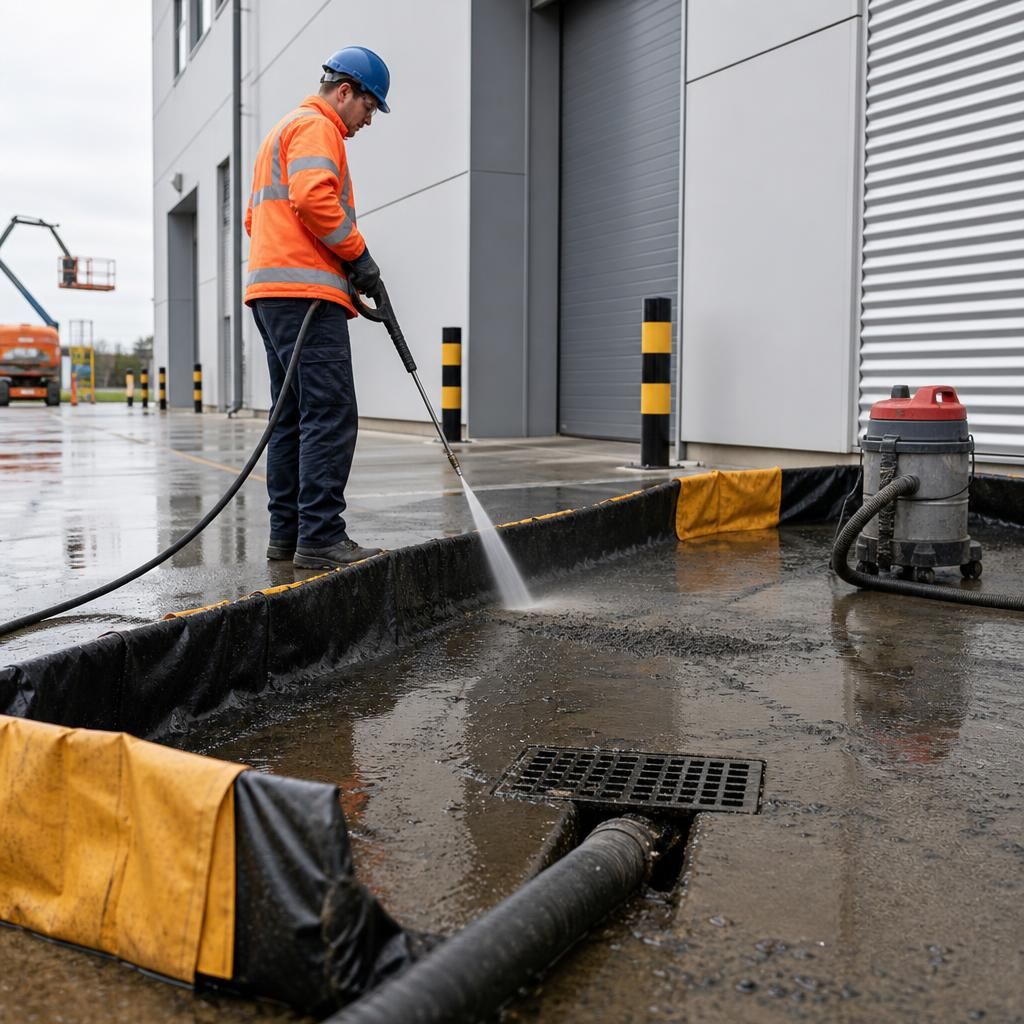
Industrial water jet cleaning supports safety and compliance when wastewater and loosened contaminants are controlled as carefully as the jet itself. Run-off can contain oil, paint residues, heavy metals, detergents or biological material, so it should not be allowed to enter surface-water drains, watercourses or unprotected ground without suitable assessment and authorisation.
Before work begins, the cleaning plan should identify the likely contaminants and specify practical controls, such as drain covers, bunding, wet vacuums, filtration or temporary collection. Recovered water and solid residues must then be assessed and directed to an appropriate disposal or treatment route, with waste transfer or consignment documentation retained where required. These measures reduce slip and exposure hazards on site while helping the client meet relevant environmental and waste-management obligations.