
What safety and environmental considerations should be taken into account when employing industrial jet washing services?
Industrial jet washing must be planned around safe pressure control, suitable access equipment, trained operators, and protection for workers, the public and nearby property. Environmental considerations include responsible water use, preventing contaminated run-off from entering drains or watercourses, and disposing of captured waste in accordance with relevant regulations.
Industrial jet washing should be planned as a controlled work activity, with safety and environmental measures built into the method rather than treated as an afterthought. The main considerations are pressure control, competent operators, safe access, protection of people and property, responsible use of water and chemicals, containment of contaminated run-off, and lawful disposal of recovered waste water and debris.
Risk assessment and method statements
Before work begins, the site and cleaning requirements should be assessed so that the equipment, pressure, temperature, access method and controls are appropriate. A suitable risk assessment and method statement should identify hazards such as pressurised water, falling materials, electrical services, vehicle movements, fragile surfaces, confined areas, hazardous residues, noise, chemical exposure and public access.
The plan should also define the work area, exclusion zones, emergency arrangements, inspection requirements and responsibilities for the client and contractor. Site-specific information is important: a warehouse façade, a live car park, a manufacturing floor and a contaminated industrial yard will not present the same risks.
Protecting workers, occupants and the public
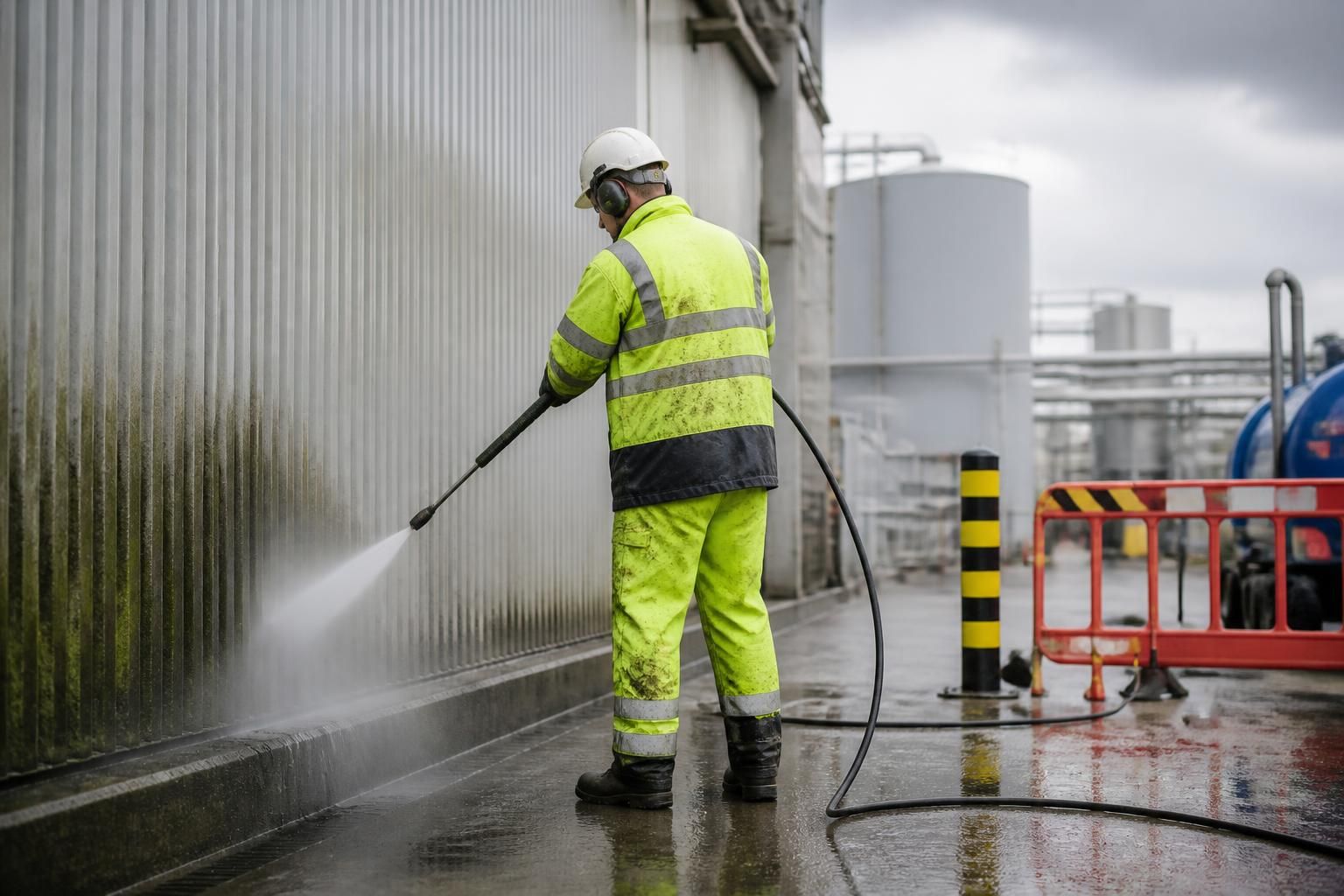
- Operators should be trained and competent in the equipment and cleaning techniques being used, including the risks associated with high-pressure water and hot-water systems.
- Appropriate personal protective equipment may include eye and face protection, waterproof protective clothing, gloves, safety footwear, hearing protection and respiratory protection where the assessment identifies a risk from aerosols, dust, chemicals or biological contamination.
- Pedestrians, employees, visitors and vehicles should be kept away from the cleaning area using barriers, signage, banksmen or temporary traffic controls where necessary.
- Hoses, cables and recovery equipment should be routed to reduce trip hazards and should not obstruct fire exits, access routes or emergency equipment.
- Operators should maintain secure control of the lance and use the correct nozzle, pressure and stand-off distance. A jet should never be directed at people, animals, unprotected electrical equipment or vulnerable building components.
- Wet surfaces can create an immediate slip hazard, so cleaning should be scheduled and controlled to limit access until surfaces have been checked and are safe to use.
Access equipment and work at height
Façades, roofs, canopies and elevated cladding often require a cherry picker, scissor lift, tower, scaffold or other access system. The selected equipment must suit the ground conditions, working height, reach, load, weather and the operator’s ability to control the jet safely from the platform. Access equipment should be inspected and used by people with suitable training, with ground-level exclusion zones established beneath the work area.
Where work at height is unavoidable, it should be planned to prevent falls and falling objects. Roof work requires particular care around fragile rooflights, unprotected edges, skylights and areas that may not support the equipment or operator. Wind, rain, ice and poor visibility can make elevated jet washing unsafe and may require the work to stop.
Equipment, pressure and chemical controls
Jet washing equipment should be maintained, inspected and operated in accordance with the manufacturer’s instructions. Hoses, couplings, trigger guns, lances, pumps, heaters and safety devices should be checked before use. Pressure should be selected for the surface and soil being removed; using excessive pressure can strip coatings, damage joints, force water behind cladding or enter building interiors.
Hot water and steam introduce additional burn and fire risks. Operators need controls for temperature, hose handling, fuel, ventilation and contact with heat-sensitive materials. Chemicals, detergents, biocides and degreasers should only be used where necessary and in accordance with their safety data sheets. Their storage, dilution, application and disposal should be controlled under the relevant COSHH assessment. A product described as biodegradable is not automatically suitable for discharge to a drain or watercourse.
Electrical, fire and site-specific hazards
Water and electricity must be kept apart. Electrical installations, sockets, lighting, control panels and temporary supplies should be identified before cleaning and protected or isolated where appropriate. Equipment used in wet conditions should be suitable for the environment, with cables and connections managed to reduce the risk of electric shock.
Industrial premises may contain combustible dust, flammable residues, fuels, gases or processes that cannot tolerate water ingress. The cleaning plan should account for these hazards and include isolation, ventilation or specialist controls where required. Cleaning around machinery should only take place once the client has confirmed that equipment has been safely shut down or protected.
Preventing contaminated run-off
Run-off is one of the most important environmental considerations in industrial jet washing. Water from cleaning can contain oils, fuels, detergents, metals, paint residues, cement, biological material, silt, microplastics or other contaminants. It should not be allowed to enter surface-water drains, streams, rivers, ponds or groundwater unless the discharge has been assessed and specifically authorised.
- Drainage points should be identified before work starts, including the distinction between foul and surface-water drainage.
- Drain covers, drain mats, bunding, temporary dams, booms or other suitable barriers can be used to prevent uncontrolled discharge.
- Dirty water should be collected using wet vacuums, recovery systems, pumps or other appropriate equipment rather than being left to flow across the site.
- Oil, chemical and sediment contamination should be kept separate where practical, as different waste streams may require different treatment or disposal.
- Any accidental release should be stopped, contained and reported through the agreed site emergency procedure.
Discharge to a foul sewer may require the consent of the relevant sewerage undertaker, particularly where the wastewater contains chemicals, oils or unusually high pollutant loads. If discharge cannot be authorised, the wastewater should be removed by an appropriately registered waste carrier and taken to a suitable permitted facility. The contractor and site operator should agree in advance who is responsible for approvals, sampling, records and disposal documentation.
Responsible use of water and energy
Water use should be proportionate to the cleaning objective. Effective pre-treatment, suitable nozzles, controlled working methods, pressure adjustment and recovery equipment can reduce unnecessary consumption without compromising the result. Hot-water systems may improve the removal of grease and oil, but their fuel use, ventilation requirements and potential impact on heat-sensitive surfaces should be considered before use.
Where appropriate, recovered water may be filtered and reused for compatible stages of the work, provided that doing so does not spread contamination or damage the surface. The priority should always be to prevent pollution rather than simply to reduce the volume of water used.
Waste, chemicals and site restoration
Sludge, silt, paint flakes, vegetation, oil residues, absorbent materials and contaminated disposable equipment should be collected and classified before disposal. Waste should be stored securely, kept from drains and transferred through the appropriate waste arrangements, with records retained where required. Waste should not be swept into drainage systems or mixed together if that could change its classification or make treatment more difficult.
After cleaning, the area should be inspected for remaining contamination, standing water, blocked drains, damaged coatings, displaced materials and trip hazards. Drain covers and temporary barriers should only be removed once the surrounding area is clean and the recovered water has been dealt with appropriately. The client should be informed of any defects, unexpected contamination or conditions that prevented the planned method from being used.
Evidence of competent and compliant working
For complex projects, it is reasonable to request evidence of operator training, equipment inspections, insurance, risk assessments, method statements, chemical safety information and waste-transfer arrangements. Depending on the work, the planning may also need to address work-at-height controls, lifting or access equipment inspections, pressure equipment, traffic management and environmental permits or sewer consents.
A responsible industrial jet washing service should be able to explain how it will protect people, buildings and drainage systems before arriving on site, not just respond to problems during the clean. Clear communication with the facilities manager, production team or principal contractor is essential where cleaning takes place near live operations, sensitive processes or the public.
For an industrial facility, the safest and most environmentally responsible approach is therefore a documented, site-specific plan covering access, equipment, operator protection, public safety, water and chemical use, run-off containment, waste disposal and post-work inspection. These controls should be reviewed if the surface, contamination, weather, access conditions or operational use of the site changes.
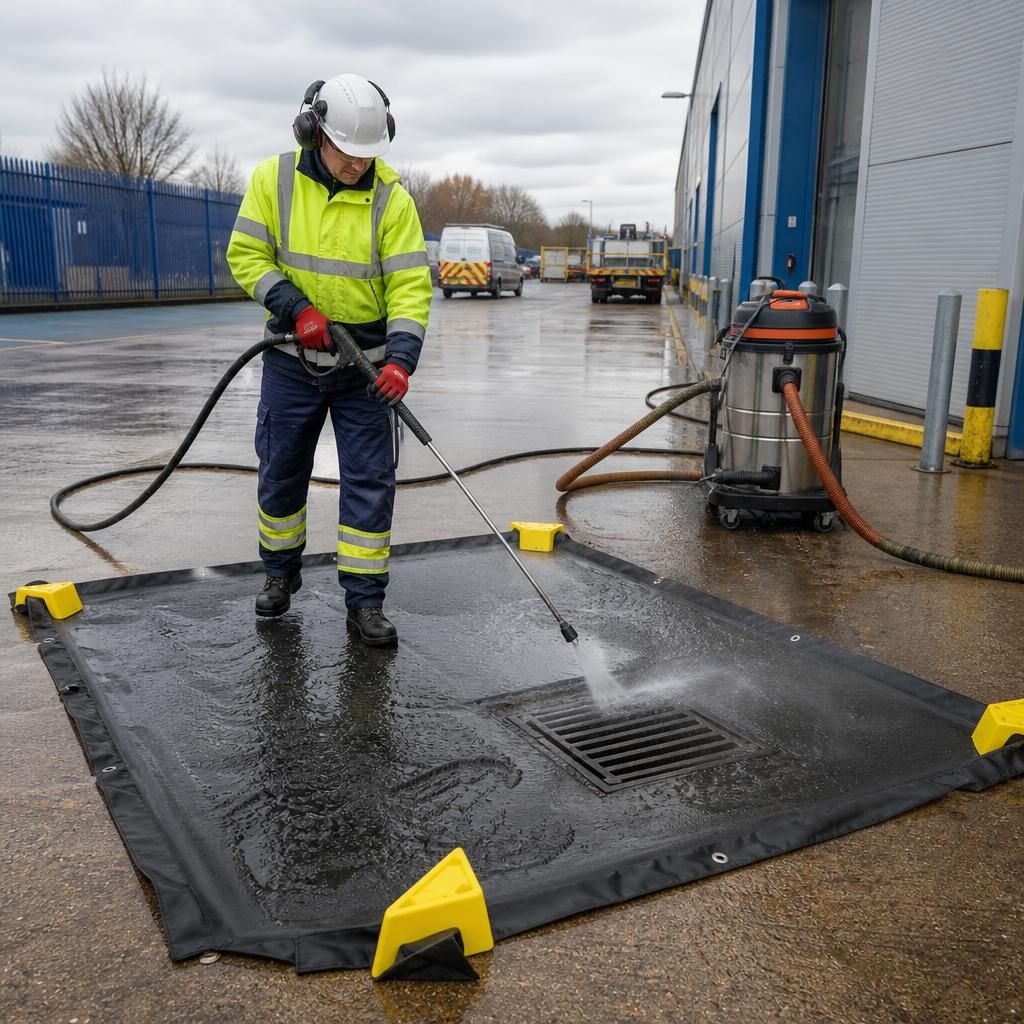
Environmental control in industrial jet washing means preventing contaminated water, oils, chemicals and debris from reaching surface-water drains, soil or nearby watercourses. Before cleaning starts, drainage points should be identified and suitable drain mats, bunding or temporary barriers installed where needed.
Dirty water should be recovered using wet vacuums, pumps or other suitable equipment, then assessed for lawful discharge or disposal. This approach protects the site, prevents pollution and provides a clear record of how wastewater and contaminated waste were managed.