
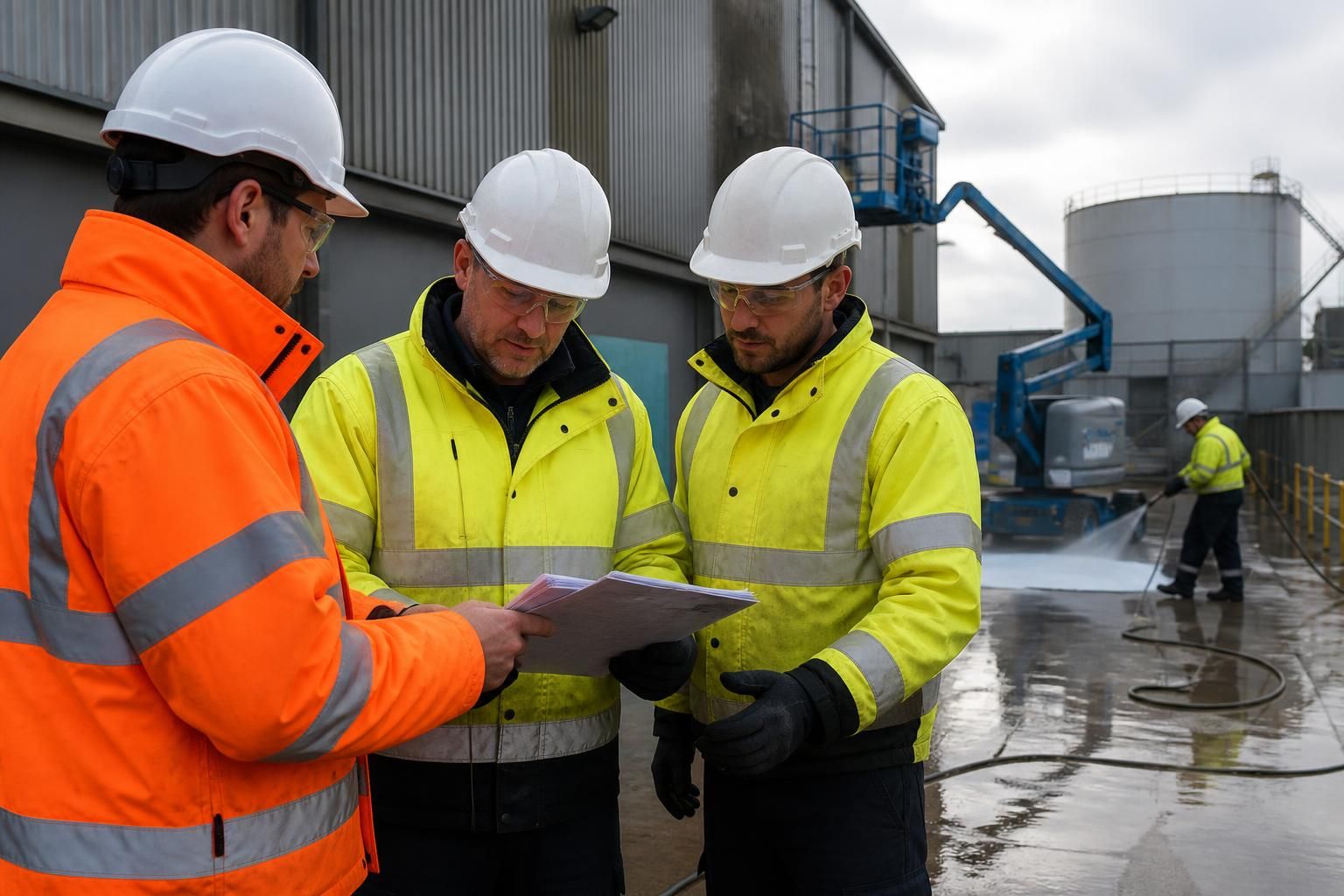
How can I ensure that the industrial jet washing service provider has the appropriate certifications and qualifications for handling complex cleaning projects?
Ask the provider for current evidence of relevant water-jetting training, risk-assessment and method-statement competence, plus operator qualifications for any access equipment used, such as IPAF or PASMA. Also verify suitable health and safety, environmental and quality-management systems, public and employers’ liability insurance, waste-disposal procedures and membership of recognised contractor assurance schemes, checking that certificates are in date and apply to the people and work involved.
The safest way to verify an industrial jet washing provider is to check evidence of individual operator competence, relevant water-jetting training, access-equipment qualifications, suitable management systems, insurance and site-specific planning. There is no single certificate that covers every industrial cleaning project, so the evidence must match the equipment, surfaces, access arrangements, water pressures, contaminants and environmental risks involved.
Start by checking the provider’s water-jetting competence. Ask which recognised training has been completed by the operatives who will carry out the work. Water Jetting Association training and certification are commonly used within the industry to demonstrate competence in operating water-jetting equipment safely. Confirm that the certificates relate to the type of work proposed, are current, and belong to the people attending your site rather than only to the company’s management team.
Training should cover more than simply operating a pressure washer. Competent operatives should understand pressure and flow hazards, reaction forces, hose management, nozzle selection, exclusion zones, safe start-up and shut-down procedures, equipment inspection and emergency arrangements. If the project involves specialist techniques such as ultra-high-pressure cleaning, abrasive injection, vacuum recovery or cleaning in a confined space, ask for evidence that the team has been trained for those specific activities.
Check qualifications for access equipment separately. Jet washing may require mobile elevating work platforms, towers, scaffolds, suspended access systems or other equipment. Operators of powered access equipment should hold appropriate IPAF training, while users of mobile access towers should have suitable PASMA training where applicable. These qualifications do not automatically cover every type of machine, so check that the category of equipment and the planned method of use are appropriate. The provider should also be able to demonstrate inspection, maintenance and pre-use-check arrangements for access equipment.
Additional competence may be necessary where the work involves particular hazards. Depending on the site and task, this can include:
- confined-space training and rescue arrangements;
- working-at-height competence and suitable fall-protection training;
- asbestos awareness where older buildings or suspect materials are present;
- chemical awareness and COSHH assessment for detergents, degreasers or biocides;
- electrical-safety procedures, including isolation requirements near electrical installations;
- traffic-management competence for work in active yards, car parks or roads; and
- training for spill response, contaminated water control and the handling of hazardous waste.
Request the provider’s management documentation before work starts. A suitable contractor should be able to provide a project-specific risk assessment and method statement, often referred to as RAMS. These documents should identify the surfaces and contaminants, proposed pressure and temperature, chemicals, water supply, access method, exclusion zones, personal protective equipment, public protection, drainage controls and emergency procedures. Generic documents copied from another job are not sufficient evidence of competence.
For complex work, review the RAMS with the contractor rather than treating it as a paperwork exercise. Check that the proposed method explains how damage to cladding, masonry, coatings, sealants, roofing membranes, joints and drainage systems will be prevented. It should also identify how the team will test an unfamiliar surface, control overspray and protect nearby vehicles, staff, electrical equipment and building entrances.
Verify the company’s wider health, safety and environmental systems. An independently audited management standard can provide useful evidence that procedures are documented and reviewed, although certification does not replace checking the actual project arrangements. Relevant systems may include quality management, environmental management and occupational health and safety management certifications. Ask to see the certificate, its scope, the issuing or auditing body, expiry date and any limitations. The scope should cover the exterior cleaning services and locations relevant to your contract.
Membership of a recognised contractor-assurance or pre-qualification scheme can offer additional reassurance, particularly for facilities with formal procurement requirements. However, approval on a scheme is not proof that every operative is qualified for every task. Confirm what was assessed, when it was assessed and whether the accreditation remains active. It is reasonable to request current evidence rather than relying on a logo in a quotation or on a website.
Check insurance and legal responsibilities. Ask for current employers’ liability and public liability insurance certificates, and consider whether the level and scope of cover are suitable for the value and risks of the project. Where the work could affect the structure, waterproofing, machinery or specialist finishes, ask whether the contractor’s policy covers accidental damage arising from the proposed activities. Insurance evidence should show the insured business name, policy period and relevant activities. It should not be confused with a qualification or an assurance of technical competence.
Environmental compliance is particularly important in jet washing because contaminated water, detergents, oil residues, paint particles and other debris must not be allowed to enter surface-water drains or the surrounding ground without appropriate controls. Ask how wastewater will be contained, tested if necessary, recovered and disposed of. The contractor should explain whether drain covers, bunding, vacuum recovery, filtration or a foul-drain discharge arrangement will be used, and who has authorised any discharge. Confirm that waste is transferred through an appropriate, documented route and that waste transfer records will be supplied where required.
Use a practical verification process:
- Describe the work accurately, including the surfaces, height, contamination, operating environment and required finish.
- Request a schedule of the qualifications held by the proposed operatives, supervisors and access-equipment users.
- Check certificate holders’ names, training categories, issuing bodies, validity dates and any restrictions.
- Ask for the relevant insurance, management-system and contractor-assurance documents.
- Review a site-specific risk assessment, method statement and environmental plan before mobilisation.
- Confirm that equipment inspections, water controls, chemical assessments and emergency arrangements are documented.
- Verify the evidence with the issuing organisation or insurer if a certificate appears unclear, expired or inconsistent.
- Record the agreed competence requirements in the purchase order or service contract.
On arrival, the site supervisor should be able to identify the trained operatives, explain the RAMS and complete a site briefing or induction. Ask to see relevant operator cards or certificates if this is part of your site-control process. Stop and review the arrangement if the attending team, equipment or cleaning method differs materially from what was assessed.
Finally, do not select a provider solely on the basis of the lowest price or the largest list of certificates. The strongest evidence is consistent: appropriately trained people, correctly maintained equipment, clear RAMS, suitable insurance, controlled wastewater and a willingness to explain how the qualifications apply to your specific facility. Keeping copies of the documents, briefing records, inspection records and waste documentation will also provide a useful audit trail for ongoing industrial cleaning contracts.
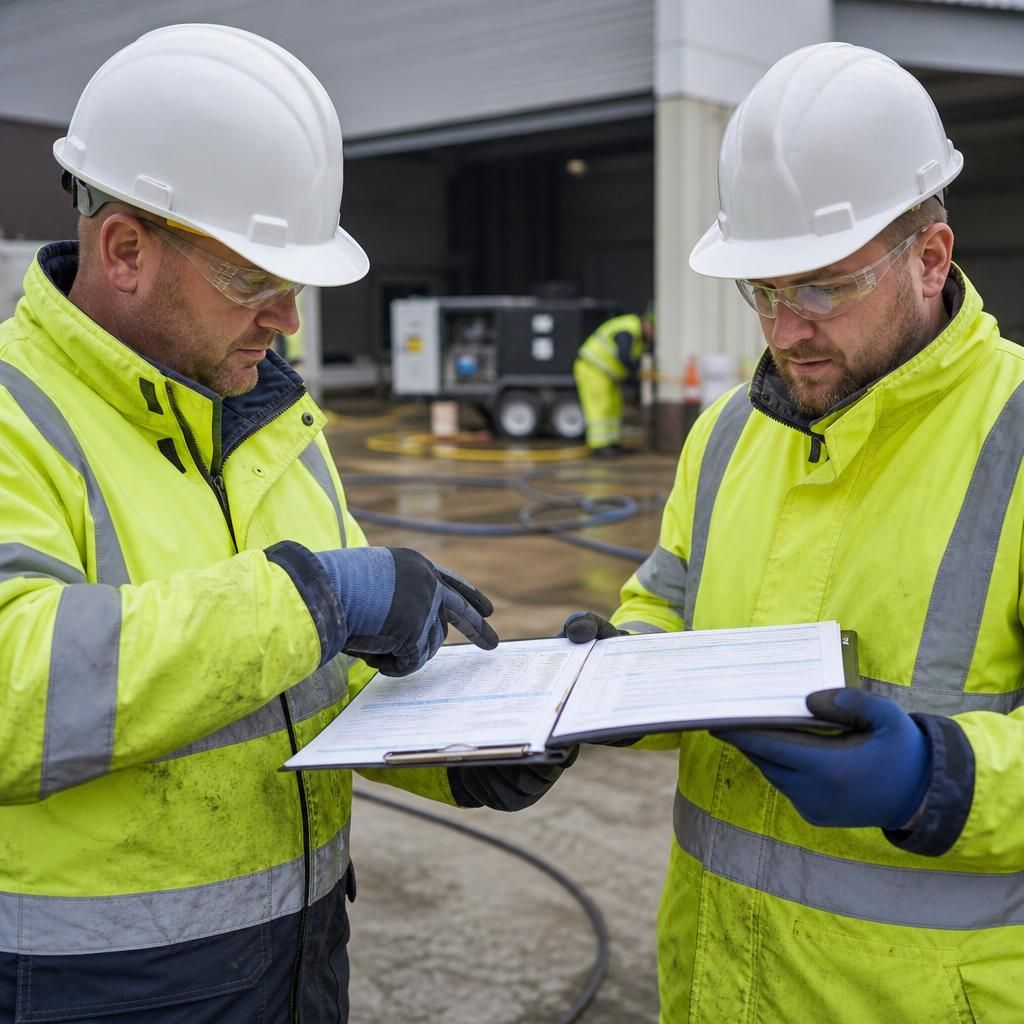
Appropriate certification means the qualifications and training held by the attending team match the equipment, access method, pressure, contaminants and risks of the proposed cleaning work. A company certificate alone does not prove that every operative is competent for every task.
Before work begins, request current evidence of recognised water-jetting training, access-equipment competence and any additional training required for confined spaces, work at height, chemicals or contaminated wastewater. Check the certificate holders’ names, scope, issuing body and expiry dates, then compare these details with the project-specific risk assessment and method statement. This confirms that the people carrying out the work have been assessed for the actual conditions at your facility.
Verify your industrial jet washing provider’s qualifications
Contact Encanto Exterior Cleaning to review your industrial jet washing requirements, site risks and required qualifications before work begins. We can provide the relevant competence, RAMS, insurance and environmental documentation for your project.