
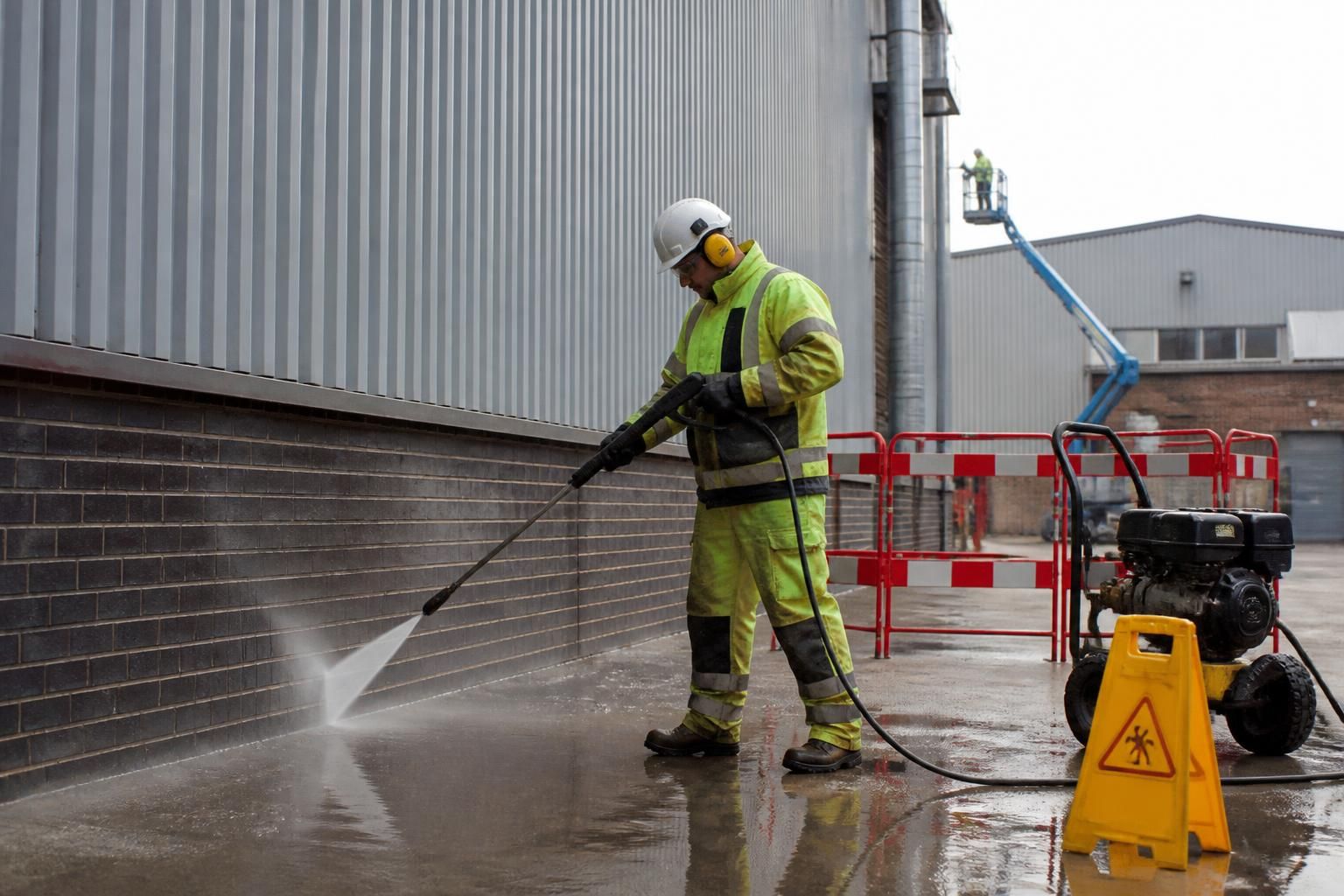
What safety measures should be implemented during industrial jet washing?
Industrial jet washing should be carried out under a documented risk assessment and method statement, with trained operatives using suitable personal protective equipment (PPE), inspected equipment and controlled exclusion zones. Operators must also manage water, chemical and electrical hazards, protect nearby people and surfaces, and follow site-specific access, traffic and environmental controls.
Industrial jet washing should be carried out under a site-specific risk assessment and method statement (RAMS), by trained and competent operatives using inspected equipment, suitable personal protective equipment (PPE) and controlled work areas. The main safety measures are designed to prevent high-pressure injection injuries, slips, falls, exposure to chemicals, contact with electricity, damage to property and risks to members of the public or other site users.
Risk assessment and method statement
Before work starts, the contractor should assess the surface, water pressure, equipment, access arrangements, drainage, nearby activities and likely hazards. The RAMS should explain the cleaning method, operating limits, required PPE, exclusion zones, emergency arrangements and how waste water will be contained or removed. It should also account for site-specific risks such as vehicle movements, fragile roofs, overhead services, confined areas, occupied premises and vulnerable surfaces.
The assessment should be reviewed if conditions change. For example, a different nozzle, cleaning chemical, access method or pressure setting may introduce additional risks. Operatives should receive a site briefing and understand who is responsible for stopping work if an unsafe condition develops.
Competent operatives and safe working practices
Jet washing should only be undertaken by operatives who have been trained to use the relevant pressure-washing equipment and understand the surfaces being treated. They should be able to recognise unsafe pressure reactions, unstable access equipment, damaged hoses and signs of electrical or chemical hazards. Operators should maintain a stable stance, keep both hands on the lance when required, avoid directing the jet towards people or animals, and never leave pressurised equipment unattended.
High-pressure water can cause serious injection injuries even where the wound appears small. The lance must never be pointed at a person, and an injury involving a high-pressure jet requires urgent medical attention. Operatives should not attempt to continue working or treat such an injury as a minor cut.
Personal protective equipment
PPE should be selected following the risk assessment rather than treated as a substitute for other controls. Depending on the work, this may include:
- Water-resistant protective clothing or coveralls to reduce exposure to contaminated spray and cleaning products.
- Safety footwear with suitable grip and protection against wet surfaces and falling objects.
- Eye protection or a full face shield to protect against rebound, debris and chemical splashes.
- Hearing protection where equipment or surrounding machinery creates hazardous noise levels.
- Waterproof, chemical-resistant gloves appropriate to the products being used.
- Head protection and high-visibility clothing where overhead, construction or vehicle risks are present.
- Respiratory protection where the risk assessment identifies harmful mist, dust or vapour that cannot be adequately controlled by other means.
PPE should be inspected before use, kept clean and replaced when damaged or no longer provides effective protection. Wet-weather clothing and gloves must not restrict the operator’s grip or movement.
Equipment inspection and maintenance
Pressure washers, pumps, lances, trigger guns, hoses, couplings and electrical leads should be checked before each use. Operatives should look for cuts, bulges, exposed wires, damaged plugs, leaking connections, worn seals and faulty safety devices. Hoses should be routed to avoid sharp edges, hot surfaces, vehicle routes and trip hazards, and connections should be secured before the system is pressurised.
Equipment should be used within the manufacturer’s operating limits and maintained under an appropriate inspection and servicing regime. Where applicable, work equipment should be managed in line with the Provision and Use of Work Equipment Regulations (PUWER), while electrical supplies and portable equipment should be suitable for the wet environment and protected by appropriate residual current protection. Petrol or diesel-powered units must not be operated in enclosed areas unless adequate ventilation has been confirmed.
Operatives should select the correct nozzle, lance and pressure setting for the task. Starting at a lower setting and increasing it only when necessary helps reduce the risk of losing control, damaging the substrate or creating excessive rebound.
Exclusion zones and protection of other people
A clearly defined exclusion zone should be established around the cleaning area. Barriers, cones and warning signs should prevent pedestrians, visitors and unauthorised workers from entering the spray area. The zone should be large enough to account for overspray, ricochet, falling debris, hose movement and water running across the ground.
Where work takes place near entrances, walkways or occupied premises, the cleaning operation may need to be phased, redirected or scheduled outside busy periods. A banksman or other designated person may be required to control access, assist with vehicle movements or monitor the area while the operator concentrates on the equipment.
Traffic management is particularly important on car parks, service yards, roads and construction sites. Vehicles should be kept away from hoses and wet surfaces, and temporary closures or diversions should be used where necessary. Members of the public should not be expected to walk through an area affected by spray, runoff or loose debris.
Work at height and access equipment
Cleaning from roofs, elevated platforms, façades and other high-level locations requires a separate assessment of fall risks. The safest practical method should be selected, which may involve ground-based equipment, water-fed systems, mobile elevating work platforms, scaffold or other access equipment. Ladders should not be used as a substitute for a suitable work platform where the task requires force, extended reach or prolonged work.
Access equipment must be suitable, inspected and positioned on stable ground. Operatives should use guardrails, harnesses or other fall-protection measures where required, and should account for the reaction force from the jet, wind, wet surfaces and the possibility of falling tools or debris. A rescue plan should be in place where a fall-arrest system or elevated access equipment is used. Work at height should be managed in accordance with the Work at Height Regulations.
Electrical, chemical and contamination controls
Water and electricity present a serious combined hazard. Electrical installations, cables, sockets, lighting, plant and temporary supplies should be identified before cleaning. Items that cannot be safely isolated or protected should not be sprayed. Leads and connections must be kept away from standing water, and equipment should be suitable for the conditions.
Cleaning chemicals should only be used where necessary and in accordance with their safety data sheets. The risk assessment should cover storage, dilution, labelling, application, ventilation, PPE and emergency actions. Chemicals must never be mixed unless the manufacturer’s instructions specifically permit it. COSHH controls should be followed where substances could harm people or the environment.
Surfaces contaminated with oil, biological material, bird fouling, mould, lead residues or other hazardous substances may require additional controls. The operator should prevent contaminated spray and sludge from reaching clean areas, drains, watercourses or unprotected personnel. Suitable containment, collection and disposal arrangements should be agreed before work begins.
Slip, trip and runoff prevention
Jet washing creates wet surfaces, hose runs and potentially slippery deposits. Hoses should be positioned safely, water should be directed towards an approved collection point, and pedestrians should be kept away until surfaces are safe to use. Where appropriate, the area should be squeegeed, vacuumed, dried or monitored until the slip risk has reduced.
Drainage routes should be identified before cleaning. Runoff containing silt, oil, detergents, paint residue or other contaminants must not be allowed to enter surface-water drains or watercourses without suitable controls. Drain covers, bunding, wet vacuums, temporary dams or other containment methods may be required. The waste should then be handled and disposed of in accordance with the relevant site and environmental requirements.
Weather and site conditions
Wind can carry spray, debris and chemicals beyond the intended work area, while freezing conditions can create ice and unstable footing. Rain, poor visibility, lightning, excessive heat and high winds may make the operation unsafe, particularly when working at height or near electrical equipment. The supervisor should monitor conditions and pause or change the method when controls are no longer effective.
Surfaces should also be checked for instability, loose coatings, damaged masonry, fragile cladding and hidden defects. Jet washing can dislodge weak material, so nearby glazing, vents, signage, seals, joints and delicate finishes should be protected or excluded from the cleaning method.
Emergency arrangements and completion checks
The site team should know how to stop and isolate the equipment quickly, summon assistance, report an injury and deal with a spill or uncontrolled discharge. First-aid arrangements, access for emergency services and the location of relevant safety information should be confirmed before work starts. Any incident, near miss, equipment failure or unexpected surface damage should be recorded and investigated.
On completion, the operator should depressurise and isolate the equipment, remove barriers only when the area is safe, inspect the cleaned surface and check that drains, access routes, doors, plant and nearby property have not been adversely affected. A responsible person should confirm that excess water, debris, hoses and equipment have been removed and that the premises can be returned to normal use.
For larger or higher-risk projects, these controls should be coordinated with the client’s site rules and other contractors. Clear communication before, during and after the work is essential: industrial jet washing is safest when the cleaning method, access arrangements, exclusion zone, water controls and emergency response are agreed before the equipment is switched on.
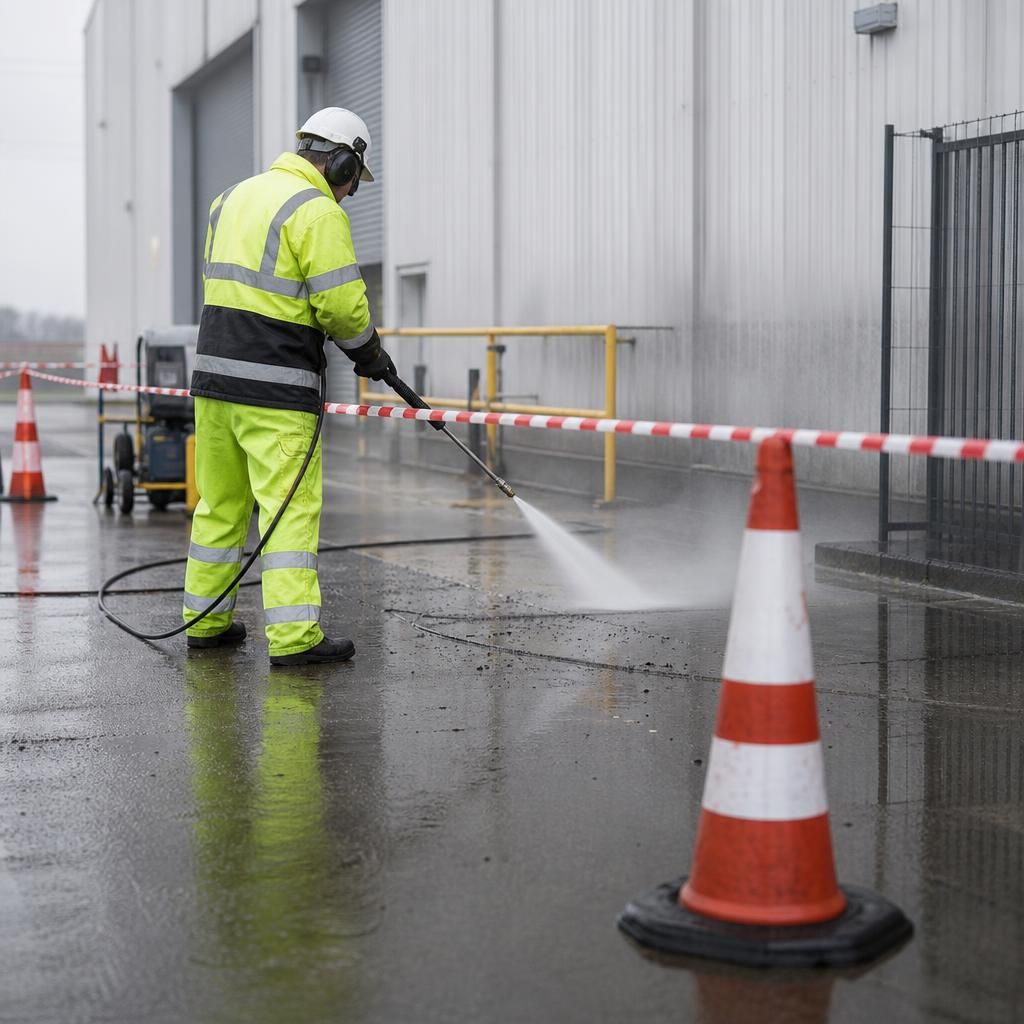
An exclusion zone is a controlled area around the jet-washing operation that prevents people, vehicles and unprotected property from being exposed to high-pressure spray, rebound, falling debris, hoses or contaminated runoff.
Before work starts, the operator should establish the zone according to the equipment, surface, spray direction and surrounding activities. Barriers, cones and clear warning signs should be used, with access restricted to authorised personnel. On busy sites, cleaning may need to be scheduled outside peak periods, with a designated person managing pedestrians and vehicle movements.
The area should remain controlled until spraying has stopped, equipment has been depressurised, standing water and debris have been removed, and the surface is safe for normal use. This is particularly important around entrances, car parks, service yards, public footways and occupied premises.