
What safety measures are in place during industrial jet washing operations?
Industrial jet washing operations are controlled through site-specific risk assessments, trained operators, pre-use equipment checks and appropriate personal protective equipment (PPE), including eye, hearing and slip-resistant protection. Work areas are secured with barriers and warning signs, while operators control water pressure, manage hoses and runoff, and coordinate with site personnel to protect people, property and surrounding surfaces.
Industrial jet washing is controlled through a combination of site-specific risk assessments, trained operators, suitable personal protective equipment (PPE), equipment inspections and secure work areas. These measures reduce the risks associated with high-pressure water, flying debris, noise, slips, access equipment, electrical services, chemicals, traffic and contaminated runoff.
Before work starts, the team reviews the site and prepares suitable risk assessments and method statements. This includes identifying the surfaces to be cleaned, the required water pressure and temperature, nearby buildings and vehicles, access restrictions, overhead or buried services, drainage arrangements and the presence of employees, members of the public or other contractors. The planned method is adjusted where conditions change, such as during poor weather, unexpected surface defects or changes to site access.
Only operators with the appropriate training, instruction and practical competence should use industrial jet washing equipment. Operators must understand the equipment controls, safe lance handling, hose management, pressure selection, emergency procedures and the hazards associated with the surface and contaminants being removed. Site-specific inductions and coordination with the client’s representative are also important where cleaning takes place within an active industrial, commercial or construction environment.
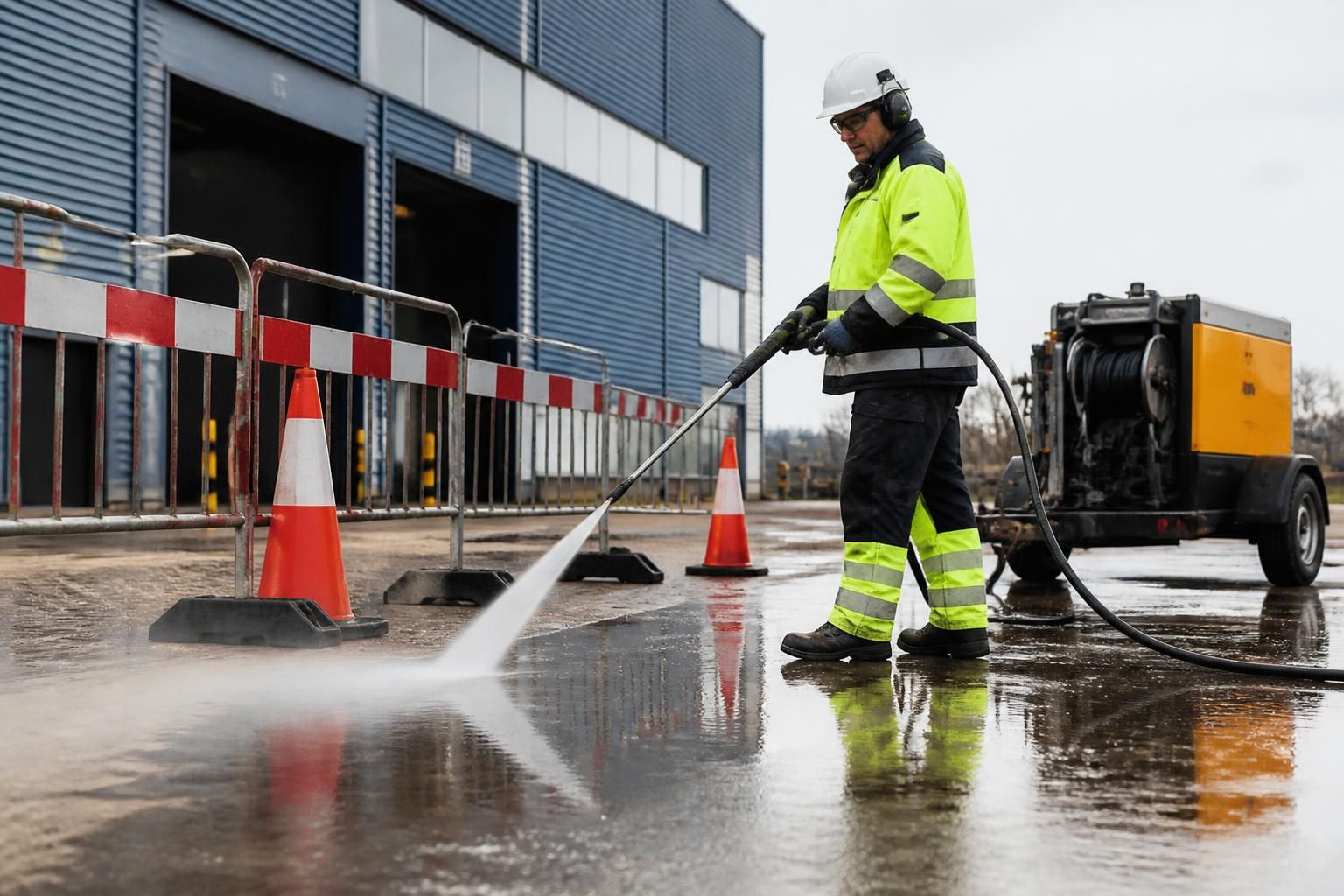
Appropriate PPE is selected according to the work involved. This may include:
- Eye or face protection to guard against spray, particles and dislodged debris.
- Water-resistant protective clothing and gloves suitable for the equipment and any cleaning products used.
- Slip-resistant safety footwear to improve grip on wet surfaces.
- Hearing protection where pumps, machinery or confined areas create potentially harmful noise levels.
- Safety helmets, high-visibility clothing or respiratory protection where the site risk assessment identifies a need.
PPE is an important final layer of protection, but it does not replace safe planning, suitable equipment or control of the work area. PPE must be correctly fitted, kept in good condition and replaced if it becomes damaged or contaminated.
Jet washing equipment is checked before use. Operators look for damage to hoses, lances, trigger guns, couplings, seals, guards and electrical connections, as well as signs of leaks or abnormal operation. Connections are secured, safety devices are present and the equipment is used in line with the manufacturer’s instructions. Defective equipment is removed from service rather than being used until a problem becomes more serious.
Pressure, flow rate and water temperature are set to suit the surface and the cleaning objective. Operators maintain a controlled stance, keep both hands on the lance where required and avoid directing the jet towards people, animals, vehicles, glazing, vulnerable joints or unprotected electrical equipment. The nozzle is not left unattended while the system is pressurised, and the equipment is isolated before adjustments, clearing blockages or maintenance.
The work zone is secured before cleaning begins. Barriers, cones and warning signs help keep pedestrians and unauthorised personnel away from the jet, spray and wet surfaces. Where vehicles or plant operate nearby, the cleaning area may require a traffic management arrangement, a spotter or agreed exclusion zones. Access points are controlled, and the team communicates with site personnel before starting, pausing or moving the operation.
Hoses are routed to minimise trip hazards, sharp bends and damage from vehicles or machinery. They are kept as clear as practicable from walkways and protected where they must cross an access route. The team also monitors the ground for pooling water, algae, loosened debris and other slip hazards, keeping completed areas controlled until they are safe for normal use.
Work at height is planned separately rather than relying on the jet lance to compensate for unsafe access. Suitable access equipment, edge protection, harness systems or other controls are used where the risk assessment requires them. Access equipment is positioned on stable ground, operated by competent personnel and kept clear of the spray zone. Operators avoid working beneath unsecured materials or areas where cleaning could dislodge masonry, coatings, fittings or other debris.
Electrical risks are assessed before water is introduced. Electrical installations, cables, sockets and equipment are isolated, protected or kept outside the spray area where necessary. Jet washing equipment is connected and operated using suitable electrical protection, and operators do not use water to clean around exposed or damaged electrical components. Any uncertainty about an electrical installation is referred to the responsible site representative before work proceeds.
Where detergents, degreasers or other cleaning chemicals are needed, they are selected for the surface and used in accordance with their safety information and manufacturer’s instructions. Operators use the required chemical-resistant PPE, control access to the application area and prevent incompatible products from being mixed. Product containers are labelled and stored safely, and any chemical spill is dealt with using the site’s agreed procedure.
Runoff and removed contaminants are managed as part of the cleaning method. The team considers nearby drains, watercourses, soil, planted areas and sensitive surfaces before work begins. Drain protection, containment, wet vacuum recovery or controlled collection may be used where necessary. Contaminated water, silt, oil residues, paint particles or chemical solution must not be allowed to enter drainage systems or the wider environment without appropriate controls and disposal arrangements.
Operators maintain communication throughout the task and stop work if a new hazard appears. Examples include an unauthorised person entering the exclusion zone, loss of stable footing, equipment malfunction, unexpected damage to the surface, a blocked drainage route or changing weather conditions. In an emergency, the equipment is shut down, the area is made safe and the site’s first-aid, reporting and escalation procedures are followed.
These controls are reviewed before and during each industrial jet washing operation. The precise measures depend on the site, surface, access arrangements, equipment and contaminants involved, so a safe method cannot be based on pressure washing alone. A properly planned operation protects workers, site users, property and surrounding areas while allowing the cleaning work to be completed in a controlled manner.
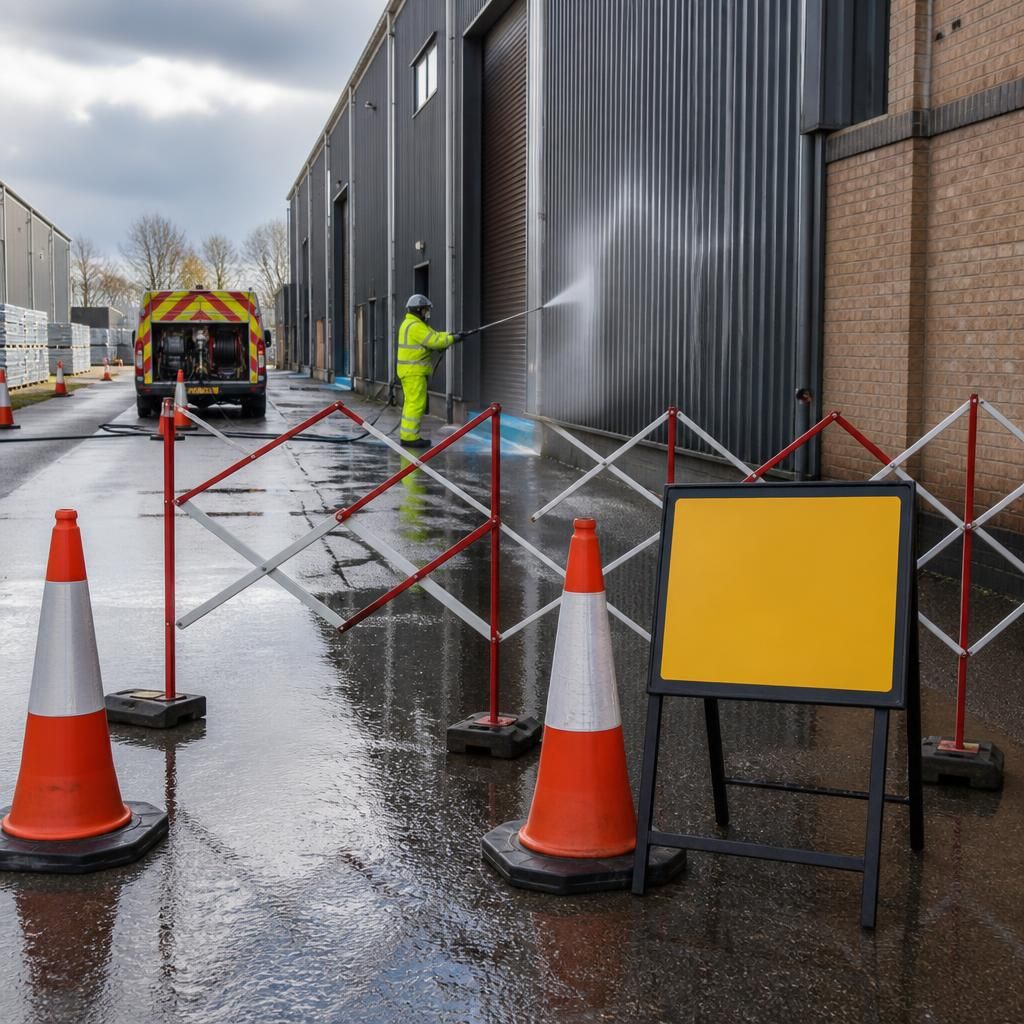
A secure exclusion zone is one of the most important safety measures during industrial jet washing. Barriers, cones and warning signs keep employees, visitors and passing vehicles away from high-pressure spray, dislodged debris, equipment and wet surfaces.
Before work begins, the cleaning team agrees access arrangements with the site contact and identifies nearby walkways, entrances, loading areas and vehicle routes. Hoses are routed away from pedestrian paths where possible, while any unavoidable crossings are protected and clearly marked. The area remains controlled until the surface is safe to use and pooled water or debris has been removed.
Where cleaning takes place in an active commercial, industrial or construction environment, the exclusion zone may also require traffic management, a designated spotter or temporary changes to site access. Operators pause the work if an unauthorised person enters the area or conditions make the agreed controls ineffective.