
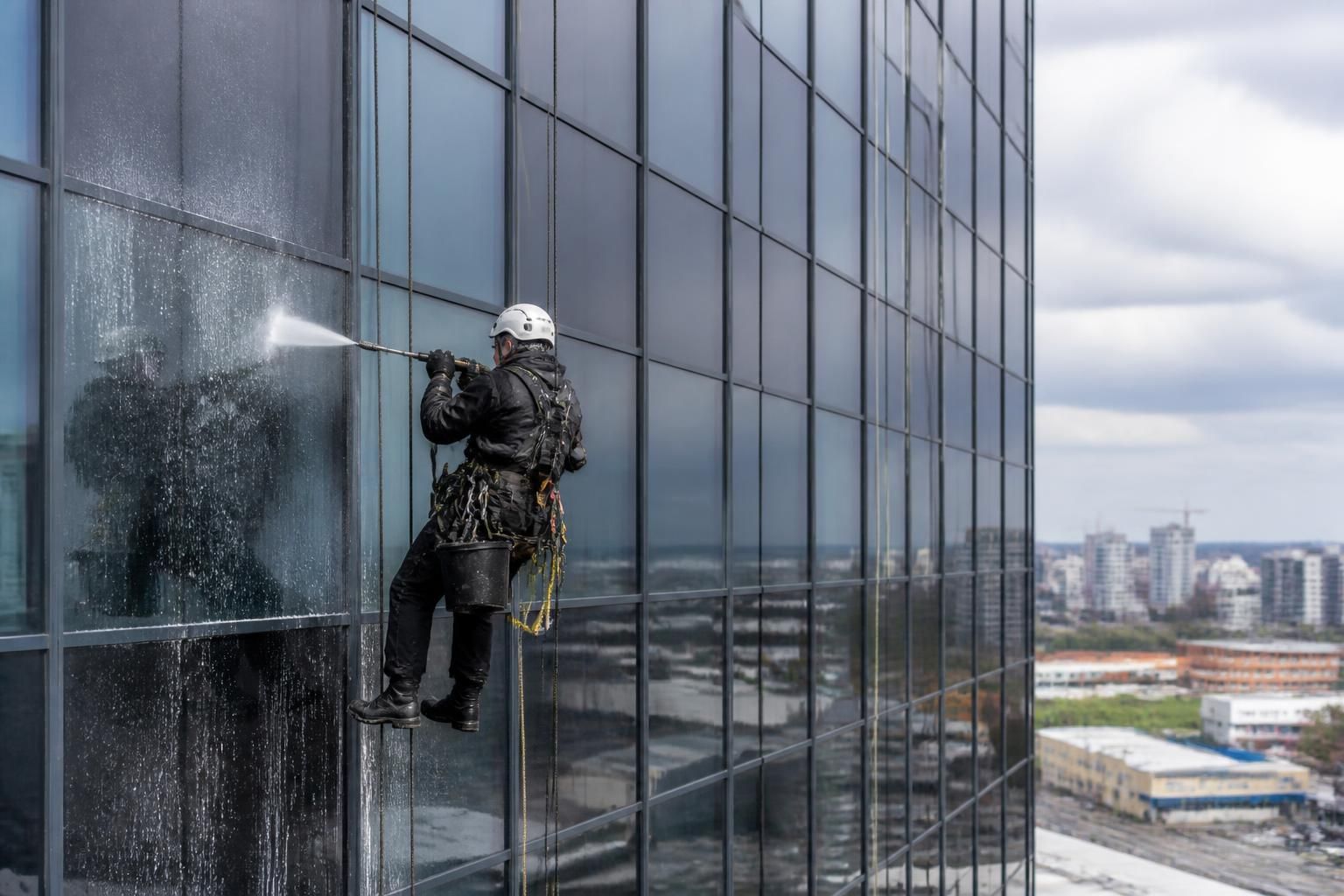
What advanced equipment and techniques are employed for efficient high-rise jet washing?
Efficient high-rise jet washing combines adjustable pressure-washing and steam-cleaning systems with telescopic water-fed poles, rope-access equipment and, where suitable, mobile elevated work platforms. Technicians select pressure, temperature, cleaning agents and access methods for the façade material and contamination, while controlled rinsing and recovery procedures help protect the building and surrounding areas.
Efficient high-rise jet washing relies on a combination of adjustable pressure-washing systems, steam-cleaning equipment, specialist access methods and controlled cleaning techniques. The equipment is selected according to the building’s height, façade material, access restrictions, type of contamination and requirements for water management. This allows technicians to remove dirt effectively without applying unnecessary pressure, heat or chemical treatment to the building.
Adjustable pressure-washing systems
Professional pressure-washing units provide a controlled flow of water at a pressure suitable for the surface being cleaned. Operators can adjust the pressure, flow rate and spray pattern rather than treating every area at the same intensity. Lower-pressure cleaning may be appropriate for delicate render, painted surfaces, joints and older masonry, while more robust concrete or hard-surfaced areas may tolerate a stronger setting following an assessment.
Different nozzles and lance configurations help control the shape and reach of the water jet. Fan sprays distribute water across a wider area, while more concentrated patterns can target localised deposits. The operator keeps the lance at a suitable distance and works methodically to reduce the risk of etching, surface damage, water penetration or disturbance to pointing and sealants.
Steam-cleaning equipment
Steam cleaning uses heated water to soften and lift contamination with less reliance on aggressive pressure or chemical products. It is particularly useful for atmospheric staining, organic growth, grease, residues and some forms of graffiti, although the precise method depends on the substrate. Hot-water and steam systems can also improve cleaning efficiency where cold water would require repeated passes.
Temperature is controlled to suit the material. Excessive heat can affect coatings, plastics, sealants and certain cladding finishes, so technicians assess the surface and test an inconspicuous area before proceeding. Steam cleaning is often combined with gentle agitation or a compatible cleaning product where deposits are bonded to the façade.
Telescopic water-fed poles
Telescopic water-fed poles allow operatives to clean many elevations from ground level or from a suitable lower access point. Water is delivered through the pole to a brush or rinse head, reducing the need for ladders and making the method useful for windows, cladding, signs and accessible façade sections.
Pure or treated water may be used for final rinsing where appropriate. This helps limit spotting on glass and reduces the need for wiping at height. Pole systems are not suitable for every high-rise elevation, particularly where the building is set back, obstructed or beyond the practical reach of the equipment, but they can improve productivity and reduce access requirements on suitable areas.
Rope-access systems
Rope access enables trained technicians to reach elevations that cannot be cleaned effectively from the ground or from a platform. Operatives descend or position themselves using dedicated working and safety lines connected to suitable, assessed anchor arrangements. Hoses, lances, brushes and other tools are managed so that they remain controlled while the technician works across the façade.
This approach is useful for towers, narrow elevations, recessed areas and locations where a large access machine cannot be positioned. Before work begins, the building and its anchor points are assessed, access and rescue arrangements are established, and exclusion zones are set below the work area. Rope access is therefore part of a planned system of work rather than simply a way to reach a greater height.
Mobile elevated work platforms
Where there is adequate ground space and suitable bearing capacity, a mobile elevated work platform can provide a stable working position close to the façade. Scissor lifts, boom lifts and other platforms may be considered for sections of a building, particularly where technicians need to carry equipment or inspect the surface closely while cleaning.
Platform selection depends on required reach, working position, access routes, ground conditions, overhead obstructions and the presence of traffic or pedestrians. The equipment must be operated by competent personnel and positioned in accordance with the site assessment. A platform may be used alongside pole systems or rope access rather than as a single solution for the entire building.
Specialist surface-cleaning tools
Jet washing is supported by equipment such as soft-bristle brushes, non-abrasive pads, surface cleaners, extension lances and controlled rinse systems. These tools help technicians work on different materials without relying solely on water pressure. For example, brushing can loosen biological growth, while a surface-cleaning attachment can help control spray on broad, hard-wearing areas.
Graffiti removal may require a low-pressure system, steam, a substrate-compatible remover or gentle abrasive treatment. The chosen method depends on the paint, the underlying surface and the risk of altering the façade finish. Test cleaning is important because a method that works on bare concrete may be unsuitable for coated metal, brickwork, stone or rendered panels.
Water management and recovery
High-rise cleaning can generate contaminated run-off containing dirt, biological material, cleaning residues and removed coatings. Drain covers, temporary bunding, collection equipment and controlled discharge arrangements may be used where the site assessment identifies a risk to surface-water drains, landscaping, entrances or occupied areas. Where necessary, water is collected and handled in line with the agreed environmental controls.
Hose routing and water delivery are also planned carefully. Technicians use suitable hoses, reels, pumps and shut-off controls to maintain a consistent supply without creating trip hazards, excessive loading or uncontrolled discharge. Good water management protects the building and surrounding property while helping the cleaning team work continuously and efficiently.
Surface assessment and test cleaning
The most important technique is matching the cleaning process to the façade. Before full-scale work, technicians review the construction materials, existing coatings, joints, drainage points, previous repairs and visible defects. They consider whether the contamination is atmospheric dirt, algae, moss, oil, bird fouling, efflorescence, rust staining or graffiti, as each deposit may respond differently.
A small test area allows the team to check pressure, temperature, dwell time, agitation, chemical compatibility and rinsing requirements. The results are used to establish a method that removes the contamination while preserving the surface finish. This reduces the likelihood of streaking, patchiness, colour variation or damage caused by using an unnecessarily aggressive process.
Controlled application and rinsing
Technicians generally work in planned sections, keeping the cleaning path and overlap consistent. Cleaning agents, where required, are applied in a controlled manner and allowed sufficient contact time to break down the contamination. They are not left to dry on the surface, and adjacent materials are protected from unintended contact.
Rinsing is carried out thoroughly, using a pressure and flow suitable for the façade and the surrounding details. Particular care is taken around windows, vents, electrical fittings, movement joints, sealants and areas where water could enter the building. A final inspection from suitable viewpoints helps identify missed deposits, runs or areas requiring additional treatment.
How the equipment works together
High-rise jet washing is rarely based on one machine alone. A project may combine ground-based water-fed poles for accessible glazing, a heated pressure system for heavily soiled areas, rope access for upper elevations and a mobile platform for detailed work around entrances or projecting features. This combined approach avoids using a high-pressure jet where a gentler method would be more appropriate and avoids deploying complex access equipment where simpler equipment is sufficient.
Equipment and techniques are reviewed as work progresses, particularly if the façade contains different materials or the contamination varies between elevations. The result is a controlled cleaning process that improves coverage, limits unnecessary water and chemical use, and protects the condition of the building while maintaining an efficient programme.
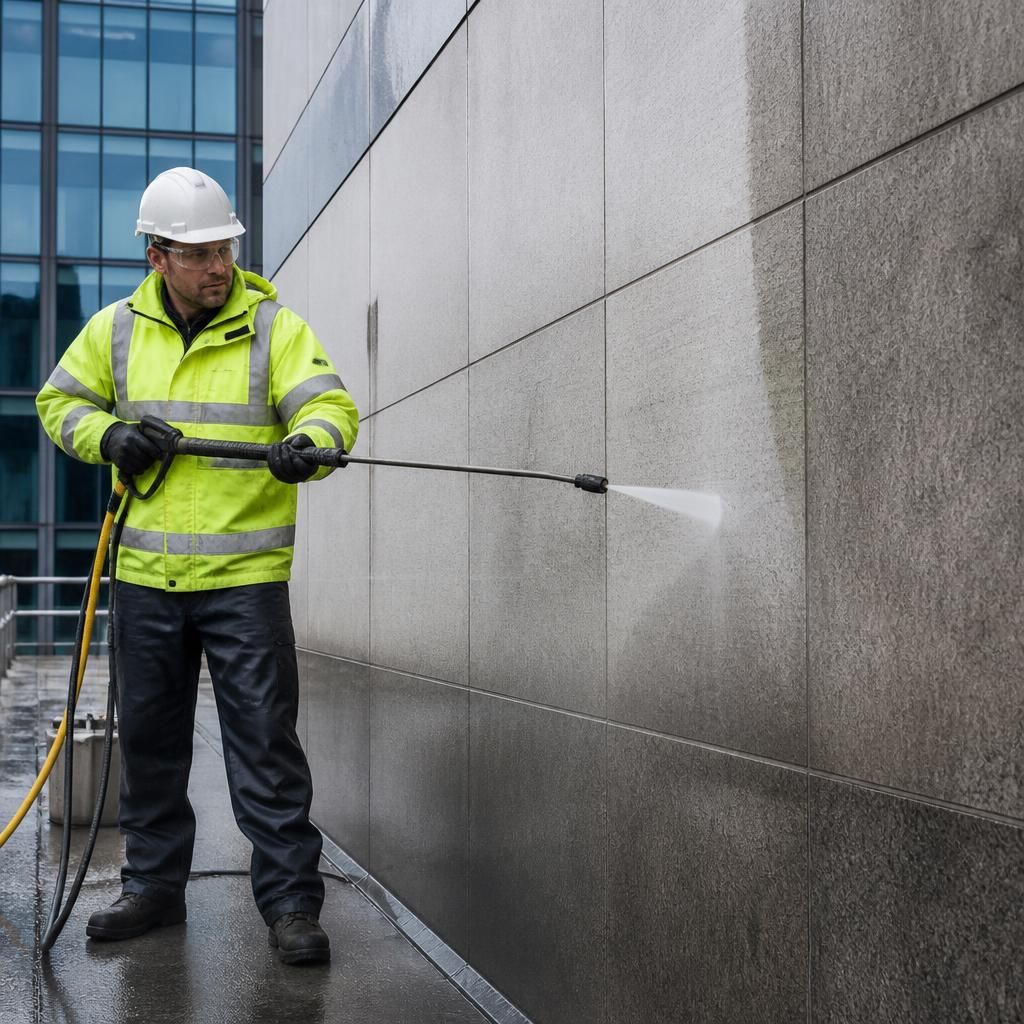
Surface assessment and test cleaning determine which equipment and technique are suitable for a high-rise façade. Technicians first identify the substrate, existing coatings, joints, sealants and type of contamination. A small test area is then cleaned using controlled pressure, temperature, flow rate and, where appropriate, a compatible cleaning product.
The results show whether the method removes the deposits without etching, discolouring or loosening the surface. The approved process can then be adjusted for different elevations, such as using gentle steam on delicate cladding, a soft-bristle brush for biological growth or a more robust pressure-washing setting on suitable concrete. This reduces unnecessary water, heat and chemical use while producing a consistent finish across the building.