
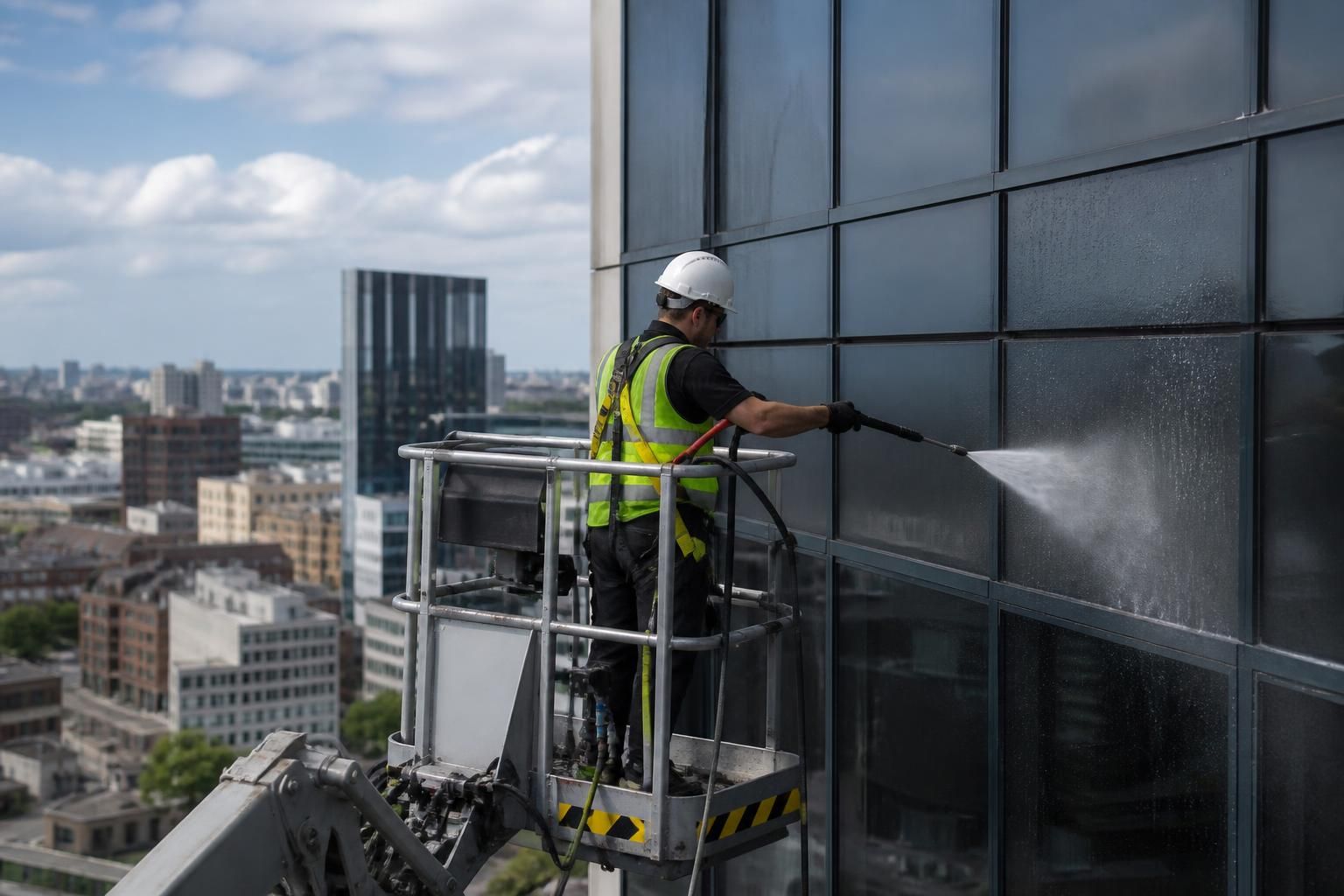
How often should high-rise buildings undergo jet washing?
High-rise buildings should undergo jet washing on a planned maintenance schedule, typically adjusted to the building’s exposure, surface condition and level of soiling rather than a fixed interval. Buildings in busy, industrial or coastal locations may need more frequent cleaning, while a site assessment can determine the most appropriate schedule.
High-rise buildings should usually be jet washed as part of a planned maintenance programme rather than at a fixed interval. A practical starting point is an annual façade condition review, with jet washing commonly scheduled every few years where the building remains in reasonable condition. The correct frequency depends on exposure, surface type, level of soiling, access requirements and the consequences of allowing deposits to remain in place.
High-rise cleaning should not be based on appearance alone. Dirt, traffic film, atmospheric deposits, algae, moss, bird fouling and other contaminants can affect the appearance and condition of façades, cladding, roofs, balconies and associated external areas. A planned schedule allows deterioration to be identified early and avoids waiting until heavy soiling requires more aggressive treatment.
Factors that affect the cleaning interval
- Location: Buildings beside busy roads, construction sites, industrial premises or dense urban areas generally accumulate airborne dirt more quickly than properties in quieter locations. Coastal exposure can also contribute to salt deposits and surface contamination.
- Building height and exposure: Taller elevations may receive stronger wind-driven rain and airborne pollutants, while sheltered sections can retain moisture and organic growth for longer.
- Surface material: Glass, powder-coated or anodised cladding, rendered surfaces, masonry, stone and concrete each have different cleaning tolerances. Some finishes can be damaged by excessive pressure or unsuitable chemicals, so the method may need to be adjusted rather than simply repeated more often.
- Existing condition: Long-standing deposits, staining, corrosion products, algae and bird fouling may require an initial deep clean followed by lighter maintenance visits.
- Building use: Residential towers, offices, hotels, hospitals, schools and public buildings have different presentation, hygiene and access requirements. Areas around entrances, loading bays and frequently used pedestrian routes may need additional attention.
- Previous cleaning history: A building that has been maintained regularly will often be easier to clean than one where contamination has been allowed to build up over an extended period.
Typical maintenance planning
For many high-rise properties, the most effective approach is to combine routine inspections with a planned external cleaning cycle. A property manager may arrange an inspection each year and schedule façade jet washing when deposits become established, commonly within a one-to-three-year maintenance window depending on the site. This is a planning guide, not a universal rule. A highly exposed commercial building may need more frequent cleaning, while a sheltered building with durable finishes may need less frequent full-scale work.
Different parts of the same building may also require separate schedules. Entrances, canopies, podium areas, car parks and lower-level elevations are usually more exposed to traffic film, splashback and public contact than upper façades. These areas may need interim cleaning even when the main high-level elevations remain acceptable.
When an earlier clean may be necessary
Jet washing should be brought forward if there is visible build-up that cannot be removed by routine methods, persistent algae or moss, bird fouling in occupied or public areas, staining around drainage points, or a noticeable decline in the appearance of the façade. Cleaning may also be appropriate before external painting, refurbishment, re-letting, an inspection, a property handover or a planned maintenance project.
Urgent cleaning is particularly sensible where contamination could create a slip hazard, obstruct drainage, conceal surface defects or contribute to the deterioration of coatings, sealants or masonry. Bird fouling and other biological contamination should be assessed with appropriate hygiene controls rather than treated as ordinary dirt.
Why cleaning too frequently can be unhelpful
More frequent jet washing is not automatically better. Repeated or overly aggressive cleaning can wear coatings, force water into vulnerable joints, disturb pointing or affect sealants and delicate finishes. The pressure, temperature, nozzle, cleaning agent and working distance should be selected for the specific surface. Where a low-pressure wash, steam cleaning or another controlled method will achieve the required result, it may be more suitable than high-pressure water.
A competent contractor should inspect the elevations, identify sensitive areas and carry out a suitable test clean before the main works. The inspection should consider the condition of cladding, render, masonry, windows, joints, drainage details and any previous repairs. This helps establish whether the proposed method is appropriate and whether the planned frequency needs to be changed.
How to set a suitable schedule
- Review the building’s elevations and external areas, including sheltered and difficult-to-access sections.
- Record the type and severity of soiling, along with any areas affected by algae, bird fouling, traffic film or staining.
- Check the condition and cleaning requirements of each surface finish.
- Consider the building’s location, occupancy, presentation standards, access arrangements and upcoming maintenance work.
- Use the inspection findings and any test-clean results to select the safest effective method.
- Set a planned cleaning date and a review point so the interval can be shortened or extended based on actual site conditions.
Access planning is also part of frequency planning. High-rise jet washing may require suspended access, mobile elevating work platforms, cradles or other specialist equipment. Availability, weather conditions, exclusion zones, water management and coordination with occupants can affect when work is undertaken. Booking planned cleaning before contamination becomes severe usually provides more flexibility and can reduce the need for intensive treatment.
For most properties, the best schedule is therefore condition-led: inspect at least annually, clean on a planned cycle suited to the site, and bring work forward when contamination or safety concerns develop. A site-specific assessment can confirm whether the building is better suited to annual cleaning, a longer interval, or separate schedules for high-use and high-level areas.
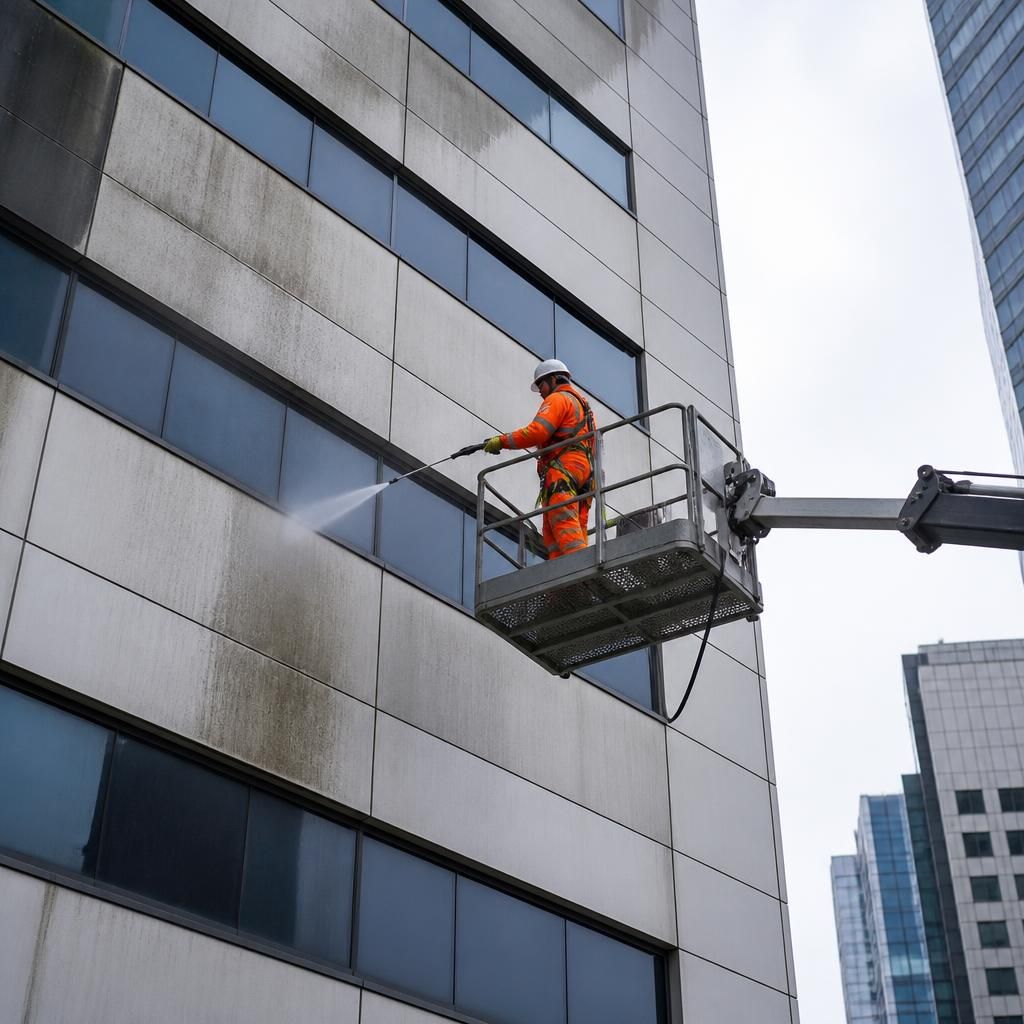
The most reliable way to plan high-rise jet washing is to use condition-led maintenance rather than a fixed cleaning interval. Arrange regular inspections of the façade and external areas, then schedule cleaning when deposits become established or before they begin affecting the surface, appearance or safe use of the building.
Different areas may need different treatment. Entrances, canopies, podiums, car parks and lower elevations often collect traffic film, splashback and bird fouling more quickly than upper façades. These high-use areas may require interim cleaning while the main elevations remain on a longer planned cycle. A site assessment can confirm the safest method and establish when each area should be reviewed.