
What types of industrial cleaning machines are best suited for heavy-duty warehouse floor maintenance?
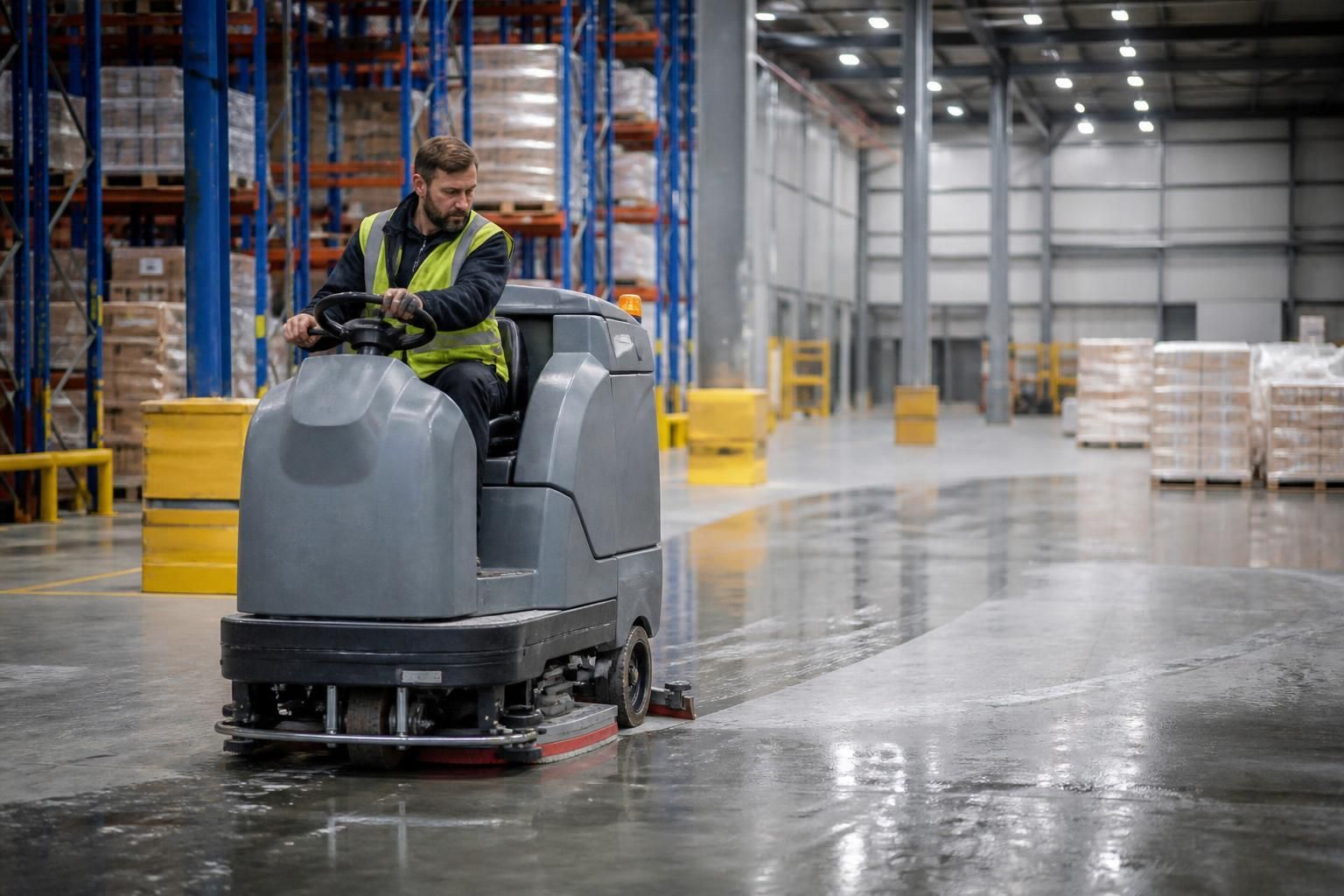
For heavy-duty warehouse floor maintenance, ride-on scrubber dryers are generally the best all-round option because they combine mechanical scrubbing with water recovery, removing ingrained dirt while leaving floors safer and quicker to return to use. Industrial sweepers are suited to dry dust and loose debris, while pressure washers or steam cleaners are better for stubborn contamination, loading areas and targeted deep-cleaning where drainage and drying arrangements permit.
Ride-on scrubber dryers are usually the best all-round machines for heavy-duty warehouse floor maintenance. They combine powered brushes or pads with a controlled water solution and an integral vacuum system, removing ingrained dirt while recovering the dirty water in the same pass. This makes them suitable for large concrete, resin and sealed warehouse floors where safe, consistent cleaning and a relatively quick return to service are important.
The most suitable machine depends on the contamination, floor surface, available space, traffic levels and whether the cleaning area has suitable drainage. In practice, heavy-duty warehouse maintenance is often most effective when a sweeper, scrubber dryer and pressure or steam cleaning equipment are used for different parts of the task rather than relying on one machine for every condition.
Ride-on scrubber dryers are well suited to expansive warehouse aisles, production areas and distribution floors. Their larger cleaning width and operator seating allow productive coverage of open areas, while the scrubbing action lifts tyre marks, tracked-in soil, dust deposits and other bonded contamination. The recovery system leaves less water on the floor than conventional mopping or uncontrolled washing, reducing slip risks and disruption. Choose a machine with suitable brush pressure, tank capacity and manoeuvrability for the floor finish and aisle layout. It must still be able to turn safely around racking, columns, dock areas and pedestrian routes.
Walk-behind scrubber dryers are more appropriate where access is restricted or the floor plan contains many obstacles. They can clean around racking, machinery, doorways and narrow passages that may be difficult for a ride-on model. They generally require more operator effort and may cover large open floors less efficiently, but their control and compact dimensions can make them the better choice for detailed or sectional cleaning.
Industrial sweepers should be used when the main problem is loose, dry material. Powered brushes collect dust, packaging fragments, grit, metal swarf and other debris before it is moved into traffic routes or worked into the floor surface. Ride-on sweepers are efficient across large areas, while compact walk-behind units are useful around confined spaces and edges. Sweeping is normally a preparation stage rather than a substitute for scrubbing where oil, residue or adhered dirt is present.
For dusty environments, select a sweeper with effective dust filtration and, where appropriate, controlled dust suppression. Filters need to match the type of dust being generated, particularly in facilities handling fine powders. The machine should also allow practical access for emptying the hopper and cleaning or replacing filters without releasing collected dust back into the workplace.
Combination sweeper-scrubber dryers can be useful where a facility needs to collect loose debris and wash the floor in one operation. They reduce the need to change machines and can be valuable in busy distribution or manufacturing areas. However, they are more complex than single-purpose equipment and may not provide the same specialist performance as a dedicated sweeper or scrubber dryer in particularly dusty, heavily soiled or congested areas.
Pressure washers are suited to concentrated heavy contamination, including loading bays, external warehouse approaches, service areas and floors with substantial oil or mud deposits. High-pressure water can remove material from textured concrete and hard-to-reach edges more effectively than a standard scrubber dryer. It should not be used indiscriminately on warehouse floors: water can enter joints, damage vulnerable coatings, affect stored goods and create slip or drainage problems. The area must have suitable drainage, segregation and drying arrangements, and the pressure and temperature must be compatible with the floor finish.
Steam cleaners use heated water to soften grease and sanitise suitable hard surfaces with relatively little added water. They are particularly useful for localised treatment around machinery, dock equipment, thresholds and stubborn residues where flood washing is unsuitable. Steam cleaning is generally a targeted method rather than the fastest option for maintaining a very large floor area. Operators must also consider heat sensitivity, ventilation, residue removal and the risk of driving contamination into joints or porous surfaces.
Single-disc rotary machines and orbital scrubbers are useful for intensive spot cleaning, edge work, preparation and the treatment of areas that need more mechanical agitation. They can address scuffing and embedded marks on suitable floors, but they normally leave the operator to manage the resulting slurry. They are therefore best paired with a wet vacuum or extraction system and are less convenient than a scrubber dryer for routine cleaning across a large warehouse.
Wet vacuum cleaners and slurry recovery units are important when water-based cleaning is carried out without an integral recovery system. They remove dirty water from loading areas, spill zones and heavily washed sections, helping prevent contaminated water from spreading across active floor space. Their capacity, hose reach and filtration should be suitable for the volume and type of material being recovered.
When comparing machines, assess the following practical factors:
- Floor construction and finish: Confirm compatibility with concrete, resin, sealed, painted or coated surfaces. Brush type, pad material, pressure, chemical concentration and water temperature can all affect the finish.
- Contamination: Dry dust calls for sweeping; bonded soil normally needs mechanical scrubbing; grease, oil and heavy deposits may require pre-treatment, hot water, steam or pressure washing.
- Area size and cleaning frequency: Large, regularly maintained floors usually benefit from ride-on equipment, while smaller or interrupted spaces may be better served by walk-behind machines.
- Layout and access: Check aisle widths, turning areas, gradients, doorways, dock plates, racking clearances and access to charging or storage points.
- Operational disruption: Battery-powered equipment can reduce exhaust emissions indoors, while low-noise operation may be important around offices, staff areas or active production. Cleaning should still be scheduled around vehicle and pedestrian movements.
- Water and waste management: Confirm access to clean water, drainage and an approved method for disposing of recovered slurry or contaminated liquid. Dirty water should not be discharged without checking the relevant site and environmental requirements.
- Operator controls and safety: Look for clear visibility, emergency stops, braking performance, warning systems, controlled speed, secure chemical handling and protection against unintended brush or machine movement.
- Maintenance support: Brushes, squeegees, filters, batteries, hoses and recovery tanks require routine inspection and cleaning. A machine that is difficult to service may deliver inconsistent results and higher downtime.
A practical heavy-duty programme often starts with mechanical sweeping to remove loose debris, followed by scrubbing with a suitable detergent and brush or pad. The dirty solution should be recovered rather than left to dry on the surface. Stubborn local contamination can then be treated separately with a pressure washer, steam cleaner or rotary machine, subject to the floor specification and site controls. Edges, joints, corners and areas beneath equipment may need manual detailing because large ride-on machines cannot reach them fully.
Machine selection should be based on a site assessment rather than cleaning width alone. The assessment should identify the floor material, contamination type, drainage arrangements, environmental controls, traffic routes, storage conditions and the required drying time. Test cleaning in an inconspicuous area before using a new pad, chemical or high-pressure setting across the facility. This helps confirm that the chosen equipment removes the contamination without marking, etching or loosening the floor finish.
For most large warehouses, a ride-on scrubber dryer supported by an industrial sweeper provides the strongest routine combination. Add a walk-behind unit for restricted areas and specialist pressure or steam cleaning for localised heavy contamination. Where the floor is unusually porous, damaged, contaminated with hazardous substances or subject to strict discharge controls, the equipment and cleaning method should be specified by a competent industrial cleaning contractor before work begins.
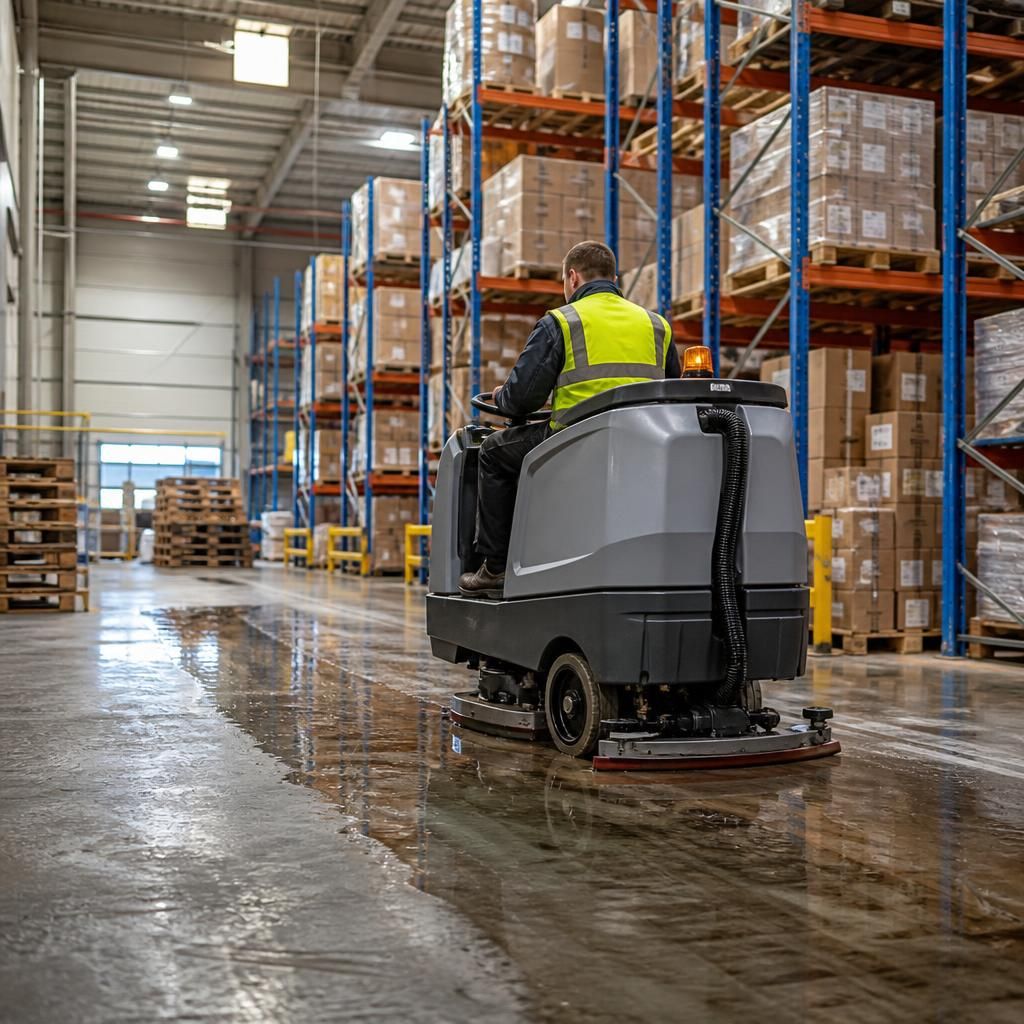
Ride-on scrubber dryers are generally the most suitable primary machine for maintaining large warehouse floors because they combine powered brushing, controlled detergent application and immediate dirty-water recovery. This removes bonded soil, tyre marks and tracked-in residue while leaving the surface considerably drier than conventional washing.
Select the machine according to the floor finish, aisle width, turning space and level of contamination. Brush pressure, pad type, tank capacity and recovery performance must be compatible with the surface and the required cleaning schedule. A sweeper should normally remove loose debris first, while pressure washing or steam cleaning is reserved for localised heavy contamination where drainage, ventilation and drying arrangements are suitable.
Discuss the Best Industrial Cleaning Machines for Your Warehouse
Contact Encanto Exterior Cleaning to arrange a site assessment and identify the most suitable industrial cleaning machines for your warehouse floor, contamination and access requirements. We can recommend a practical cleaning plan covering routine maintenance and localised heavy-duty treatment.