
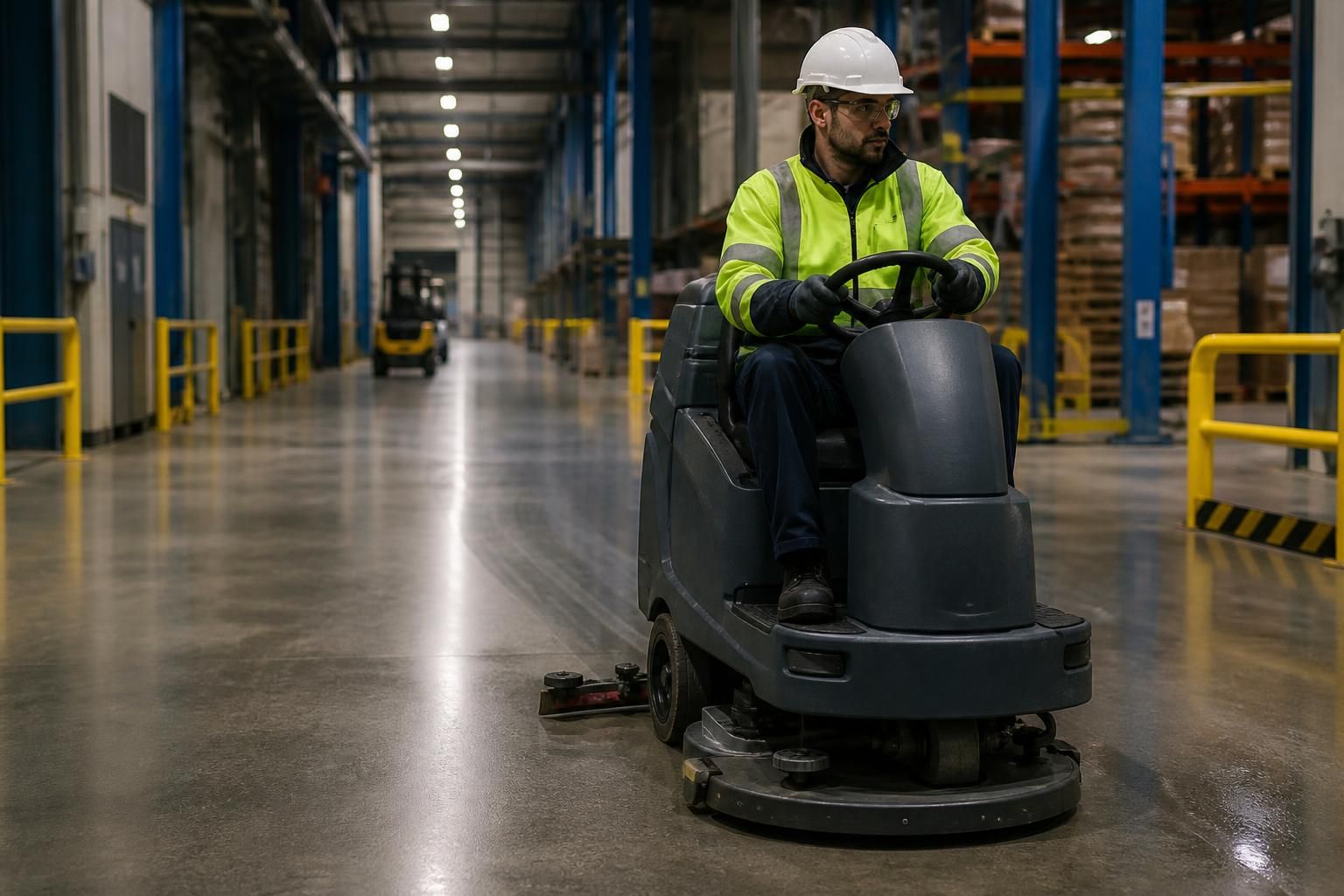
What safety features should I consider when selecting an industrial concrete floor cleaning machine for my facility?
When selecting an industrial concrete floor cleaning machine, prioritise safety features such as emergency-stop controls, dead-man switches, reliable braking, guarded moving parts, non-slip operator platforms and clear warning indicators. Also check for suitable noise, dust, chemical and battery-safety controls, plus manufacturer certification and documented operating guidance for your facility.
The most important safety features in an industrial concrete floor cleaning machine are emergency-stop controls, a dead-man switch, dependable braking, guarded moving parts, good operator visibility and clear warning systems. These should be assessed alongside controls for dust, noise, water, cleaning chemicals, electrical hazards and battery charging. The machine must also be suitable for the traffic, floor condition, gradients, cleaning chemicals and access arrangements within your facility.
Safety is not determined by one feature alone. A machine that is safe in a quiet warehouse may be unsuitable in a busy distribution centre, production area or car park. Review the manufacturer’s instructions, complete a site-specific risk assessment and check that operators can use every control without leaving a safe driving or standing position.
Emergency stopping and operator-presence controls
- Choose a machine with a clearly identified emergency-stop button that is easy to reach from the normal operating position. It should stop hazardous movement promptly and be protected against accidental activation without being difficult to use in an emergency.
- A dead-man switch or operator-presence control should stop the brushes, pads, squeegee system or drive when the handle is released or the operator leaves the controls. Check what the control stops, as some machines may require separate isolation for certain functions.
- Controls should be clearly labelled, logically arranged and usable while wearing the gloves and other personal protective equipment required for the task.
- For ride-on machines, look for a seat or platform presence sensor, controlled start-up and protection against unintended movement when the operator is not in position.
Braking, speed control and stability
- Reliable service braking and a parking brake are essential, particularly for ride-on equipment, machines used on ramps and cleaning in areas where pedestrians or vehicles may be present.
- Check that the brake remains effective when the recovery tank is full and that the machine cannot roll when parked. A safe stopping distance should be established during the site trial rather than assumed from the specification.
- Variable speed control helps operators reduce risk around racking, doorways, loading bays and pedestrian routes. A lower-speed setting can be valuable in confined areas.
- The machine should have a stable design, suitable wheel configuration and a clearly stated maximum gradient. Avoid using equipment on slopes or uneven surfaces beyond the manufacturer’s limits.
- For walk-behind machines, assess handle height, balance and manoeuvrability. Excessive push or pull force can increase the risk of strain and loss of control, especially on rough concrete or when tanks are full.
Protection from moving parts and stored energy
Rotating brushes, pads, drive wheels, belts and other moving components should be guarded so that hands, feet, loose clothing and cleaning materials cannot readily reach them during normal operation. Guards should remain secure and should not be bypassed. Check whether brushes stop when the handle is released and whether there is a safe isolation procedure before clearing wrapped cable, film or debris.
Operators should be able to remove and refit brushes, pads and squeegees without placing their hands near moving parts or relying on an unstable posture. Battery compartments, hydraulic components and other stored-energy systems should also be protected, with maintenance isolation instructions available to authorised personnel.
Visibility, alarms and communication
- Good forward and rear visibility is important when cleaning around racking, columns, plant and vehicles. Ride-on machines should provide a clear view of the travel path and any attachment or squeegee behind the machine.
- Headlights, work lights and reflective markings can improve visibility in low-light areas, although they do not replace adequate warehouse lighting or a traffic-management plan.
- Audible travel alarms, warning beacons and horns should be appropriate for the facility. In a noisy environment, combine visual warnings with a defined pedestrian-exclusion arrangement rather than relying on an alarm that may not be heard.
- Warning indicators should identify low battery, a full recovery tank, blocked suction, brush faults, overheating or other conditions that could make continued operation unsafe.
Water, slip and electrical protection
Concrete floor cleaning creates a slip risk if water is left behind. Select a scrubber dryer with effective recovery performance, a well-designed squeegee and a recovery-tank full indicator or automatic shut-off. Check the stopping distance and traction on the actual floor surface, including areas contaminated with oil, dust or detergent. Wet-floor signs, temporary barriers and a planned drying period may still be required.
Electrical components should be protected against the level of water and cleaning solution used, in accordance with the manufacturer’s instructions. Inspect cables, plugs, chargers and connectors before use, keep electrical connections away from standing water, and use the specified charging equipment and protective devices. Do not use a machine outdoors or in a wash-down area unless it is designed and approved for those conditions.
Battery and charging safety
For battery-powered machines, consider the battery type, charging location and ventilation requirements. The machine should have protection against overcharging, excessive discharge and incorrect connection where applicable. Charging should be carried out in a designated area with suitable ventilation, segregation from ignition sources and protection from vehicle impact.
Check that the charger displays its status clearly and that the battery compartment can be accessed without creating a manual-handling hazard. Operators should know how to respond to damaged batteries, unusual heat, swelling, leakage or a burning smell. Battery servicing and replacement should be restricted to trained personnel following the manufacturer’s procedure.
Dust, noise and chemical controls
Concrete dust can contain respirable silica, particularly where dry sweeping, grinding or disturbed deposits are involved. If the machine can generate or collect dust, look for effective dust containment, suitable filtration, sealed collection systems and a method of emptying the machine without releasing dust. Wet cleaning can reduce airborne dust, but it does not remove the need to control residues and protect workers during maintenance.
Noise should be considered in relation to the work area, exposure duration and nearby personnel. Select a quieter machine where practicable and identify whether hearing protection, restricted operating periods or separation from other work is needed. Cleaning chemicals must be compatible with the machine’s tanks, hoses, seals and floor finish. Chemical labels and safety data sheets should guide storage, dilution, handling and personal protective equipment.
Ergonomics and operator protection
- Adjustable handles, a suitable driving position and easy-to-reach controls reduce awkward reaching and twisting.
- Controls should not require excessive force, and the machine should be manageable when tanks are full or when brushes encounter uneven concrete.
- Access steps, platforms and handholds should be secure, cleanable and slip resistant. Avoid machines that require operators to climb over tanks or attachments.
- Seat belts, where fitted, should be used as intended. A restraint is particularly important on ride-on equipment operating near edges, ramps or uneven surfaces.
- Manual handling points should be provided for batteries, tanks, squeegees and brushes, or the machine should allow mechanical assistance during removal.
Safety documentation and suitability checks
Before purchase or hire, request the operating manual, maintenance instructions, declaration of conformity where applicable, noise information, battery and charger guidance, and details of required training. Confirm that safety-critical parts, such as brakes, tyres, switches, squeegees, guards and filters, can be inspected and replaced through an appropriate servicing arrangement.
Ask for a practical demonstration on representative concrete surfaces. Test the machine when empty and full, on the areas it will clean, around fixed obstructions and alongside normal pedestrian or vehicle movements. Confirm that it can stop, turn, recover water and warn the operator effectively without obstructing access routes or creating additional slip and collision risks.
Finally, include the machine in your workplace inspection and maintenance system. Operators should carry out pre-use checks, report defects immediately and remove unsafe equipment from service. A documented cleaning method, traffic controls, training record and planned servicing schedule are as important as the machine’s built-in safety features. If the equipment cannot safely manage your facility’s floor condition, gradients, dust, chemicals or traffic, select a different machine or use a specialist contractor for that part of the work.
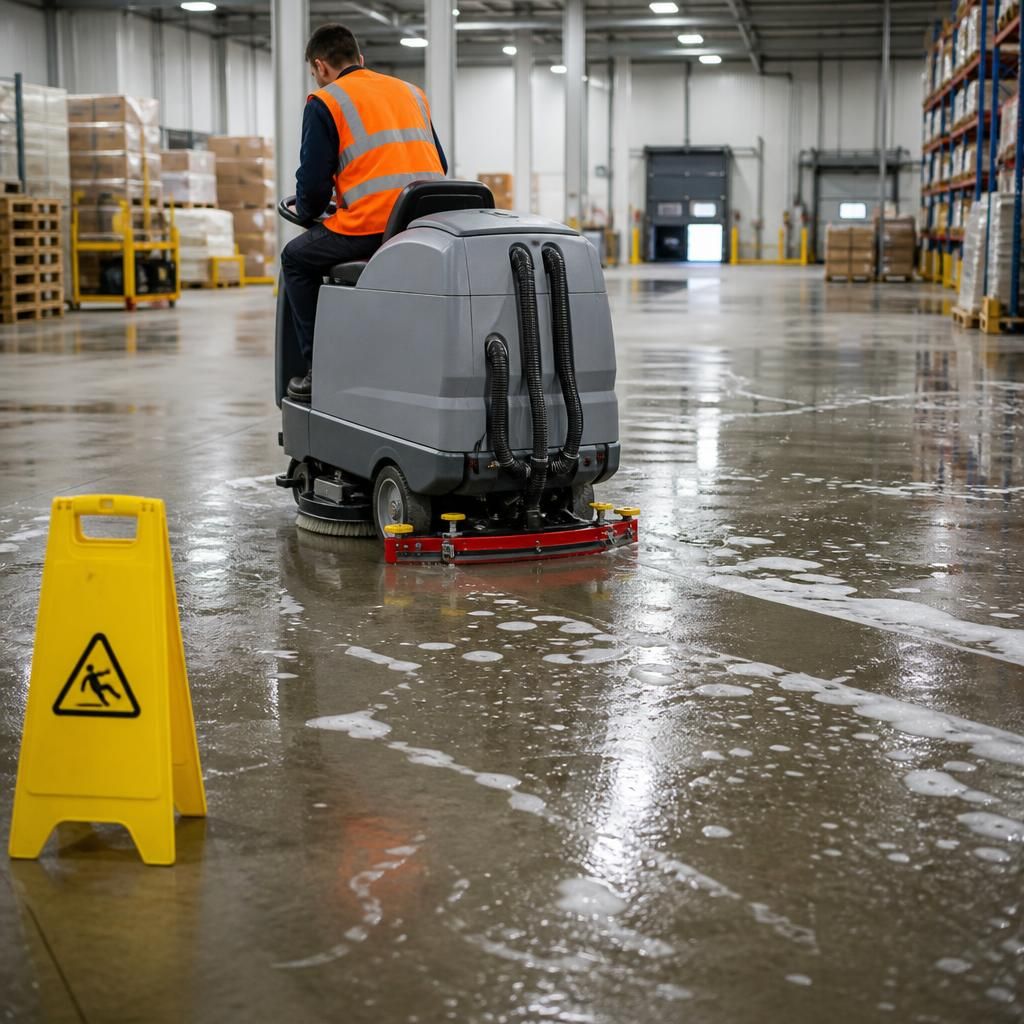
Effective water recovery is a key safety feature in an industrial concrete floor cleaning machine because residual water can create a slip hazard for employees, visitors and vehicles. A scrubber dryer should have a well-designed squeegee, dependable suction and an indicator or automatic shut-off for a full recovery tank.
Before selecting the machine, test its drying performance on the actual concrete surface, including uneven areas, joints, slopes and sections affected by dust or detergent. Check that it maintains traction and leaves no unsafe trail when turning or stopping. Wet-floor signs, temporary barriers and a planned drying period may still be necessary, particularly in busy warehouses, loading bays and pedestrian routes.