
What factors should be considered when choosing industrial floor cleaning machines for different warehouse and factory environments?
When choosing industrial floor cleaning machines, assess the floor surface, dirt type, cleaning area, available access, operating conditions and required hygiene standard. The machine’s cleaning method, capacity, manoeuvrability, power source, noise level, safety features and ongoing maintenance requirements should match the demands of the specific warehouse or factory environment.
The right industrial floor cleaning machine is determined by the site’s floor surface, contamination, cleaning area, access restrictions, operating conditions and required hygiene standard. A machine suitable for a dry distribution warehouse may be unsuitable for a food-processing area, engineering workshop or vehicle depot. Selection should therefore begin with a site assessment rather than with machine size or headline power.
Assess the floor surface first. Concrete, resin, quarry tile, sealed stone and safety flooring each respond differently to mechanical agitation, water and cleaning chemicals. Check whether the surface is sealed, polished, textured, damaged or uneven. Highly textured concrete may need stronger brush action and adequate water recovery, while a smooth resin floor may require softer brushes and controlled pressure to avoid marking or premature wear. Polished floors can lose their finish if an overly aggressive pad or abrasive detergent is used.
Also identify joints, expansion gaps, drainage channels, ramps, thresholds and areas of damaged flooring. A ride-on machine may work efficiently across a large, level slab but may be unsuitable where it cannot cross thresholds safely or where its turning radius is restricted. Smaller walk-behind equipment can provide better control around obstacles and confined areas.
Identify the type of dirt and spillage. The machine must be capable of removing the contamination that is actually present, not simply general dust. Common warehouse and factory contaminants include pallet debris, rubber marks, oil, grease, metal swarf, clay, mud, product residue, packaging fragments and ingrained traffic soil.
- Loose dust and dry debris: consider a sweeper, vacuum system or combination sweeper-scrubber before wet cleaning.
- General traffic soil: a scrubber-dryer with suitable brushes or pads is often effective on hard, sealed floors.
- Oil and grease: select equipment that provides sufficient agitation, detergent delivery and recovery, while checking that the cleaning chemical is compatible with the floor.
- Heavy or bonded deposits: higher brush pressure, specialist pads, steam or a separate preparation stage may be required.
- Fine dust: prioritise effective filtration and dust containment so that cleaning does not redistribute airborne particles.
Where several contamination types occur, a combination of machines may be more practical than expecting one unit to perform every task. For example, sweeping loose debris before scrubbing reduces brush wear, prevents blockages and improves the quality of water recovery.
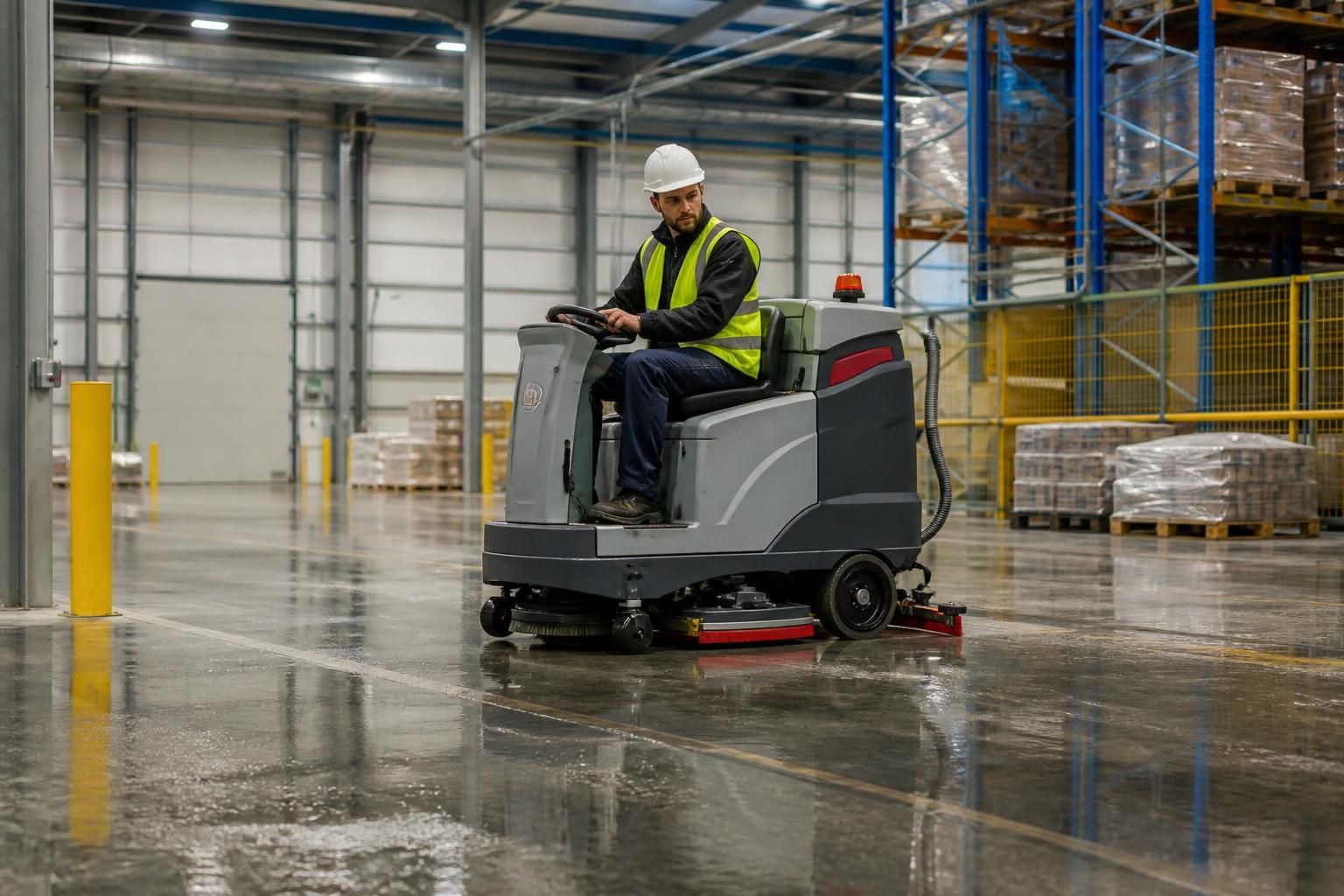
Match the machine to the size and layout of the facility. Large, open warehouses and production halls can benefit from ride-on sweepers or scrubber-dryers because they cover extensive areas efficiently and reduce operator fatigue. In smaller factories, stores, loading bays and congested production areas, a compact walk-behind machine may be faster overall because it can work around racking, machinery and stored materials.
Consider the effective cleaning width, travel speed, tank capacity, battery or fuel runtime, charging or refuelling arrangements and time available for cleaning. A machine with a large cleaning width is not necessarily the best choice if it cannot pass through doorways, fit between aisles or turn safely at the end of a run. The practical measure is the area that can be cleaned effectively within the available operating window, including time for filling, emptying, charging and moving around obstructions.
Check access and manoeuvrability. Measure the narrowest doorways, aisles, corridors, lifts, ramps and turning points. Confirm the machine’s dimensions, turning circle, ground clearance and operating weight, including water and attachments. Floor loading may be relevant on suspended areas or mezzanines. If the machine needs to travel between buildings, assess changes in level, outdoor surfaces and weather exposure.
Visibility is also important. Racking, plant, vehicles and stored stock can create blind spots. Choose equipment that allows the operator to see the cleaning path and surrounding pedestrians, with controls that remain accessible while wearing the required personal protective equipment.
Choose the appropriate cleaning method. Sweeping is suited to loose dry debris, while scrubbing removes adhered soil using water, detergent and mechanical action. Scrubber-dryers are particularly useful where the floor must be left safe to walk or drive on soon after cleaning. Steam can help with localised grease or hygiene-sensitive work, but it is not a substitute for a machine designed to collect large volumes of loose debris or wastewater. Pressure washing may be appropriate in suitable external or drainage-equipped areas, but uncontrolled water can damage stock, electrical equipment, joints and adjacent surfaces.
Where a wet process is used, recovery performance is as important as brush pressure. The machine should collect dirty water effectively without leaving pools, streaks or slippery residues. Check the squeegee design, suction performance, recovery tank capacity and the availability of suitable replacement blades.
Consider the power source and working environment. Battery-powered machines avoid trailing cables and may be preferable around moving equipment, vehicles and public access routes. Their suitability depends on operating time, charging capacity, battery type, charging location and whether the facility can accommodate the required charging controls. Mains-powered equipment can provide continuous operation but requires careful cable management and suitable electrical supplies. Combustion-powered machines may be appropriate in well-ventilated external areas, but exhaust emissions, noise and fire-risk controls can make them unsuitable indoors.
Noise can be a significant factor in occupied factories, distribution centres and premises operating around the clock. Select a machine that meets the site’s noise controls and does not interfere with communication, alarms or hearing protection requirements. Where dust, vapour or flammable materials are present, the machine and any electrical equipment must be suitable for the assessed hazardous environment. This should be confirmed with the responsible health and safety person before purchase or deployment.
Set the required hygiene and contamination-control standard. Food, pharmaceutical, healthcare and other hygiene-sensitive environments may require controlled chemical use, dedicated equipment, documented cleaning procedures and measures to prevent cross-contamination. Look for cleanable tanks and contact surfaces, straightforward drainage, effective recovery and compatibility with the site’s approved detergents and disinfectants. Cleaning equipment should be assigned, stored and maintained in a way that prevents dirty water, brushes or squeegees from contaminating cleaned areas.
For general industrial floors, the priority may instead be slip prevention, removal of oil and reduction of dust. In these environments, confirm that the machine can deliver consistent results without spreading contaminants into adjacent work zones.
Review safety features and operator controls. Essential considerations include emergency stops, controlled acceleration, reliable braking, non-slip access points, warning beacons, audible alerts and protection against unintended movement. Ride-on machines should provide good visibility and stable handling, particularly on ramps or uneven surfaces. Automatic reduction of speed when turning can be useful in busy areas, while water-flow and brush-pressure controls help prevent over-wetting or floor damage.
Operators should be able to fill, empty, adjust and clean the machine without unnecessary lifting or exposure to contaminated water. Controls should be clearly labelled and simple enough to use consistently. Training, written instructions, pre-use checks and site-specific traffic controls remain necessary; safety features do not replace competent operation.
Allow for maintenance, cleaning and servicing. A machine that is difficult to maintain may deliver poor results even if its initial specification is suitable. Check how easily operators can inspect brushes, pads, filters, hoses, squeegees, batteries, tanks and suction components. Recovery tanks should be emptied and rinsed after use, filters should be cleaned as instructed, and brushes or pads should be replaced when worn. Residual water and detergent can create odours, blockages and hygiene problems if the machine is stored without proper cleaning.
Confirm the availability of replacement parts, technical support and servicing arrangements before committing to a machine. Review the recommended maintenance schedule, battery care requirements and expected consumables. Total cost should include purchase or hire, operators, detergent, pads, brushes, batteries, servicing, repairs, water disposal and downtime, not only the initial price.
Consider environmental and operational efficiency. Low-water systems, accurate detergent dosing, efficient water recovery and reusable or durable components can reduce waste and operating costs. Battery equipment may reduce local emissions, but its environmental performance also depends on charging arrangements, battery life and responsible end-of-life handling. Avoid selecting an oversized machine that uses more water, energy and consumables than the facility requires.
Before making a final decision, define the required cleaning outcome, map the areas to be cleaned, record contamination and access constraints, and test the machine on representative floor sections. A practical trial should assess cleaning quality, drying time, operator visibility, noise, manoeuvrability, water use, battery endurance and the condition of the floor after cleaning. The most suitable industrial floor cleaning machine is the one that achieves the required standard safely and consistently within the site’s real working conditions, with manageable maintenance and operating costs.
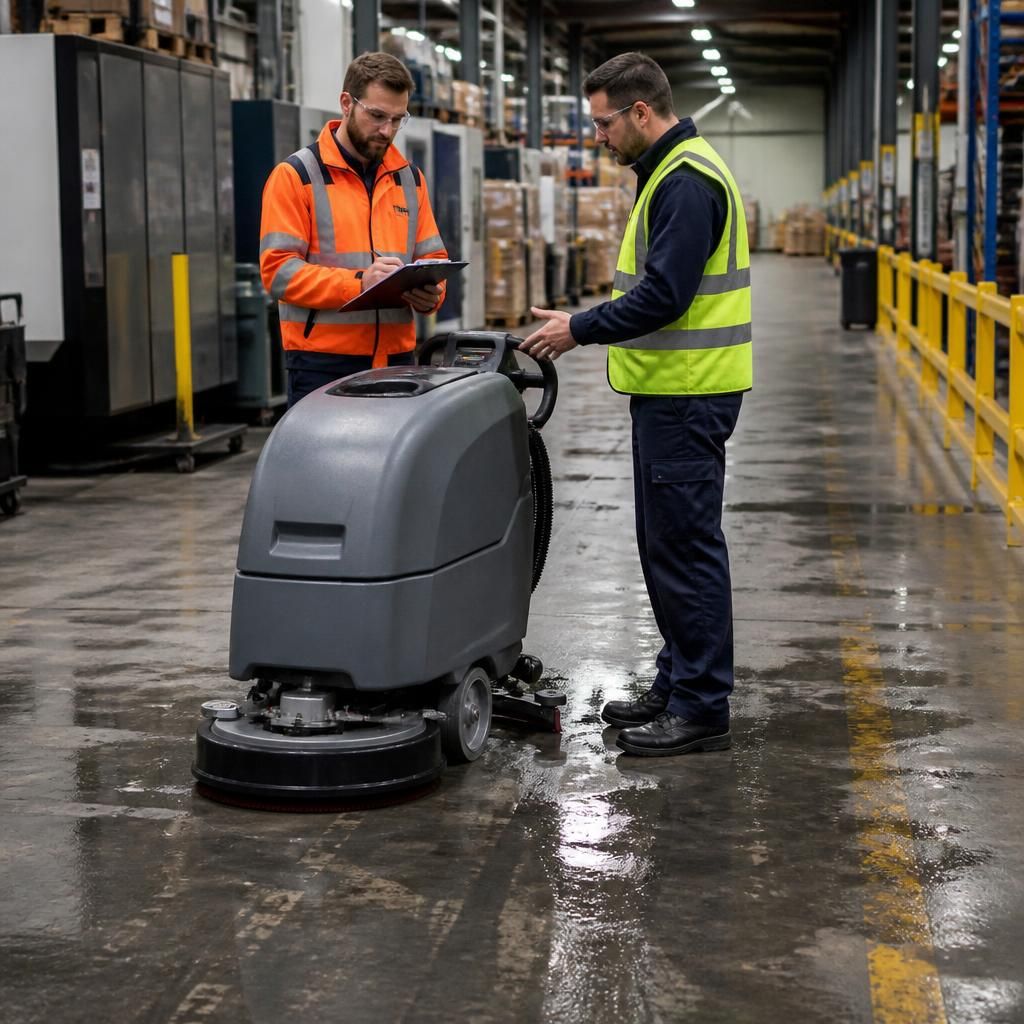
The most reliable way to choose an industrial floor cleaning machine is to test it on representative areas of the actual warehouse or factory floor. A machine that appears suitable on paper may struggle with restricted aisles, heavy contamination, uneven surfaces or the site’s available cleaning window.
During a practical trial, assess cleaning results, drying time, water recovery, operator visibility, manoeuvrability, noise and battery endurance. Check that the machine can pass through doorways, work safely around racking and plant, and leave the floor free from excess water or slippery residue. The trial should also confirm that brushes, pads, detergents and suction settings are compatible with the floor finish.
Record the findings alongside ongoing requirements such as tank emptying, charging, consumable replacement and routine maintenance. Selecting equipment based on observed performance and whole-life practicality provides a more dependable result than choosing solely by machine size, cleaning width or purchase price.