
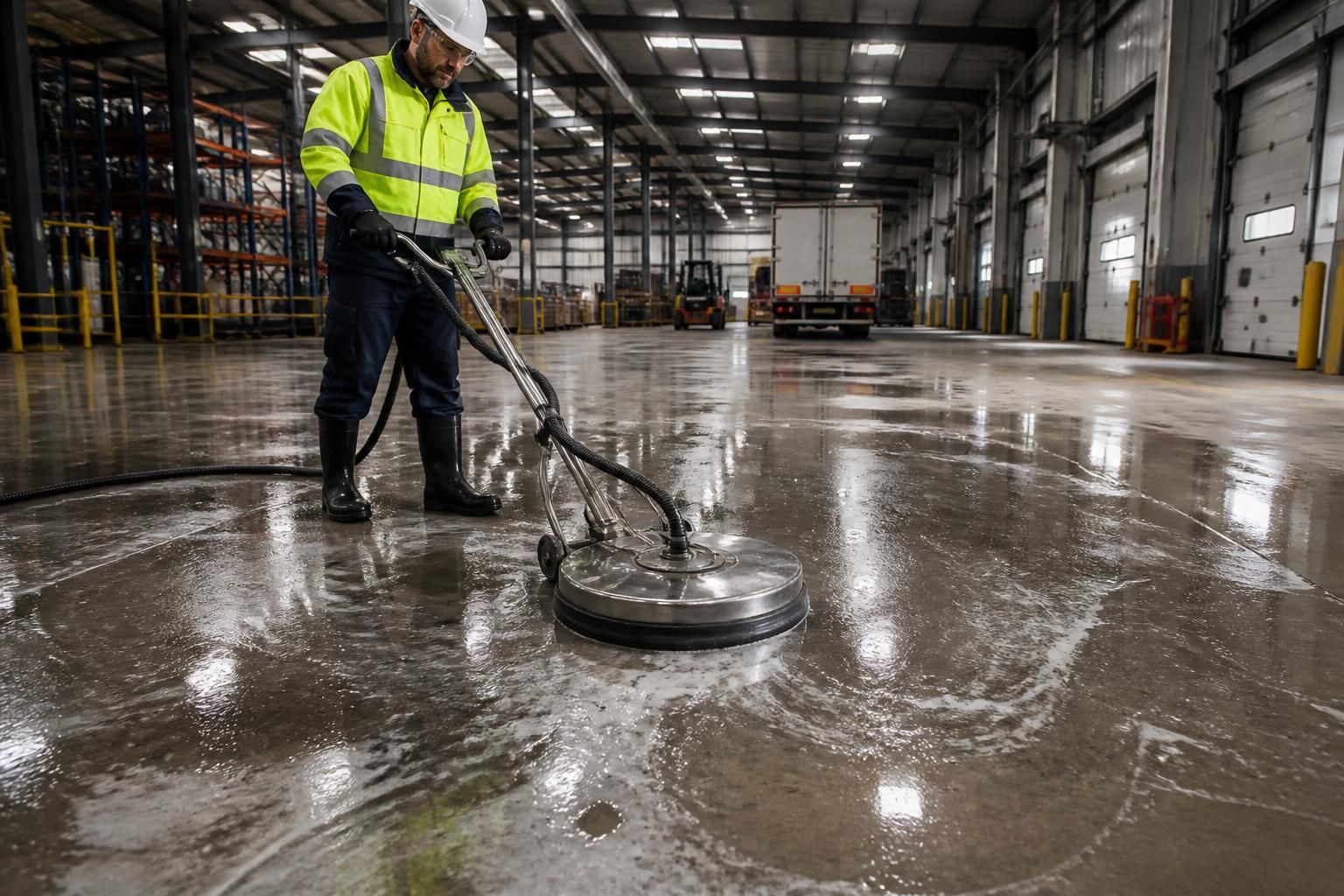
What qualifications or certifications should a concrete floor cleaning provider possess to ensure quality service?
A quality concrete floor cleaning provider should demonstrate documented training in pressure washing, steam cleaning, chemical handling, COSHH, risk assessment and safe equipment operation, supported by suitable public liability and employers’ liability insurance. Where work involves access equipment, work at height or controlled waste, check for relevant operator certifications and competency schemes, while accreditations such as ISO 9001, ISO 14001 or recognised contractor-safety schemes can provide additional evidence of consistent, compliant procedures.
A competent concrete floor cleaning provider should be able to demonstrate relevant training, documented safe systems of work, suitable insurance and the correct certifications for the equipment, chemicals, access methods and waste-handling activities involved. There is no single UK qualification that covers every type of concrete cleaning, so quality is best assessed by checking whether the provider’s competence matches the risks of your site and the proposed cleaning method.
Ask the provider for evidence of the following before work begins:
- Cleaning and pressure-washing competence: Operatives should have practical training in pressure washing, steam cleaning and the safe use of rotary cleaners, vacuum recovery systems and other equipment being used. Training should cover surface assessment, pressure selection, nozzle control, water management, protection of joints and coatings, and preventing damage to concrete, nearby structures and drainage systems.
- Chemical-handling training: Where degreasers, biocides, acid-based products or other treatments are required, staff should understand product labels, safety data sheets, dilution, storage, personal protective equipment and emergency procedures. Training under the Control of Substances Hazardous to Health (COSHH) regulations is particularly relevant. A provider should be able to explain why a chemical is needed and whether a lower-risk alternative is suitable.
- Risk-assessment and method-statement competence: The contractor should prepare a site-specific risk assessment and method statement rather than relying solely on a generic document. This should address slips and trips, vehicle and pedestrian movements, electrical equipment, water runoff, chemical exposure, pressure injection injuries, fragile surfaces, confined areas and any interaction with the public or other contractors.
- Health and safety training: Operatives should receive suitable training in PPE, manual handling, first aid arrangements, emergency response and safe working around traffic, machinery and members of the public. On construction or major development sites, clients may also require site-specific inductions and evidence of a recognised construction-site competency card or scheme.
Additional certification may be necessary when the work extends beyond ground-level cleaning. For example, operators using a mobile elevating work platform should hold appropriate training, commonly through an IPAF category relevant to the machine. People assembling or using mobile access towers may require PASMA training, while other powered plant or lifting equipment may call for a recognised operator qualification such as CPCS or NPORS. These credentials should correspond to the actual equipment and task; a general safety course does not prove competence on every type of access platform.
Work at height should also be planned and supervised in line with the Work at Height Regulations. Check that the provider has suitable rescue arrangements, inspected equipment and a clear approach to preventing falls. Equipment used for lifting people or loads should be properly selected, maintained and inspected in accordance with applicable requirements, including PUWER and, where relevant, LOLER. Certification of equipment does not replace the need for a trained operator and a site-specific assessment.
Insurance is an essential part of due diligence, although it is not a qualification. Confirm that the contractor holds current public liability insurance at a level appropriate to the project and employers’ liability insurance where they employ staff. Depending on the contract, professional indemnity or hired-in plant cover may also be relevant. Ask to see certificates and check that the policy covers pressure washing, chemical use, work at height and commercial or industrial premises where applicable.
Environmental and waste-handling competence should be checked for projects involving contaminated water, oil, detergents, paint residues or other pollutants. The provider should explain how runoff will be contained, collected, filtered and disposed of, rather than allowing wash water to enter surface-water drains. If the contractor transports controlled waste, it may need to be registered as a waste carrier, and the waste itself must be transferred to an appropriately authorised facility. Discharge to a drain or watercourse may require permission from the relevant water company, local authority or environmental regulator. The provider should identify these requirements before cleaning starts.
Formal management-system accreditations can provide further assurance, but they should be treated as supporting evidence rather than a substitute for operative competence. ISO 9001 indicates a structured quality-management system, while ISO 14001 relates to environmental management and ISO 45001 to occupational health and safety. Recognised contractor-assessment or safety schemes, including SSIP-based assessments where relevant, can also show that a company’s policies, insurance and procedures have been reviewed. Always check the scope and current validity of an accreditation, as registration may not cover every service or trading entity.
A reliable provider should be willing to supply a concise evidence pack containing training records, equipment-operator certificates, insurance documents, risk assessments, method statements, COSHH assessments and waste-disposal arrangements. It should also provide product information for any chemicals and explain how the chosen method suits the concrete finish, contamination and surrounding environment.
Be cautious if a contractor relies on a single badge, makes broad claims about being “fully certified” without identifying the awarding body, cannot explain runoff control, or proposes aggressive pressure or chemicals without inspecting the floor. The most useful assessment is whether the company can connect its qualifications and procedures to the specific risks of your premises, including production areas, warehouses, car parks, loading bays and public-facing spaces.
For an ongoing commercial cleaning programme, review competence periodically and request updated insurance, training and waste documentation when required. Clear records, trained operatives and a method that protects both the concrete and the wider site are the strongest indicators of safe, compliant and consistently high-quality service.
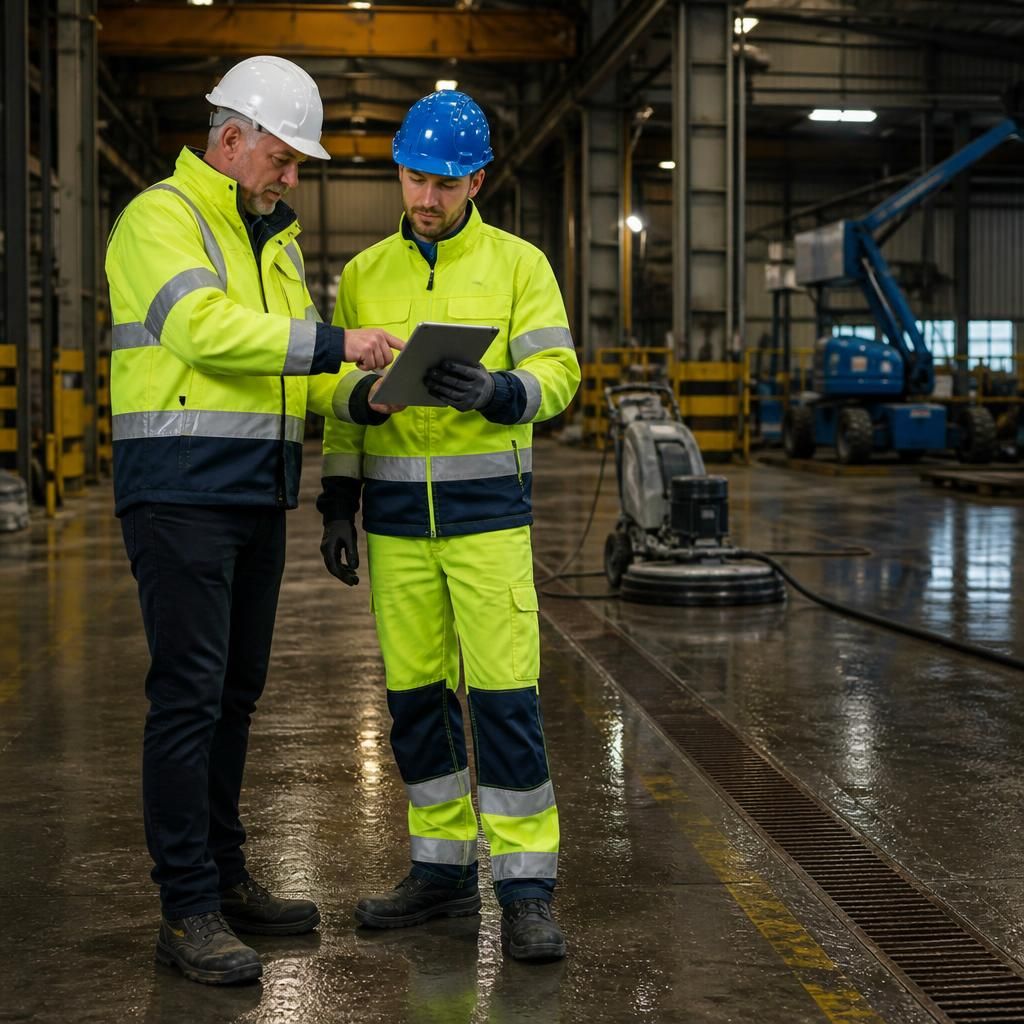
The strongest evidence of a qualified concrete floor cleaning provider is a site-specific assessment that links operative training, equipment and cleaning methods to the risks identified at your premises. A generic certificate alone does not demonstrate that the contractor can safely clean your particular floor, contamination or working environment.
Before work starts, the provider should be able to explain and document:
- Why pressure washing, steam cleaning, chemical treatment or mechanical cleaning has been selected for the concrete surface and type of staining.
- How water, chemical exposure, slips, vehicle movements, electrical equipment and nearby drainage will be controlled.
- Which operatives are trained to use the proposed pressure washers, rotary cleaners, recovery systems or access equipment.
- How wastewater, oil residues, detergents and other contaminants will be contained and disposed of lawfully.
Ask to see the relevant risk assessment, method statement, COSHH assessment, insurance certificates and operator training records. These documents should be current, clearly written and specific to the work rather than copied from an unrelated project. This evidence provides a more reliable indication of quality and compliance than a broad claim that the company is “fully certified”.