
What measures are in place to handle heavy foot and vehicle traffic during the cleaning of car park and forecourt floors?
We manage heavy foot and vehicle traffic by planning cleaning around quieter periods, dividing the area into controlled sections and maintaining safe pedestrian and vehicle routes throughout the work. Barriers, clear signage, suitable equipment and rapid-drying methods help minimise disruption while ensuring surfaces are safe before they are reopened.
Heavy foot and vehicle traffic is managed through planned scheduling, phased cleaning, controlled access and clearly defined safe routes. Before work starts, we assess how the car park or forecourt operates, identify peak periods, review pedestrian and vehicle movements, and agree an access plan with the responsible site contact. This allows cleaning to proceed without unnecessarily closing the whole area.
Work is scheduled to reduce disruption. Where operationally possible, cleaning is carried out during quieter periods, outside delivery windows or when customer and staff movements are lower. For sites that operate continuously, the work can be divided into manageable sections so that usable parking bays, entrances, loading areas and pedestrian routes remain available. The programme is coordinated with the site team when access requirements change during the day.
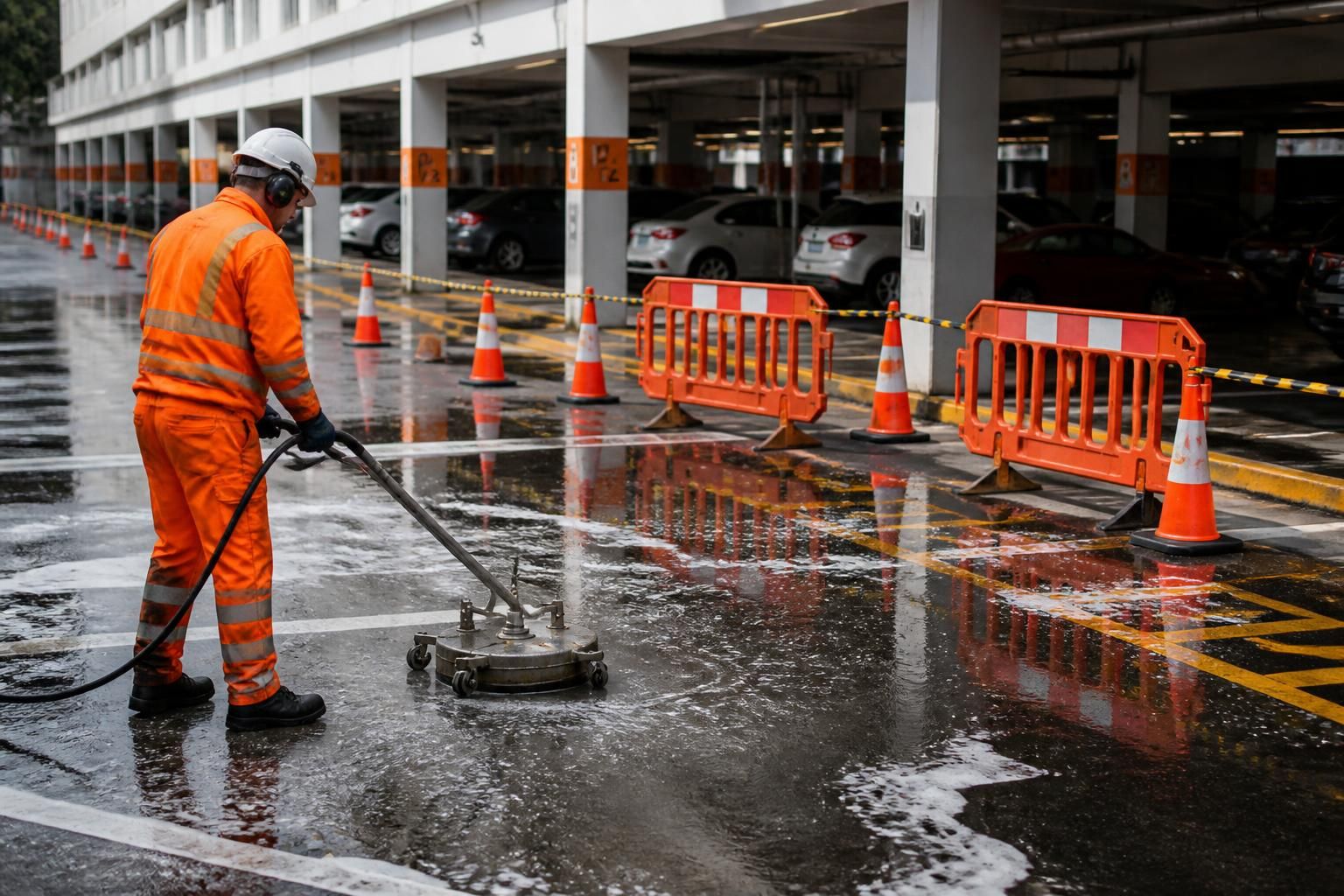
Cleaning areas are segregated from live traffic. Barriers, cones, temporary fencing and prominent warning signs are positioned around the active work zone. The precise arrangement depends on the site layout and the type of traffic using it. Vehicle entrances, pedestrian crossings, payment points, doorways, delivery routes and emergency access are considered when establishing the exclusion area. Staff can also direct vehicles or pedestrians around the section being cleaned where additional control is needed.
For larger or busier premises, the work may be completed in clearly defined phases. A typical sequence involves isolating one section, removing surface dirt and staining, cleaning and recovering wastewater, allowing the area to become safe for use, and then moving the exclusion zone to the next section. This approach prevents vehicles and pedestrians from crossing freshly cleaned or wet surfaces and limits the operational impact of the work.
Pedestrian safety is treated separately from vehicle movement. A route that is suitable for a vehicle may not be suitable for people walking between a car park, shop, office or public building. We therefore aim to maintain clear, stable and adequately signed pedestrian access, with particular attention to ramps, steps, crossings and entrance thresholds. Where a normal route must be temporarily closed, an alternative route should be agreed and signposted before cleaning begins.
Vehicle movements are controlled around equipment and operatives. Pressure-washing equipment, hoses, recovery systems and access equipment are kept within the defined work area as far as practicable. Hoses and cables are routed to reduce trip and vehicle hazards, while operative positioning is planned to maintain visibility and avoid working in the path of moving vehicles. On sites with frequent deliveries, reversing activity or restricted visibility, the method statement may include additional vehicle controls or a dedicated site contact.
The cleaning method is selected with traffic and reopening requirements in mind. Mechanical sweeping, pressure washing, steam cleaning and targeted treatments can be combined according to the surface, contamination and available access. Recovery equipment is used where appropriate to remove dirty water and loosened material rather than allowing it to spread across live traffic routes or enter unsuitable drainage systems. This helps keep adjacent areas cleaner and reduces the risk of contaminated water being carried onto routes that remain open.
Drying time is assessed before an area is reopened. A surface is not treated as ready for traffic simply because the cleaning equipment has moved away. We consider residual water, surface texture, gradients, temperature, wind, shade and the likelihood of slipping or tracking contamination into other areas. Where conditions permit, water removal, air movement and phased cleaning can help the surface dry more quickly. If a section remains wet or presents a risk, barriers and warning signs stay in place until it is suitable for use.
Weather can affect both the cleaning programme and the time needed before reopening. Rain may prolong drying and dilute or redistribute contamination, while freezing conditions can create additional slip hazards. Strong wind can affect signage, barriers and the safe handling of equipment. If conditions prevent safe segregation, effective cleaning or reliable drying, the work may be paused, rescheduled or adapted in agreement with the site contact.
Before each phase is released, the work area is checked for standing water, displaced debris, loose equipment, hoses, barriers and remaining treatment residue. Signs and barriers are removed or repositioned only when the route is considered safe and the agreed access arrangement can be maintained. The site team is informed of any areas that require continued restriction, further drying or follow-up attention.
For sites with particularly high or continuous traffic, the access plan should be agreed in advance and reviewed if trading hours, delivery patterns or site conditions change. Providing details of peak activity, restricted areas, emergency requirements and any vulnerable users enables the cleaning sequence to be matched to the way the premises operates. The result is a controlled cleaning process that protects pedestrians and drivers while keeping as much of the car park or forecourt available as practical.
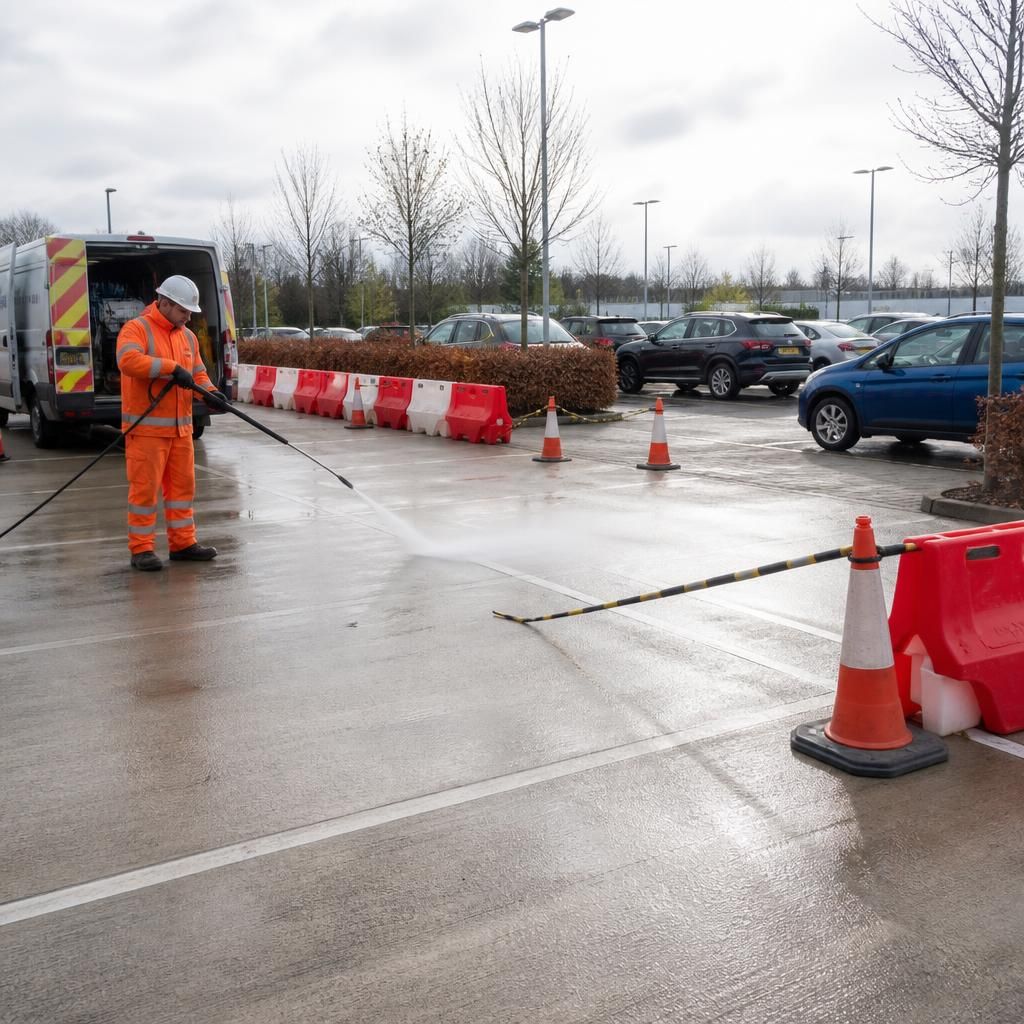
Phased cleaning keeps essential pedestrian and vehicle routes available while work is carried out. The car park or forecourt is divided into controlled sections, with barriers and clear signs separating the active work area from live traffic. Once a section has been cleaned, wastewater and debris are removed and the surface is checked before access is restored.
This approach prevents people and vehicles from crossing wet or contaminated areas and avoids closing the entire site unnecessarily. The cleaning sequence can be adjusted around deliveries, customer movements, entrances, payment points and emergency access, helping maintain safe, practical access throughout the work.