
What factors should be considered when selecting a professional car park cleaning service?
When selecting a professional car park cleaning service, assess its experience with commercial sites, suitability of its equipment and cleaning methods, health and safety procedures, environmental controls, insurance and relevant certifications. You should also compare clear quotations, availability, traffic-management arrangements and evidence that the contractor can deliver reliable, ongoing maintenance.
The most important factors when selecting a professional car park cleaning service are relevant commercial experience, suitable equipment and methods, robust health and safety controls, responsible wastewater management, clear pricing and dependable service arrangements. The contractor should be able to assess the site before work begins and provide a cleaning plan that reflects the surface material, contamination, vehicle movements, drainage and operating requirements of the premises.
Relevant experience and capability
Car park cleaning is more demanding than ordinary hard-surface washing. A professional contractor should understand how to clean large areas efficiently while protecting line markings, expansion joints, drainage systems, kerbs, barriers and surrounding buildings. Ask whether the company has experience with sites similar to yours, such as retail car parks, multi-storey facilities, industrial estates, forecourts, public-sector premises or construction sites.
Experience should include the types of contamination commonly found on your site. These may include oil and fuel residues, tyre marks, chewing gum, dirt, moss, algae, litter, food deposits, construction dust and general traffic film. Different contaminants require different treatments, and a contractor should not rely on one pressure-washing setting or chemical for every surface.
Assessment of the site and flooring materials
A competent service should inspect the car park or forecourt before quoting. This assessment allows the contractor to identify the surface material, its condition and any areas requiring special care. Concrete, tarmac, block paving, resin-bound surfaces, painted floors and coated concrete can all respond differently to pressure, heat and cleaning agents.
The inspection should also consider surface defects, loose aggregate, damaged joints, worn coatings, uneven areas and existing drainage problems. Cleaning can expose defects that were previously hidden by dirt, but it should not be used to conceal the need for repairs. Where a surface or coating is vulnerable, the contractor should explain the proposed method and, where appropriate, carry out a small test area before proceeding.
Suitable equipment and cleaning methods
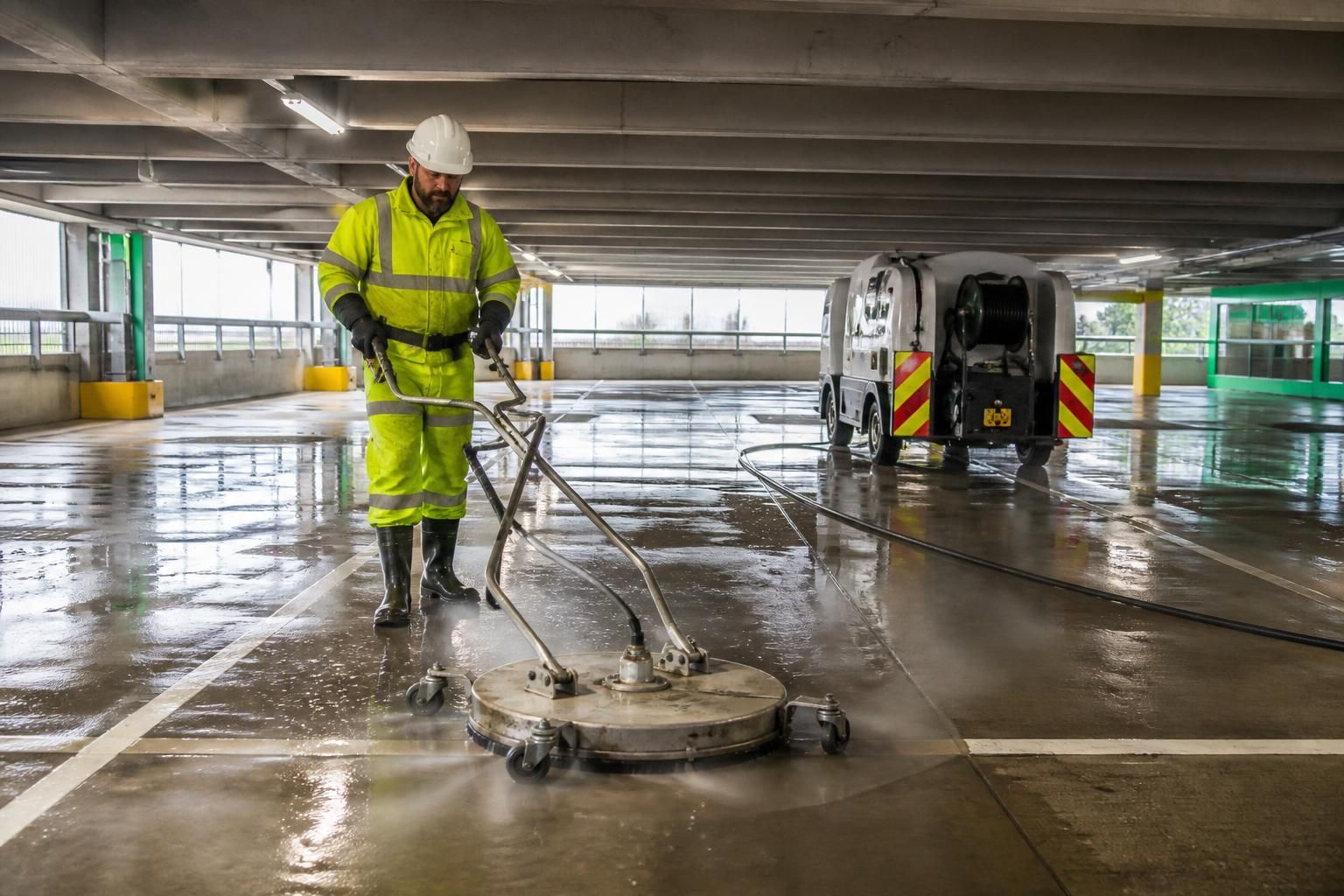
Equipment should be selected according to the size of the site, the level of soiling and the type of flooring. Professional cleaning may involve rotary surface cleaners, pressure-washing systems, steam cleaning, specialist detergents, wet vacuums and recovery equipment. Larger areas are generally cleaned more consistently when the contractor has equipment designed for commercial work rather than relying solely on handheld domestic machines.
Ask how the contractor will control pressure, water temperature and chemical use. Excessive pressure can damage weak concrete, remove jointing material or affect coatings, while unsuitable chemicals may harm painted surfaces, vegetation or drainage infrastructure. A reliable provider should explain why a particular method has been selected and what precautions will be taken around buildings, vehicles and pedestrian routes.
Health and safety procedures
Car parks combine moving vehicles, pedestrians, wet surfaces, electrical equipment, cleaning chemicals and pressurised water. The contractor should have a documented approach to managing these risks. Before work starts, request suitable risk assessments and method statements, often referred to as RAMS, together with evidence that the operatives are trained for the equipment and tasks involved.
Important controls may include segregating the work area, using warning signs and barriers, providing safe pedestrian routes, scheduling work during quieter periods and managing vehicle access. Operatives should use appropriate personal protective equipment and understand how to handle cleaning products safely. Where work takes place near roads, loading areas or public access points, the contractor should explain how traffic management will be maintained throughout the job.
Environmental and wastewater controls
Professional car park cleaning should include a plan for managing dirty water, oil residues, detergents and other contaminants. Wastewater should not be allowed to enter surface-water drains without proper consideration of its contents and the site’s drainage arrangements. The contractor should identify drainage points, use suitable containment or recovery equipment where necessary and explain how collected waste will be handled.
Ask whether the proposed cleaning products are suitable for the surface and the surrounding environment, and whether chemical use can be minimised through pressure, steam or mechanical cleaning. A responsible contractor should be able to discuss measures for protecting planted areas, watercourses, drainage systems and neighbouring premises. Environmental controls are particularly important at petrol stations, industrial sites, food-related premises and locations where oil or chemical contamination is present.
Insurance, training and professional documentation
Check that the contractor holds appropriate public liability insurance and, where relevant, employers’ liability insurance. You may also need evidence of equipment inspections, operator training, risk assessments, method statements and safe systems of work. Some sites, particularly those managed by larger organisations or public bodies, may require specific health and safety or contractor-assurance documentation before work can begin.
Certifications and memberships can support a contractor’s credibility, but they should not replace practical questions about how the work will be delivered. Consider whether the company can provide relevant references, examples of comparable projects and clear information about its procedures. Documentation should be current, relevant to the proposed work and available for review when required.
Clear quotations and scope of work
A quotation should define what is included rather than simply provide a price for cleaning the car park. It should identify the areas to be treated, the anticipated cleaning method, any stain or gum removal, line-marking protection, wastewater arrangements and the expected preparation required from the client.
Ask whether the price includes access equipment, out-of-hours work, traffic management, waste disposal, detergent use and returning to deal with areas that cannot be cleaned during the initial visit. Clarify how additional work will be authorised if concealed damage, unusually heavy contamination or access restrictions are discovered. A written scope helps you compare quotations fairly and reduces the risk of unexpected charges.
Reliability and working around site operations
The contractor should demonstrate that it can work around your opening hours, deliveries, staffing arrangements and vehicle movements. Discuss the preferred cleaning schedule, access requirements, water and power availability, parking restrictions and the time needed for surfaces to dry before they are reopened.
For busy or high-risk locations, the service should include a practical phasing plan. Cleaning may need to be completed in sections so that parts of the car park remain available, or scheduled overnight and during planned closures. The contractor should provide a named contact, confirm attendance in advance and have a process for dealing with weather-related delays, restricted access or urgent reactive cleaning.
Quality control and ongoing maintenance
Ask how the contractor will check the completed work. Suitable quality controls may include a pre-work condition record, agreed cleaning standards, supervisor inspections, photographs and a handover report identifying any areas that could not be treated. The standard should focus on the actual requirements of the site, including removal of traffic film, improvement of slip-related contamination and protection of existing surfaces.
If the car park requires regular attention, consider an ongoing maintenance programme rather than isolated deep cleans. The frequency and method can then be adjusted according to traffic levels, weather, contamination, surface condition and seasonal growth. A good maintenance plan should distinguish between routine cleaning and reactive work, such as oil spills, graffiti or contamination following construction activity.
Questions to ask before appointing a contractor
- Have you cleaned sites with similar surfaces, access requirements and contamination?
- What equipment and cleaning agents will you use, and why are they suitable?
- How will you protect line markings, coatings, drainage systems, pedestrians and vehicles?
- How will dirty water, oil residues and used cleaning products be contained and disposed of?
- Can you provide RAMS, insurance details and relevant training or certification records?
- What traffic-management arrangements and drying times should we expect?
- What exactly is included in the quotation, and how will variations be approved?
- How will the finished work be inspected and reported?
The strongest choice is not necessarily the lowest-priced quotation. It is the contractor that demonstrates a suitable method, understands the operational risks, provides transparent documentation and can deliver the required standard without disrupting the site unnecessarily. Comparing these factors will help you select a car park cleaning service that is safe, environmentally responsible and appropriate for both one-off deep cleaning and planned maintenance.
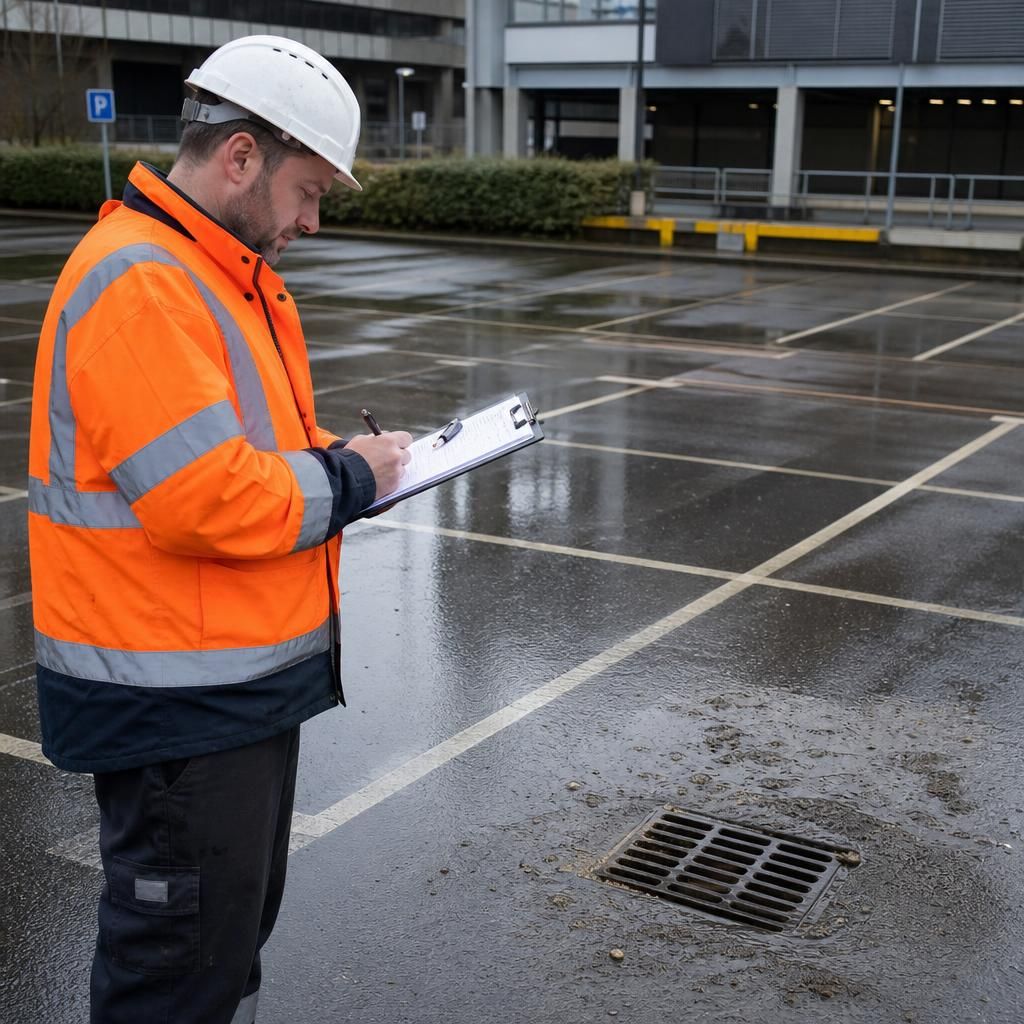
A professional car park cleaning service should assess the site before providing a final quotation. The inspection should cover the flooring material, surface condition, contamination, drainage, access restrictions, vehicle movements and nearby pedestrian routes. This allows the contractor to select suitable pressure, temperature, cleaning products and water-recovery measures rather than applying the same method to every surface.
Ask for the proposed cleaning method and scope of work in writing. It should explain how line markings, coatings, drainage systems, vehicles and surrounding areas will be protected, as well as how wastewater and oil residues will be controlled. A clear plan makes quotations easier to compare and provides a practical standard for checking the completed work.