
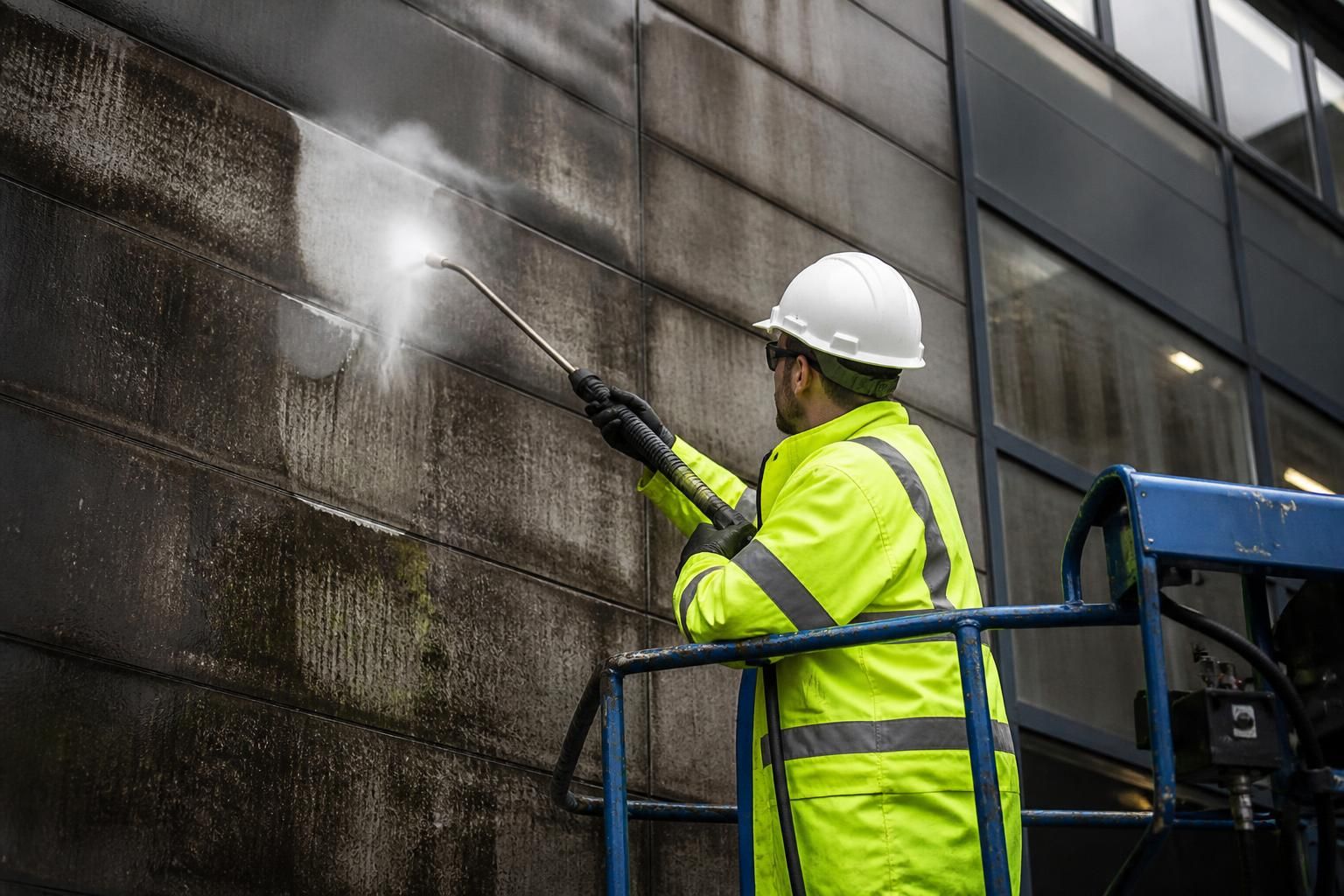
What factors determine the cost of steam jet washing services for commercial exteriors?
The cost of commercial steam jet washing depends on the size and condition of the surfaces, the type of dirt or staining, access requirements, site location and the equipment or preparation needed. A tailored quotation will also account for safety controls, water and waste management, working-hour restrictions and whether the cleaning is a one-off project or part of scheduled maintenance.
The cost of commercial steam jet washing is determined mainly by the area to be cleaned, the condition and type of surface, the nature of the contamination, and how safely the work can be accessed. A quotation will also reflect preparation, equipment, labour, water and waste controls, site location, working restrictions and whether the service is a one-off clean or part of a planned maintenance programme.
Surface area and layout
Larger façades, roofs, cladding systems, loading areas and car parks generally require more labour, operating time and water-management planning. The quoted area is not always a straightforward floor measurement. Multiple elevations, recessed sections, roof plant, columns, stairways and other features can increase the amount of work because operatives must reposition equipment and treat surfaces individually.
The condition of the site can also affect productivity. A relatively open elevation may be cleaned efficiently, whereas a congested service yard or a façade divided by architectural details may require more preparation and slower, controlled application.
Type and severity of contamination
Steam jet washing is suitable for many deposits, but different contaminants require different techniques. Dust, traffic film, algae, moss, food residue, oil, chewing gum, bird fouling, biological growth and graffiti may each require a different combination of temperature, pressure, dwell time and agitation. Long-standing staining can require repeat treatment or additional spot cleaning rather than a single pass.
Some deposits also need specialist handling. Oil and other substances that could enter surface-water drainage may require containment, collection and responsible disposal. Graffiti removal may involve testing, controlled treatment and protective measures to avoid damaging the underlying finish. These additional controls can increase the cost compared with routine dirt removal from an accessible surface.
Surface material and its condition
The substrate affects both the cleaning method and the time required. Brickwork, concrete, stone, render, metal cladding, painted surfaces, roof coverings and paved areas have different tolerances. Weathered, cracked, friable or previously coated materials may need lower-pressure application, test patches and slower progress to reduce the risk of damage.
A surface that needs careful treatment is not necessarily more expensive because of the steam itself. The additional cost usually comes from inspection, testing, operator control and the time needed to achieve a consistent result without disturbing joints, coatings, sealants or vulnerable finishes.
Access and working height
Access is often one of the most significant pricing factors for commercial exterior cleaning. Ground-level areas with clear vehicle access are generally simpler to set up than high or obstructed elevations. Depending on the building, the work may require water-fed poles, mobile access equipment, scaffolding, a MEWP, roof-access controls or other specialist arrangements.
Access requirements can include equipment hire, delivery, positioning, exclusion zones, traffic management and coordination with the building operator. If access equipment must be moved repeatedly around a site, or if parts of the façade can only be reached from certain positions, the additional set-up time will be reflected in the quotation.
Site safety and operational controls
Commercial work must be planned around people, vehicles, neighbouring properties and the building itself. The price may include a site assessment, method statement, risk assessment, permits, barriers, signage, banksmen or coordination with the client’s health and safety procedures.
High-rise, public-facing and operational sites often need more extensive controls. Cleaning may have to be carried out in sections, with pedestrian routes protected and entrances kept available. These requirements can make the work take longer than the same cleaning task on an unoccupied site.
Water supply, drainage and waste management
Steam cleaning can use less water than some conventional pressure-washing methods, but the site still needs a suitable water supply or an agreed provision for bringing water to the work area. The availability and location of external taps, hose routes and drainage points can affect preparation.
Run-off must be managed appropriately, particularly where the water contains oil, chemicals, biological material, paint residue or other pollutants. Measures may include drain covers, collection, filtration, temporary containment and disposal through an appropriate route. Where dirty water cannot be allowed to enter surface-water drains, the necessary controls and handling time will form part of the cost.
Equipment and specialist treatment
The required steam cleaning system, hoses, accessories, surface tools and access equipment will depend on the job. Additional equipment may be needed for deep cleaning, gum removal, graffiti treatment, roof work or work in confined areas. Specialist attachments and controlled cleaning methods can improve the result, but they may also involve additional preparation and operator time.
Where the site has limited power, water or vehicle access, the contractor may need to use alternative equipment or make extra logistical arrangements. These practical requirements are assessed during the survey rather than assumed from the surface area alone.
Location and site logistics
Travel distance, parking, congestion, delivery restrictions, security procedures and site induction requirements can all influence the quotation. A central commercial site may need timed deliveries and careful equipment movement, while a remote site may require additional travel and transport planning.
Work on premises across Birmingham, the West Midlands or elsewhere in the UK is therefore priced according to the actual site conditions rather than a standard rate based only on postcode. Where several buildings or locations are cleaned during the same programme, scheduling may make the overall service more efficient.
Working hours and access restrictions
Cleaning during normal operating hours may be unsuitable for premises with busy entrances, customer traffic, active loading bays or sensitive neighbours. Early-morning, evening or weekend work can reduce disruption, but out-of-hours labour and additional supervision may affect the price.
Restrictions on noise, water use, vehicle movements or access to particular areas can also extend the programme. It is useful to identify these requirements before the quotation so that the method and schedule reflect how the site actually operates.
Frequency and contract scope
A one-off deep clean normally involves more preparation because established contamination has had time to build up. Regular maintenance cleaning can be more predictable, with shorter visits and less intensive treatment when deposits are addressed before they become difficult to remove.
The quotation may also differ according to whether it covers one façade, a complete building envelope, several properties, a car park, a construction handover clean or an ongoing schedule. Clearly defining the areas, service frequency, expected finish and any exclusions helps avoid comparing prices for different scopes of work.
How to obtain an accurate quotation
A reliable commercial quotation should be based on a site assessment or sufficiently detailed information about the property. Useful details include photographs, approximate surface areas, substrate types, contamination, access arrangements, preferred working hours, drainage constraints and any known restrictions.
The quotation should explain what is included, such as preparation, test patches, access equipment, water management, waste disposal, traffic controls and post-cleaning checks. It should also identify any assumptions, areas that cannot be reached, potential additional treatments and whether prices are subject to site conditions or VAT.
For that reason, the lowest initial price is not always the most useful comparison. A properly specified quotation allows the cleaning method, safety arrangements and environmental controls to be assessed alongside the cost. Encanto Exterior Cleaning can review the site requirements and provide a tailored quotation for commercial steam jet washing across Birmingham, the West Midlands and the wider UK.
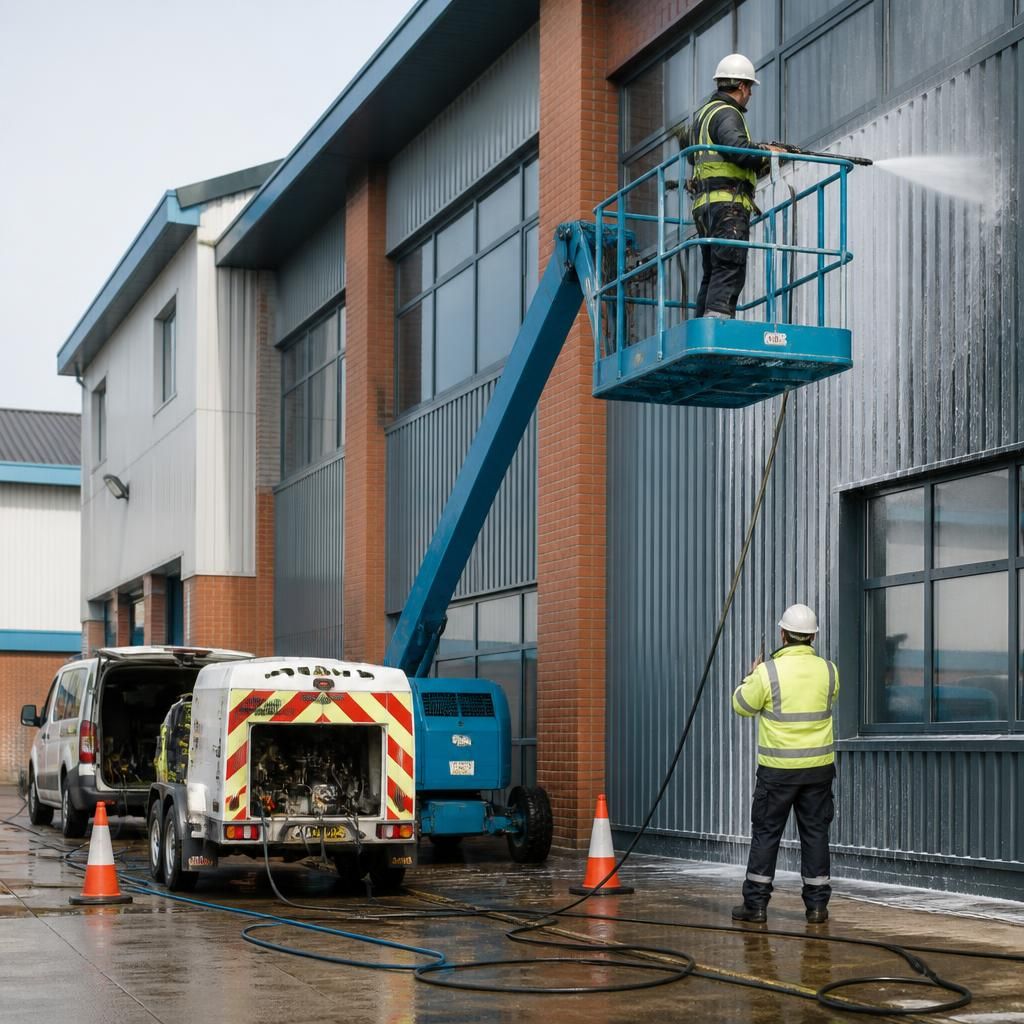
Access requirements can have a significant effect on the cost of commercial steam jet washing because they determine how equipment, water and operatives reach each exterior surface. Ground-level areas with clear vehicle access are usually quicker to prepare than high, enclosed or obstructed elevations.
A quotation may need to include MEWPs, scaffolding, roof-access controls, barriers, traffic management or additional equipment positioning. Repeatedly moving equipment around a large site, protecting pedestrians and keeping entrances or loading bays operational can also extend the working time. Providing photographs, access details and any site restrictions in advance helps ensure the quotation reflects the actual cleaning conditions rather than surface area alone.
Request a tailored commercial steam jet washing quote
Provide your site details, access arrangements and cleaning requirements so we can assess the work accurately. Contact Encanto Exterior Cleaning to request a tailored commercial steam jet washing quotation for your Birmingham, West Midlands or UK property.