
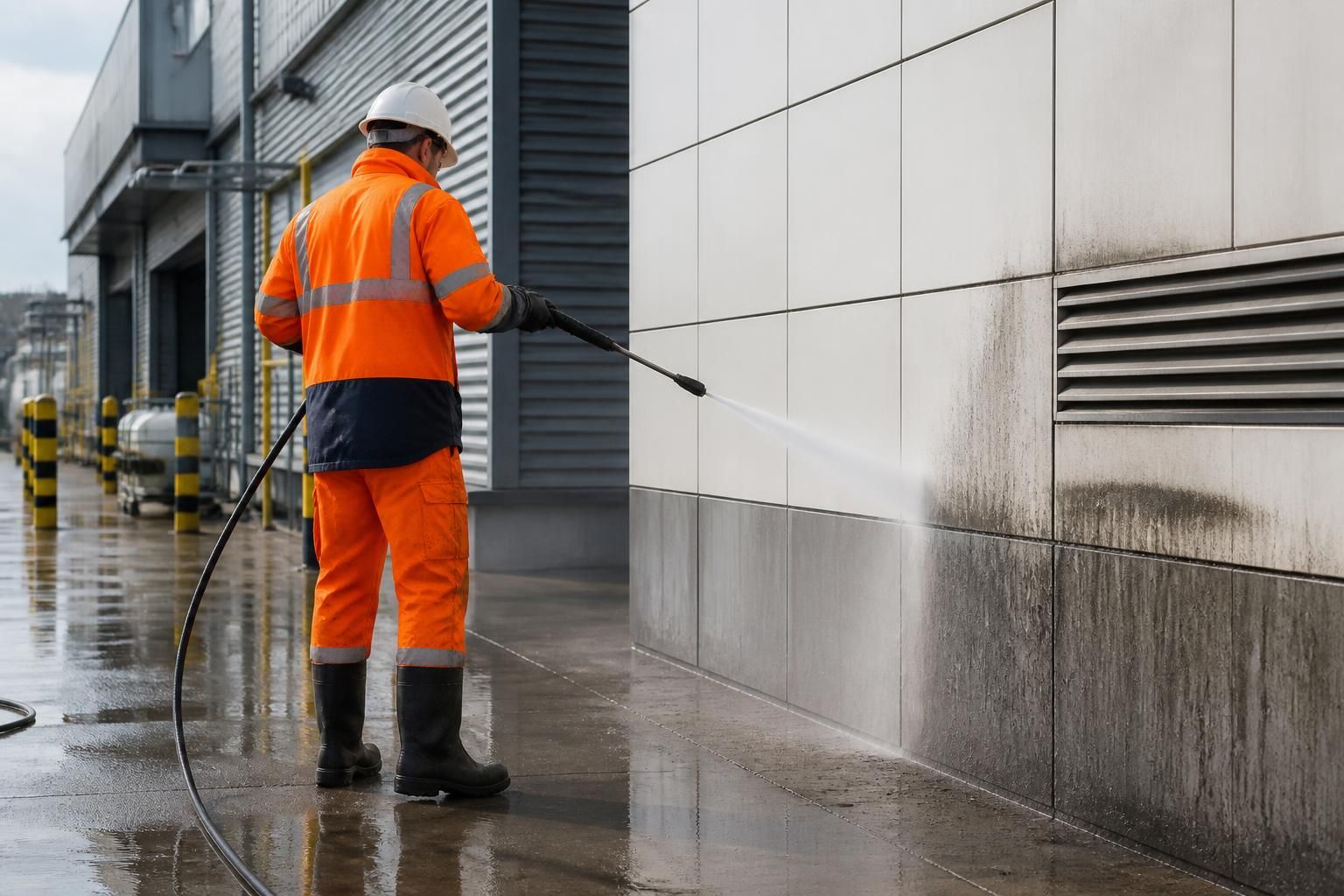
What qualifications and certifications should commercial jet washing operators possess to ensure safety and quality?
Commercial jet washing operators should have documented training in pressure-washing techniques, risk assessment, COSHH, PPE, water management and safe use of chemicals and equipment, with relevant site qualifications such as IPAF for powered access or PASMA for mobile access towers where required. Quality and safety are further supported by competent supervision, suitable insurance, evidence of experience with commercial surfaces, and recognised contractor or management-system certifications where the project specification requires them.
Commercial jet washing operators should have documented training in high-pressure water use, risk assessment, COSHH, PPE, equipment inspection and environmental controls, supported by relevant access, traffic-management or site-safety qualifications. The exact requirements depend on the work: cleaning a ground-level forecourt has different risks from using a lance at height, working near live traffic or removing contaminated material.
High-pressure water jetting training
Operators should be trained in the safe selection and use of pressure-washing equipment, including pumps, hoses, lances, nozzles, surface cleaners and recovery systems. Training should cover pressure and flow control, safe start-up and shutdown, hose management, trigger control, equipment defects and the risks of injection injuries, flying debris, slips and uncontrolled movement of the lance.
For higher-risk or specialist work, clients should look for water-jetting training aligned with recognised industry guidance, such as training provided through the Water Jetting Association or an equivalent competent training provider. The important point is not simply holding a certificate; the training must match the equipment, pressure category, surface and method being used. Operators should also receive site-specific instruction and manufacturer training where specialist machinery is involved.
Health and safety qualifications
Every operator should understand how to work under a suitable risk assessment and method statement. This includes identifying pedestrians, vehicles, electrical installations, fragile surfaces, open edges, falling material, drainage routes and nearby businesses or members of the public. Training should also cover emergency arrangements, exclusion zones, communication procedures and reporting of defects or near misses.
- Risk assessment and method statement training: enables staff to follow safe systems of work and recognise when conditions have changed.
- COSHH training: is necessary where detergents, biocides, degreasers, stain removers or other cleaning chemicals are used.
- PPE training: should cover the correct selection, fitting, inspection, cleaning and replacement of waterproof clothing, gloves, eye protection, hearing protection, safety footwear and respiratory protection where required.
- Manual handling and work-equipment training: helps operators move hoses, machines, surface cleaners and recovery equipment without avoidable injury.
- First-aid awareness: is particularly relevant because high-pressure water can cause serious injuries that may appear minor initially and require urgent medical assessment.
Training should be refreshed when equipment, chemicals, legislation, working conditions or the operator’s duties change. A responsible contractor should be able to provide a training matrix or competency record rather than relying on an informal assurance that staff are experienced.
Access and work-at-height qualifications
Jet washing from a mobile elevating work platform requires operators to hold appropriate powered-access training, commonly through an IPAF-equivalent scheme, for the category of platform being used. The qualification should correspond with the actual machine, such as a scissor lift or boom-type platform. Operators also need site-specific familiarisation, pre-use inspection knowledge and an understanding of rescue arrangements.
Where mobile access towers are used, the people erecting, altering or inspecting them should have suitable PASMA-equivalent training. Work-at-height training must also cover edge protection, harness use where applicable, dropped-object controls, ground conditions, overhead hazards and exclusion zones. A certificate for access equipment does not authorise a person to use a machine they have not been trained or familiarised on.
Equipment inspection and legal compliance
Operators and supervisors should understand the requirements of the Provision and Use of Work Equipment Regulations, commonly known as PUWER. This includes pre-use checks, planned maintenance, guarding, safe operating instructions and removal of defective equipment from service. Hoses, couplings, trigger guns and safety devices need particular attention because failures can release stored pressure or cause loss of control.
Where lifting accessories or lifting equipment are used to move machinery or materials, the relevant inspection and thorough-examination requirements under LOLER may also apply. A contractor should retain service records, inspection logs and repair records and make them available when requested. Portable electrical equipment used in wet areas should be suitable for the environment and protected through appropriate electrical safety controls.
Specialist site qualifications
Additional training may be required depending on the premises and cleaning method. Examples include asbestos awareness when working on or near older building materials, confined-space training for tanks or restricted areas, traffic-management training for roads and forecourts, and water-hygiene or site-induction requirements on particular industrial sites. Where cleaning may disturb hazardous residues, the contractor must confirm the substance and disposal arrangements before work starts rather than allowing an operator to treat it as ordinary dirt.
Construction and infrastructure clients may also require evidence of recognised site-safety training or an appropriate construction-site access card. Such cards help demonstrate that basic site requirements have been addressed, but they do not replace practical jet-washing competence, task-specific training or supervision.
Qualifications that support cleaning quality
Safety certificates alone do not demonstrate that an operator can clean a commercial façade, cladding system, roof, canopy, car park or forecourt without causing damage. Quality depends on understanding how different materials react to pressure, heat, dwell time and chemicals. Competent operators should be able to explain why a method has been selected and when a lower-pressure, soft-washing, steam or manual approach is more appropriate.
Useful evidence includes experience with comparable surfaces, completed test patches, documented cleaning specifications, inspection checklists and before-and-after records. Operators should know how to identify loose coatings, failed sealants, corrosion, damaged pointing, fragile render, blocked drainage and areas where water could enter the building. They should also understand that cleaning can reveal pre-existing defects which must be recorded rather than concealed.
Supervision and contractor-level certification
For larger projects, the contractor should appoint a competent supervisor who can brief the team, check RAMS, confirm exclusion zones, monitor water run-off and stop work if conditions become unsafe. Supervisors should have sufficient practical experience to assess pressure settings, access arrangements, surface risks and the quality of the finished work.
Some commercial procurement processes require contractors to demonstrate formal management systems or third-party assessment for quality, occupational health and safety, or environmental management. Certifications such as ISO-based management standards may provide useful evidence that procedures are documented and reviewed, but they do not prove that every individual operator is qualified. The project team should still check personal training records and the suitability of the proposed method.
Insurance and evidence to request
Public liability insurance, employers’ liability insurance where applicable, and suitable cover for hired or owned equipment are important safeguards, although insurance is not a qualification. Before work begins, a commercial client should reasonably request:
- operator and supervisor training records relevant to the task;
- access-equipment certificates where work at height is involved;
- current risk assessments and method statements;
- COSHH assessments and safety data for cleaning chemicals;
- equipment inspection, maintenance and hose-check records;
- evidence of comparable commercial experience;
- insurance certificates and any required contractor-prequalification evidence; and
- the proposed arrangements for protecting drains, recovering wastewater and disposing of contaminated residues.
The strongest indication of competence is a combination of relevant operator training, properly maintained equipment, experienced supervision and a method designed for the specific site and surface. A certificate should be current and verifiable, but it should always be assessed alongside practical experience, clear documentation and the contractor’s ability to explain how safety and quality will be controlled throughout the jet-washing operation.
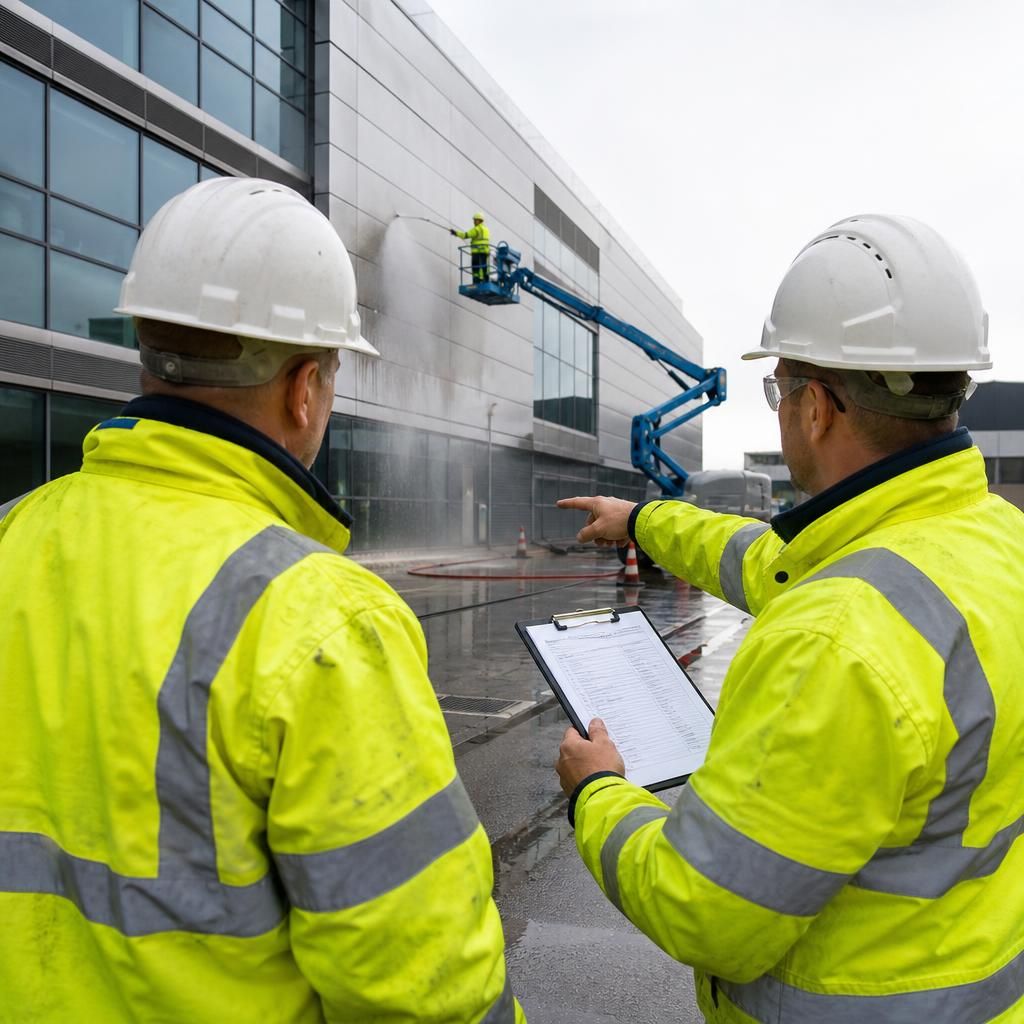
A certificate is only useful when it matches the work being carried out. For example, cleaning a ground-level car park does not require the same access training as jet washing a façade from a powered access platform. The contractor should be able to show that each operator has training relevant to the equipment, pressure, chemicals, surface and site conditions involved.
Training records should be supported by practical evidence, including suitable risk assessments, equipment inspection logs, test patches and experience with comparable commercial surfaces. This combination helps confirm that the team can work safely while controlling the risk of damage to cladding, render, roofing, coatings, joints and drainage systems.
Discuss your commercial jet washing requirements with our qualified team
Discuss your commercial jet washing requirements with our qualified team, including the site conditions, surfaces, access arrangements and certification needed for the work. We can help establish a suitable, safe cleaning method and provide the relevant documentation for your project.