
What factors should be considered when selecting equipment for commercial jet washing?
Commercial jet washing equipment should be selected according to the surface material, required pressure and flow rate, available access, water and power supplies, and the need to control runoff or recover wastewater. Operators should also consider equipment reliability, safety features, noise, emissions and suitability for the scale and conditions of the cleaning project.
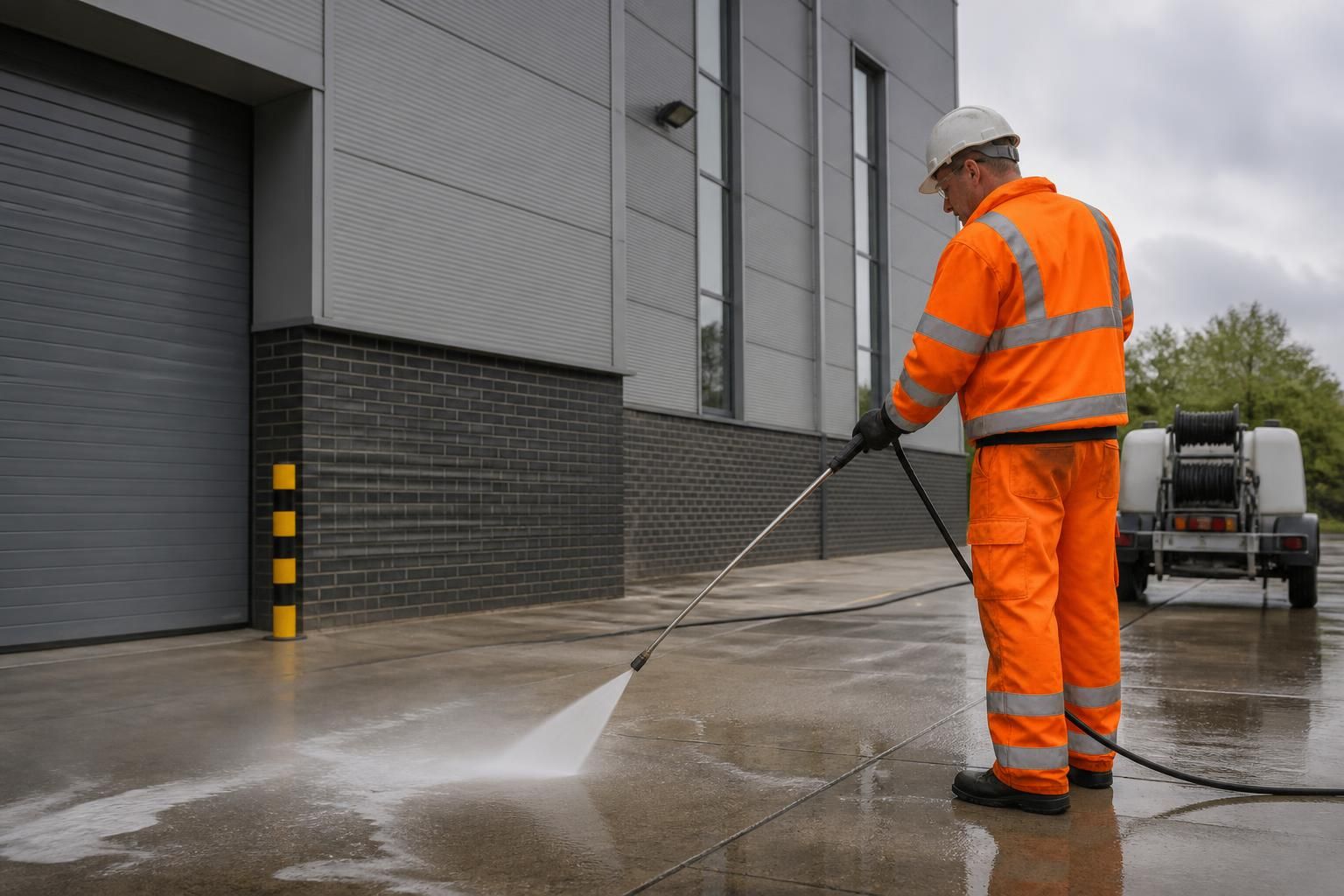
Commercial jet washing equipment should be selected according to the surface material, required cleaning pressure and flow rate, access conditions, available water and power supplies, runoff controls, and the scale of the work. The most powerful machine is not automatically the most suitable: excessive pressure, heat or water volume can damage façades, coatings, joints and drainage systems, while equipment that is underpowered can produce inconsistent results and extend the time that a site is disrupted.
Surface material and condition
The substrate is the starting point for equipment selection. Concrete, block paving, brickwork, natural stone, metal cladding, render, painted surfaces, roofing materials and composite panels all respond differently to pressure, temperature and cleaning chemicals. Older or weathered materials may have weakened joints, surface erosion, loose coatings or concealed defects that are not apparent during a brief inspection.
Operators should establish whether the surface is porous, polished, coated, painted, jointed or vulnerable to heat. A lower-pressure system with a suitable detergent may be preferable for delicate façades, whereas robust concrete or heavily soiled industrial yards may require higher flow and specialist surface-cleaning attachments. Test cleaning in an inconspicuous area helps confirm that the selected settings will remove contamination without causing etching, discolouration, water ingress or coating failure.
Pressure and flow rate
Pressure determines the force available to break the bond between the surface and the contamination. Flow rate determines how much water reaches the surface and how quickly loosened material is flushed away. Both need to be considered together. A high-pressure, low-flow machine may remove some deposits effectively but can leave residues, whereas a higher-flow system may clean large areas more efficiently at a lower operating pressure.
The correct setting should match the type of contamination. Oil, traffic film, algae, moss, chewing gum, cement residues, carbon deposits and loose dirt each require different combinations of pressure, water volume, temperature, dwell time and, where appropriate, detergent. Adjustable pressure controls and interchangeable nozzles allow the operator to refine the cleaning action rather than applying one setting across the whole site.
It is also important to distinguish the manufacturer’s maximum pressure from the pressure used at the surface. Nozzle type, distance, spray angle and hose length affect the working result. Equipment should therefore be assessed by its controllability and performance in real operating conditions, not by its headline specification alone.
Cold-water or hot-water cleaning
Cold-water equipment is suitable for many general exterior cleaning tasks, including the removal of loose dirt, dust, algae and some surface staining. Hot-water systems can improve the removal of grease, oil, traffic film and other organic or oily contamination, often reducing the need for aggressive chemical treatment. Heat can also assist with chewing gum and certain ingrained deposits.
However, temperature must be controlled where surfaces contain heat-sensitive coatings, sealants, membranes or plastics. The selected system should provide accurate temperature adjustment and allow the operator to work within the limits identified during the site assessment. Fuel storage, ventilation, fire precautions and exhaust positioning also need to be considered when using heated equipment.
Water supply and water efficiency
The site survey should confirm whether a suitable mains supply is available, whether the flow is adequate for the chosen machine and whether a holding tank or alternative supply is needed. Pressure washing equipment cannot perform consistently if the incoming supply is restricted, and inadequate water supply can cause pump damage or interruptions.
Water use matters particularly on large sites, in areas with limited drainage and where wastewater must be contained. Equipment with an appropriate flow rate, trigger control and efficient nozzle design can reduce unnecessary consumption without compromising cleaning quality. The operator should also plan how water will be directed, contained, filtered, collected or discharged in accordance with site requirements and applicable environmental controls.
Runoff recovery and wastewater management
Where cleaning may mobilise oil, silt, paint, chemical residues, biological growth or other pollutants, standard jet washing equipment may need to be supplemented with drain covers, bunding, wet vacuums, filtration units, pumps or water-recovery systems. Equipment selection should reflect the destination of the runoff, not just the cleaning task itself.
On car parks, forecourts, industrial yards and sites close to watercourses, the contractor should identify drainage points before work begins and prevent contaminated water entering surface-water systems. Recovery equipment must have sufficient capacity for the planned operation and be compatible with the expected solids and contaminants. This is an operational and environmental requirement, as well as a matter of good site management.
Access, reach and portability
Buildings and commercial sites often include canopies, roofs, elevated façades, loading bays, plant areas and restricted service yards. The equipment must be compatible with the access method, whether that involves ground-based telescopic systems, mobile elevated work platforms, scaffolding, towers, roof access systems or rope access.
Hose length, machine weight, lifting points, cable routing and the position of the water and power supply can affect both productivity and safety. Equipment carried to height must be suitable for the access system and must not exceed platform, roof or lifting limits. Long hoses can improve reach but may reduce pressure at the nozzle, create trip hazards or make handling more difficult. Compact equipment may be more suitable for congested sites, while trailer-mounted or high-capacity systems may be appropriate for extensive external areas.
Power source and operating environment
The choice between electric, petrol or diesel-powered equipment depends on the site, the required output and the available supply. Electric systems can be appropriate for enclosed or noise-sensitive areas, provided the electrical installation, residual-current protection, cable management and environmental conditions are suitable. Combustion-powered equipment may provide greater independence from the site’s electrical supply, but requires ventilation, fuel controls and careful management of exhaust emissions.
Operators should check whether the equipment can be used safely in wet conditions, near electrical installations, in confined areas or around combustible materials. Noise levels may also be important near offices, residential properties, hospitals, schools or occupied premises. Where work takes place during trading or operating hours, quieter equipment, temporary screening and appropriate scheduling may reduce disruption.
Safety features and operator control
Commercial equipment should include reliable trigger guns, emergency stop arrangements where appropriate, pressure regulation, secure hose connections and guards around moving or hot components. Hoses, couplings, lances and nozzles must be rated for the operating conditions and inspected before use. Damaged or poorly matched components can fail under pressure and create serious risks.
Equipment selection should also account for kickback, vibration, manual handling and the need to maintain stable footing. Surface-cleaning tools, rotary cleaners and extendable lances can improve control and reduce splash compared with unsuitable hand-held techniques. The system must still be operated by trained personnel using suitable personal protective equipment, including eye and face protection, gloves, protective footwear and hearing protection where required.
Attachments and specialist accessories
The right accessory can be as important as the main pump. Rotary surface cleaners can provide a more even finish on expansive hard surfaces and help contain spray. Telescopic lances may improve reach from ground level, while soft-washing or low-pressure systems can be more appropriate for fragile surfaces and biological growth. Gutter and drain-cleaning tools, wet vacuums, foam applicators, turbo nozzles and specialist gum-removal attachments each have specific uses.
Accessories should be chosen for the substrate and contamination rather than used simply because they are available. For example, a concentrated rotating jet may be unsuitable for friable brickwork, pointing or coated metal. The contractor should be able to explain why a particular nozzle, tool or cleaning method has been selected and how it will be controlled on the site.
Reliability, maintenance and suitability for continuous work
Commercial projects place greater demands on pumps, heaters, hoses and electrical components than occasional domestic use. Equipment should be robust enough for the expected duty cycle and supported by a planned maintenance regime. Important considerations include service access, availability of replacement parts, hose and nozzle condition, pump protection, descaling requirements and inspection records.
Backup arrangements may be necessary where cleaning is tied to a construction programme, planned shutdown or operational deadline. A contractor should assess whether a second machine, replacement components or an alternative cleaning method is available if the primary unit develops a fault. Reliability reduces disruption, but it should never be achieved by overlooking pre-use checks or continuing to operate defective equipment.
Scale, productivity and total cost
Equipment should be proportionate to the area, level of soiling and access restrictions. A small, easily manoeuvred unit may be the most efficient choice for detailed façade work or confined areas, while larger sites may justify higher-capacity equipment, multiple operators or dedicated recovery systems. Productivity should be assessed alongside preparation, setup, water handling, access changes and final rinsing, rather than by machine output alone.
Cost comparison should include fuel or electricity, water, detergents, transport, maintenance, access equipment, wastewater disposal and the time required to complete the work safely. A lower purchase or hire cost may not represent value if the equipment produces poor results, uses excessive water, requires repeated passes or increases the risk of surface damage.
How the selection decision should be made
A competent contractor should carry out a site assessment before confirming the equipment. This should cover the materials and their condition, contamination type, working height, access and exclusion zones, water and power supplies, drainage, runoff controls, noise restrictions, weather exposure and the client’s operating requirements. The proposed pressure, temperature, flow rate, attachments and recovery arrangements should then be documented in the method statement and risk assessment.
For complex commercial or industrial work, equipment selection is therefore part of the overall cleaning design. Matching the machine to the surface, access method and environmental controls produces a more consistent result while reducing the likelihood of damage, disruption, excessive water use and unsafe working practices.
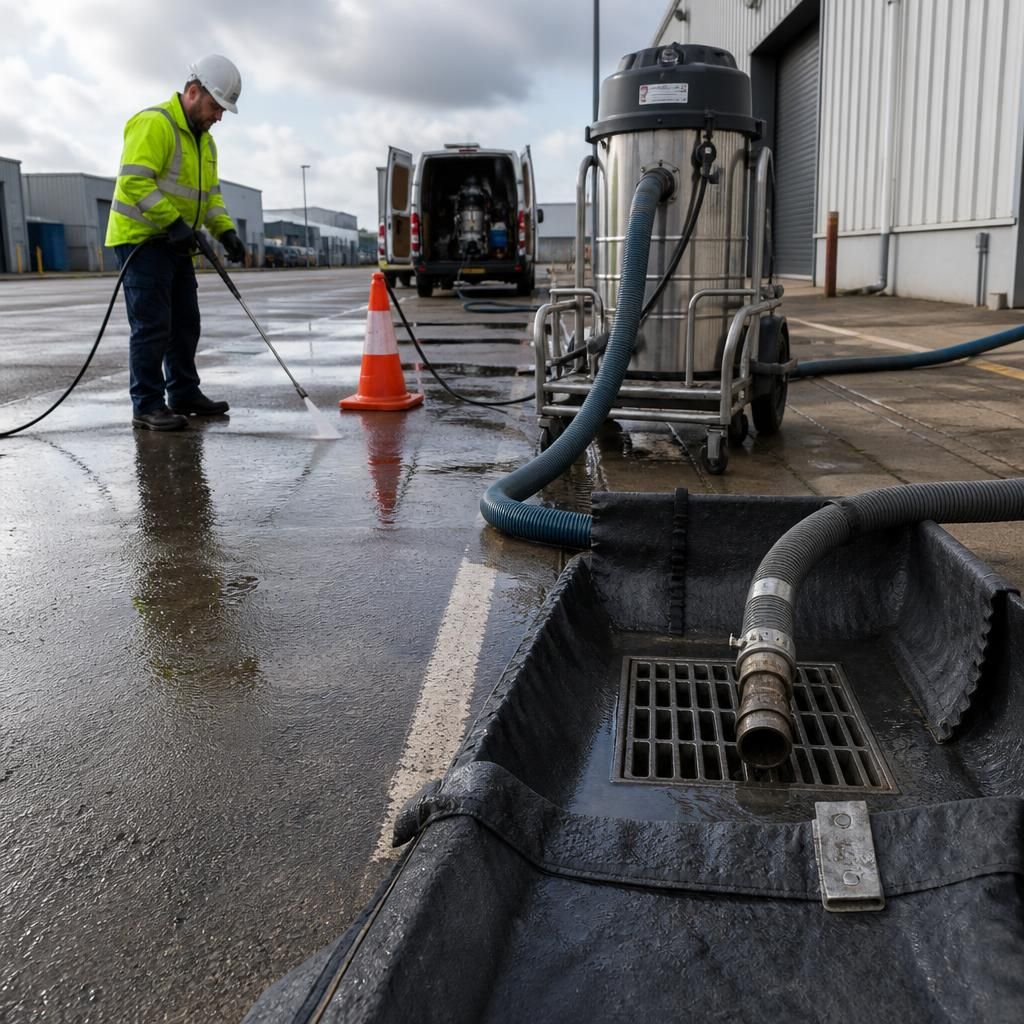
Commercial jet washing equipment must be selected for wastewater control as well as cleaning performance. Where washing may mobilise oil, silt, paint or cleaning chemicals, the setup may need drain covers, bunding, wet vacuums, filtration or recovery tanks to prevent contaminated runoff entering surface-water drains.
Recovery equipment should match the site layout, expected water volume and type of solids present. This is particularly important on car parks, forecourts, industrial yards and sites near watercourses. Planning containment before work starts helps maintain compliance with site requirements and avoids relying on unsuitable drainage during the cleaning operation.