
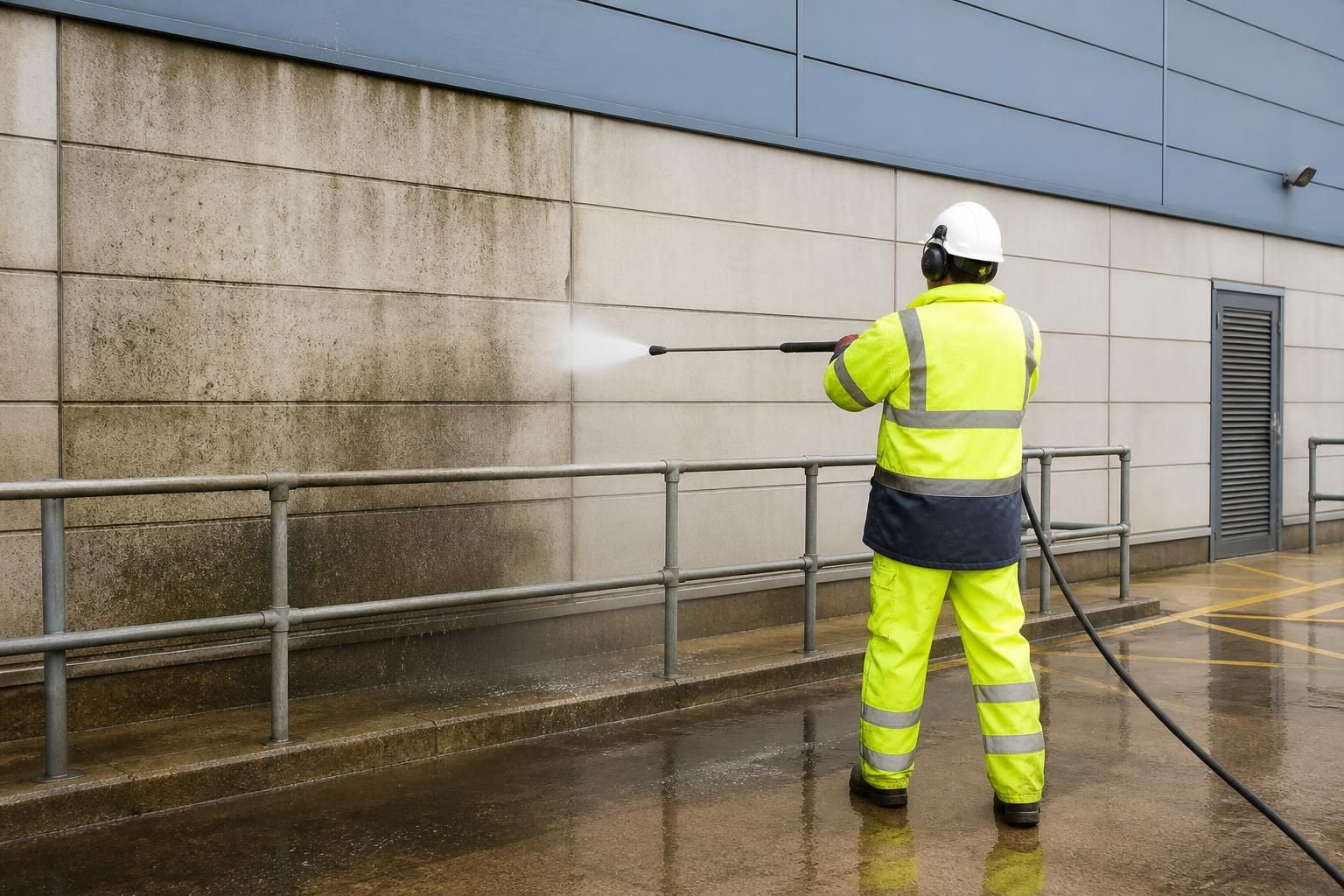
What certifications and experience should a commercial jet washing provider have?
A commercial jet washing provider should have documented pressure-washing training, suitable public and employers’ liability insurance, and recognised health and safety credentials such as SSIP accreditation where required by the client or site. Experience should include comparable commercial projects, safe use of access equipment such as IPAF- or PASMA-supported systems, surface-specific cleaning methods, and the preparation of appropriate risk assessments and method statements.
A competent commercial jet washing provider should be able to demonstrate relevant pressure-washing training, suitable insurance, robust health and safety procedures, and experience with projects comparable to yours. There is no single UK licence that covers every type of commercial jet washing, so a reliable assessment should consider the operator’s qualifications, site controls, equipment competence, environmental procedures and evidence of previous work together.
Relevant training and technical competence
Operators should have documented training in the safe use of pressure-washing equipment, including the selection of pressure, flow rate, temperature and cleaning products for different surfaces. Training should cover safe start-up and shut-down procedures, hose management, reaction forces, electrical safety, chemical handling, personal protective equipment and the risks created by flying debris, contaminated water and slippery surfaces.
Experience matters because a machine can damage stone, brick, render, cladding coatings, asphalt, concrete or jointing if it is used incorrectly. A competent provider should understand when a lower-pressure system, steam cleaning, soft washing or a controlled chemical treatment is more appropriate than conventional high-pressure cleaning. They should also be prepared to carry out a test clean or agree a small trial area before treating a sensitive or unfamiliar surface.
Health and safety qualifications and systems
The contractor should be able to provide a clear risk assessment and method statement for the planned work. These documents should address access, pedestrians, vehicles, water and electrical services, falling objects, traffic management, surface condition, weather, chemicals, wastewater and emergency arrangements. Generic documents that do not reflect the actual building or work area are less useful than site-specific controls.
Useful evidence may include training or competence in:
- Working at height, where operatives will use ladders, towers, mobile elevating work platforms, roof access systems or other elevated arrangements.
- IPAF-supported competence for relevant powered access equipment and PASMA-supported training for mobile access towers, where those systems are used.
- Manual handling, personal protective equipment, electrical safety and the control of slips, trips and falls.
- COSHH assessment and chemical-handling procedures for detergents, biocides, degreasers and other treatment products.
- Asbestos awareness where the work may take place on older buildings or near materials that could contain asbestos. Jet washing should not disturb suspected asbestos-containing materials, and specialist advice may be required.
- First aid, emergency response and site-specific induction where the project is carried out on a construction, industrial or publicly accessible site.
A provider may also hold SSIP accreditation or an equivalent recognised health and safety assessment. This can help demonstrate that its policies, insurance and operating procedures have been independently reviewed, particularly when working for a managing agent, principal contractor, local authority or large commercial organisation. Accreditation is useful evidence, but it does not replace checking the actual method statement and the competence of the operatives assigned to the job.
Insurance and legal responsibilities
Ask for current insurance documentation before work begins. Employers’ liability insurance is generally required where the business employs staff, while public liability insurance protects against claims involving third parties or property. The level and scope of cover should be appropriate to the size, location and risks of the contract. If the work involves advice, design or specification as well as cleaning, it may also be appropriate to check whether professional indemnity cover is held.
Insurance should not be treated as proof of technical competence. Check that the policy covers the activities being commissioned, including work at height, chemical use, damage to buildings and work on occupied or public-facing premises. A reputable contractor should provide certificates promptly and identify any relevant exclusions.
Experience with comparable commercial work
Commercial experience should be relevant to the premises and surfaces involved, rather than based only on the length of time the company has traded. Ask whether the provider has completed similar work on:
- Large façades, cladding panels, render, brickwork and architectural details.
- Roofs, canopies, loading areas and other locations where access and water control are significant.
- Car parks, forecourts, service yards, pedestrian routes and other areas that need traffic or public segregation.
- Industrial premises where oil, grease, process residue or other contamination may be present.
- Listed, delicate, coated or otherwise sensitive surfaces requiring controlled cleaning.
- Occupied buildings where noise, overspray, access routes and business continuity must be managed.
Evidence may include relevant case studies, photographs, method statements, references from comparable clients or a clear explanation of how a previous project was planned and controlled. Photographs alone do not prove that the same result or method is suitable for another building, so the provider should be able to explain the surface assessment, equipment selection, protection measures and completion checks.
Competence in access equipment and site control
Many commercial projects involve more than operating a washer from ground level. If powered access, towers, roof systems or specialist platforms are required, ask who will plan the access arrangement, inspect the equipment and operate it. The provider should confirm that equipment is suitable for the ground conditions, working height, reach, load and surrounding hazards.
Good site control should include barriers, warning signs, exclusion zones and a safe route for pedestrians and vehicles. On car parks, forecourts and loading areas, the contractor should explain how vehicles will be diverted or areas temporarily closed. Where hoses cross routes, they should be managed to prevent trip hazards and damage. The method should also account for falling debris, overspray, wind and water entering doorways, vents or electrical installations.
Environmental and wastewater competence
A responsible provider should understand that contaminated wash water must not simply be allowed to enter surface-water drains. Before cleaning, they should identify drainage arrangements, protect vulnerable outlets and explain how wastewater, silt, oils, chemicals and cleaning residues will be contained, recovered or disposed of. The correct approach depends on the site, the contamination and local water and waste requirements.
Ask how the contractor will minimise water and chemical use, prevent runoff, handle removed debris and protect nearby planting, watercourses and neighbouring property. Environmental management systems such as ISO 14001 can provide additional evidence of structured controls, but practical site arrangements remain the most important consideration.
Quality management and documentation
Useful documentation should normally include a written quotation or scope, risk assessment, method statement, insurance certificates, chemical information where relevant, access arrangements and any required permits. For ongoing contracts, agree how defects, missed areas, damage, complaints and follow-up cleaning will be recorded and resolved.
Quality checks should cover the agreed areas, surface condition, remaining staining, overspray, blocked or protected drainage points, residue and any damage identified before or after cleaning. A pre-work inspection with photographs can help distinguish existing defects from damage arising during the operation.
Questions to ask before appointing a provider
- What training do the operatives assigned to this site hold, and is it relevant to the equipment and access method proposed?
- Can you provide current employers’ liability and public liability insurance certificates?
- Have you cleaned comparable surfaces and premises, and can you provide relevant references or case studies?
- Will you supply a site-specific risk assessment and method statement?
- How will you control pedestrians, vehicles, overspray, hoses, noise and access during the work?
- How will wastewater and cleaning residues be contained and disposed of?
- What inspection or test-cleaning process will be used before full-scale cleaning?
- Who is responsible for access equipment, permits, site inductions and emergency arrangements?
The strongest provider is not necessarily the one listing the greatest number of certificates. It is the contractor that can connect its training and experience to the specific site, select a safe method for each surface, produce credible documentation, manage wastewater responsibly and communicate clearly before, during and after the work.
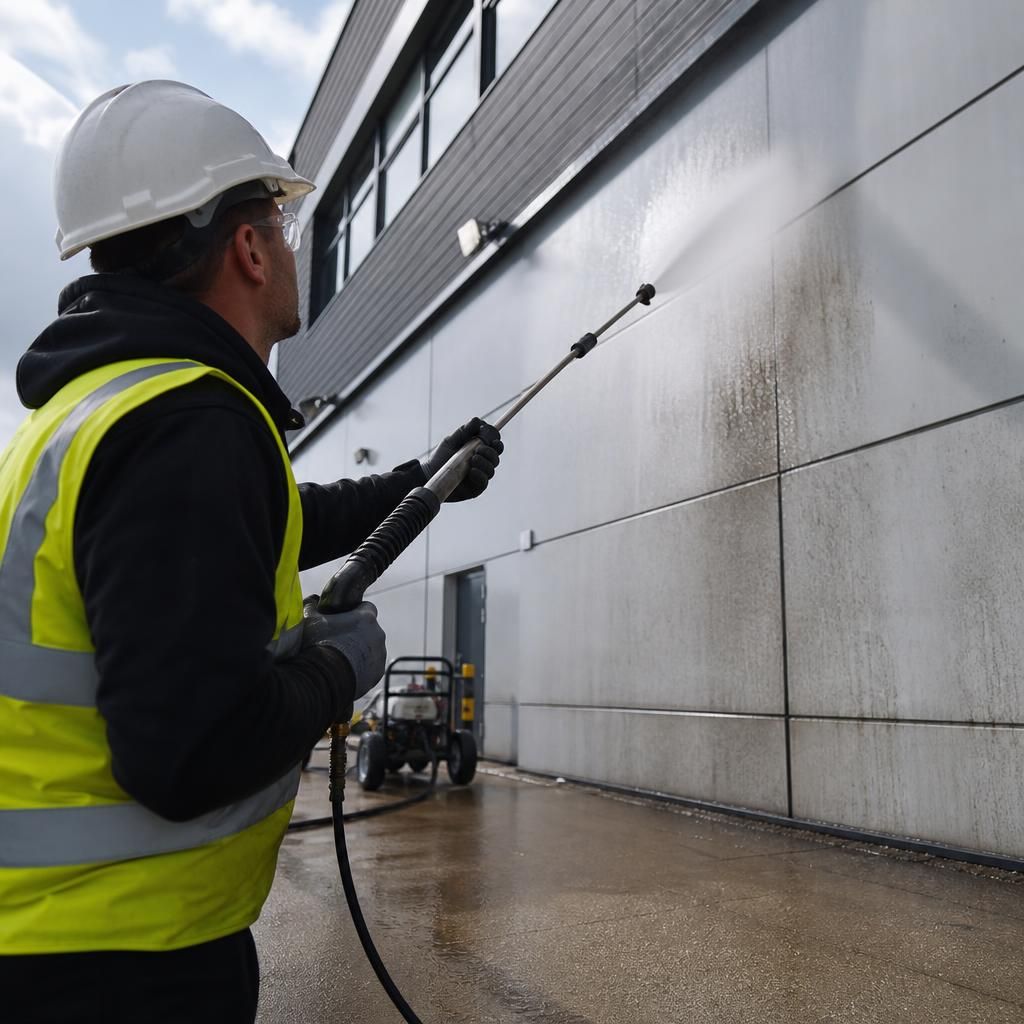
Certifications are useful evidence, but they should match the work being carried out. For example, a provider using powered access equipment should be able to demonstrate relevant operator competence, while work involving chemicals, roofs or occupied premises requires additional controls and site-specific planning.
Before work starts, ask to see the proposed risk assessment and method statement, together with current insurance documents and details of the operatives assigned to the project. These should explain how the contractor will protect people and property, control access, manage wastewater and respond to changing site conditions. Relevant experience is demonstrated by applying this knowledge to comparable façades, roofs, car parks or industrial areas—not simply by listing certificates.