
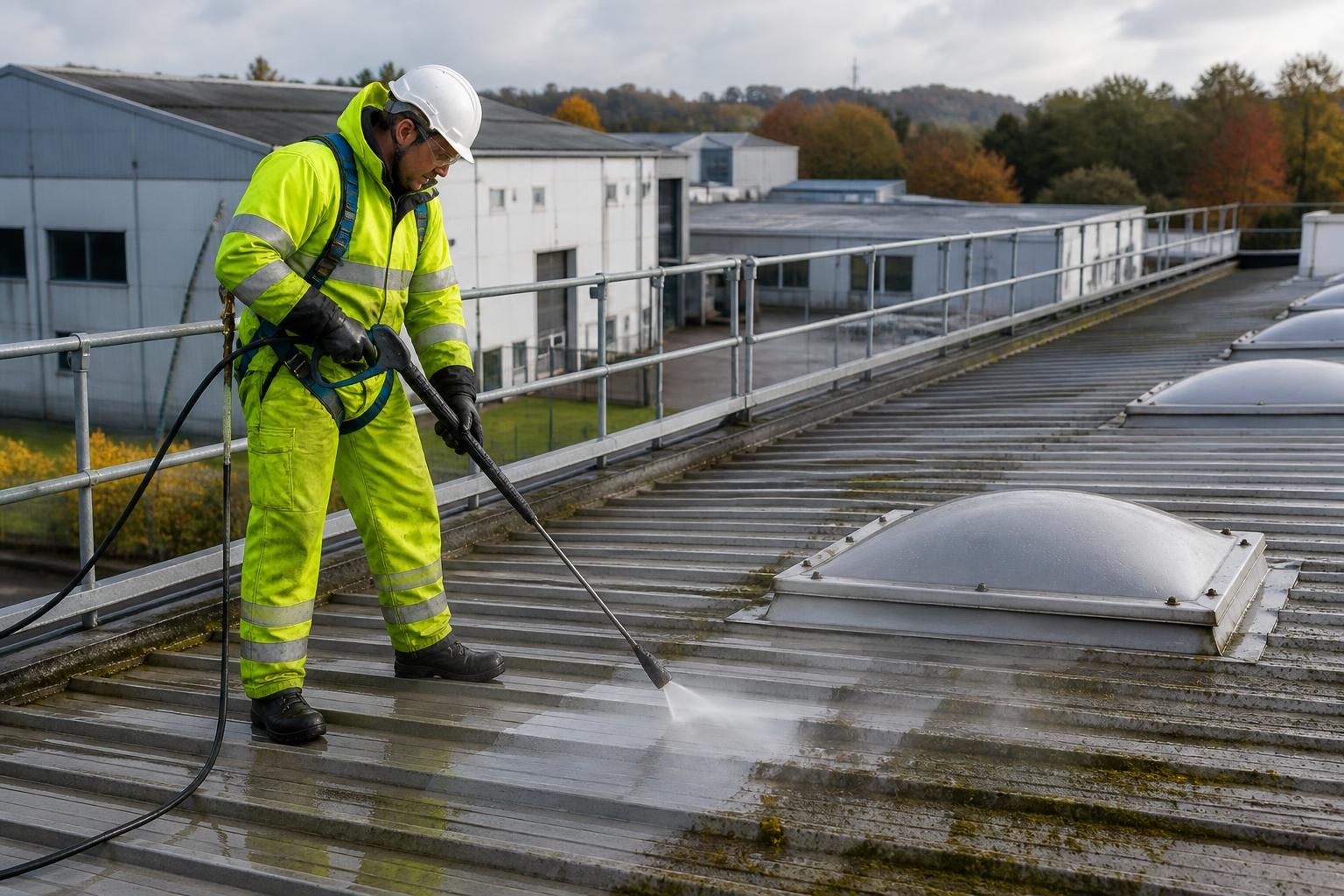
What measures should be taken to prevent potential water ingress or structural damage during the roof and canopy jet washing process?
Preventing water ingress or structural damage during roof and canopy jet washing requires a pre-cleaning inspection, protection of vulnerable openings and joints, controlled water pressure, and careful management of drainage. Operatives should avoid damaged areas, keep outlets clear, use suitable access equipment, and stop work if leaks, movement or concealed defects are identified.
Preventing water ingress and structural damage during roof and canopy jet washing depends on a documented pre-cleaning inspection, suitable equipment settings, protection of vulnerable details, and continuous control of water and access loads. Cleaning should be adapted to the construction, condition and drainage arrangement of the roof or canopy rather than carried out using a standard pressure-washing approach.
Inspect the roof or canopy before work begins. The operative should identify the covering, membrane, cladding or glazing system and check its condition before selecting a cleaning method. Particular attention is required around laps, seams, flashings, abutments, parapets, rooflights, gutters, outlets, expansion joints, sealants, fixings and service penetrations. Existing cracks, loose components, failed seals, corrosion, deflection or saturated areas should be recorded and, where appropriate, reported to the responsible person before cleaning starts.
A pre-cleaning inspection should also establish whether the roof is suitable for foot traffic or requires work from a cherry picker, scaffold, mobile access tower or other suitable equipment. Operatives must not use fragile rooflights, unsupported sheets, gutters or canopy panels as working platforms. Where the condition or construction cannot be confirmed, the area should be treated as vulnerable until a competent survey or other suitable information is available.
Use a site-specific method statement and risk assessment. The planned process should define the cleaning equipment, pressure and flow settings, detergents, access arrangements, protection measures, drainage controls and inspection points. It should also identify sensitive internal areas beneath the roof or canopy, including entrances, electrical equipment, stockrooms, offices and occupied spaces. This allows the team to plan containment or temporary protection before water is introduced.
Keep pressure and spray direction under control. Jet washing should use the lowest effective pressure and flow for the surface and level of soiling. High pressure can force water beneath laps, behind cladding, through deteriorated sealant or into ventilation and service openings. It can also lift coatings, damage membranes, loosen pointing or worsen existing defects. Operatives should use suitable nozzles, maintain a safe working distance and avoid concentrating the spray on joints, edges, penetrations and damaged areas.
Water should generally be directed away from vulnerable details and towards planned drainage points. A broad, controlled spray may be more appropriate than a narrow, aggressive jet on many roof and canopy surfaces. Settings should be tested in an inconspicuous area and adjusted if the covering moves, delaminates, sheds material or allows water to pass into the building.
Protect openings and sensitive components. Before washing, operatives should identify and protect or temporarily seal suitable non-permanent openings, including vents, roof access hatches, service penetrations, door thresholds and gaps around equipment. Protection must not obstruct essential ventilation, create a trip hazard or conceal a defect. Electrical installations and other water-sensitive equipment should be isolated or shielded in accordance with the site’s procedures, with the relevant responsible person consulted where necessary.
Rooflights and translucent canopy panels require particular care. They may be fragile, weathered or inadequately supported, even when they appear intact. They should not be used for access, and the spray should not be directed at their edges or seals at close range. Any cracked or loose panel should be reported rather than treated as a normal cleaning surface.
Manage water and drainage throughout the work. Gutters, valleys, channels, outlets and downpipes should be checked before washing and kept free from loosened dirt, moss and debris. Blocked drainage can cause temporary ponding, overflow across vulnerable joints and uncontrolled discharge into the building. Where debris is likely to accumulate, it should be removed progressively rather than allowed to reach outlets at the end of the clean.
Water should be controlled so that it does not run towards entrances, wall cavities, loading bays or areas containing sensitive equipment. Temporary sheeting, drain covers, collection points or wet vacuums may be appropriate, provided they are installed safely and do not cause flooding elsewhere. Run-off should also be managed in line with the site’s environmental and drainage requirements, particularly where cleaning agents or contaminated deposits are involved.
Use access equipment without overloading the structure. Access platforms and vehicles must be selected for the ground conditions, reach and working height, with outriggers, mats and exclusion zones used where required. Equipment should not be positioned on a roof or canopy unless its load-bearing capacity has been confirmed. Operatives should distribute materials sensibly, avoid storing hoses or equipment on fragile coverings and prevent impact from platforms, ladders and tools.
Hoses should be routed to avoid abrasion against membranes, sharp edges and flashings. They should also be secured or positioned so that they cannot pull on fittings, obstruct drainage or create a trip hazard. The work area should be kept orderly because displaced equipment can damage a surface as readily as excessive water pressure.
Consider weather and building use. Cleaning should be postponed or amended when wind could drive spray into openings, when freezing conditions could turn water into ice, or when heavy rain would overwhelm drainage controls. Extreme heat may affect some sealants, coatings and membranes. The site team should also agree suitable working periods to avoid exposing occupied areas, stock or electrical systems to avoidable moisture.
Monitor the interior and the roof during cleaning. Where the building is occupied or contains vulnerable contents, checks should be made below the work area while washing is underway. Operatives should look for damp patches, dripping, movement, unusual deflection, displaced components, blocked outlets or changes in the condition of seals and joints. The inspection should continue after rinsing, because water can travel through concealed routes and appear internally after a delay.
If water enters the building, a component moves, a rooflight flexes, drainage backs up, or a concealed defect becomes apparent, cleaning should stop in that area. The source should be isolated where possible, the affected person on site informed, and the condition recorded. Further work should not resume until the cause has been assessed and a safe, suitable method has been agreed.
Complete a post-cleaning inspection. On completion, outlets and channels should be checked again, temporary protection removed safely, and internal or adjacent areas inspected for signs of water ingress. The roof or canopy should be reviewed for disturbed fixings, damaged coatings, exposed substrate, failed sealant or other changes caused or revealed by the cleaning process. Any pre-existing or newly identified defect should be documented with clear photographs and referred for repair rather than concealed by further washing.
These measures reduce the risk of damage, but jet washing cannot make an inherently defective roof watertight. Cleaning should therefore be treated as a controlled maintenance operation, not a substitute for roof repairs, sealant renewal, drainage work or a specialist structural assessment where those requirements have been identified.
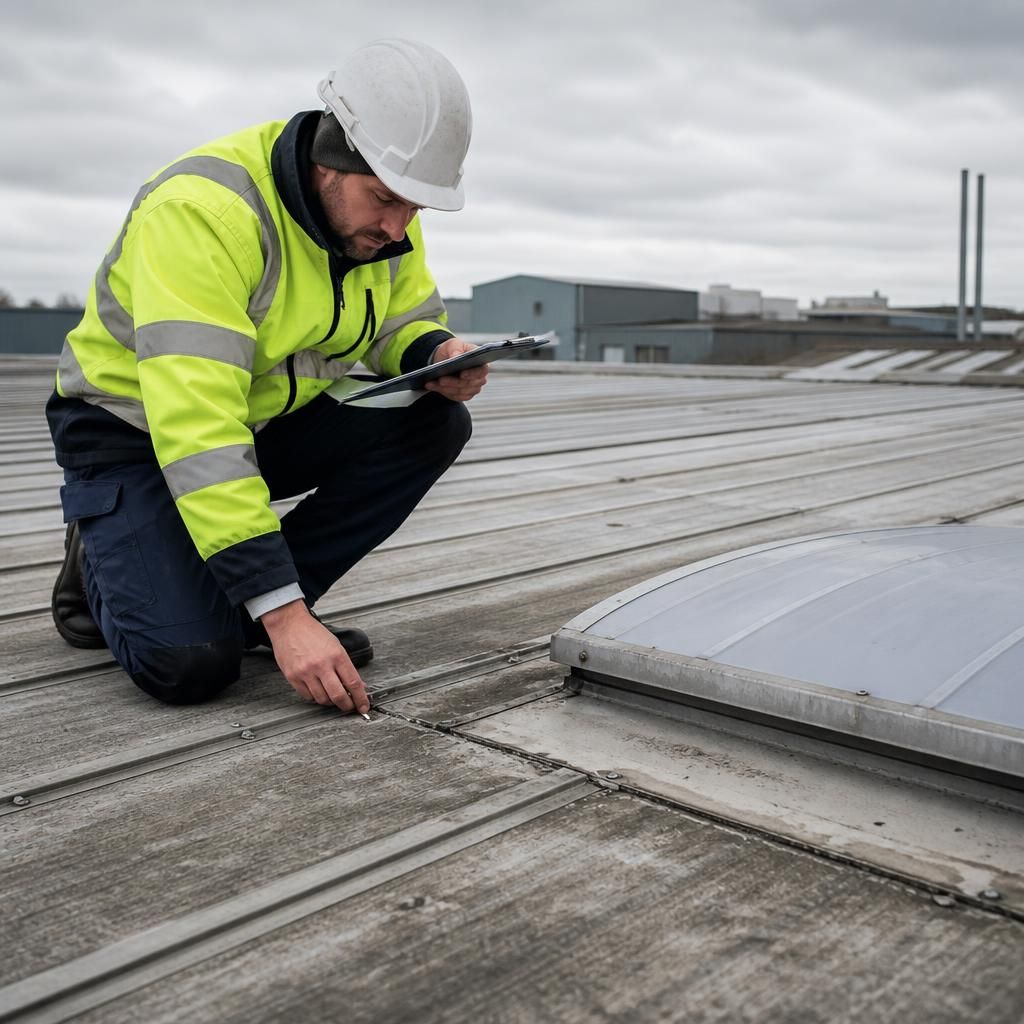
Pre-cleaning inspection is the primary safeguard against water ingress and structural damage during roof and canopy jet washing. The operative should identify fragile coverings, rooflights, failed sealants, open joints, service penetrations, drainage outlets and existing signs of movement or deterioration before water is applied.
These findings determine the safe cleaning method. Vulnerable areas should be protected or avoided, pressure and spray direction adjusted, and gutters and outlets kept clear so water cannot pond or discharge through defective details. If movement, leakage or concealed damage is identified, cleaning should stop in that area until the condition has been assessed.