
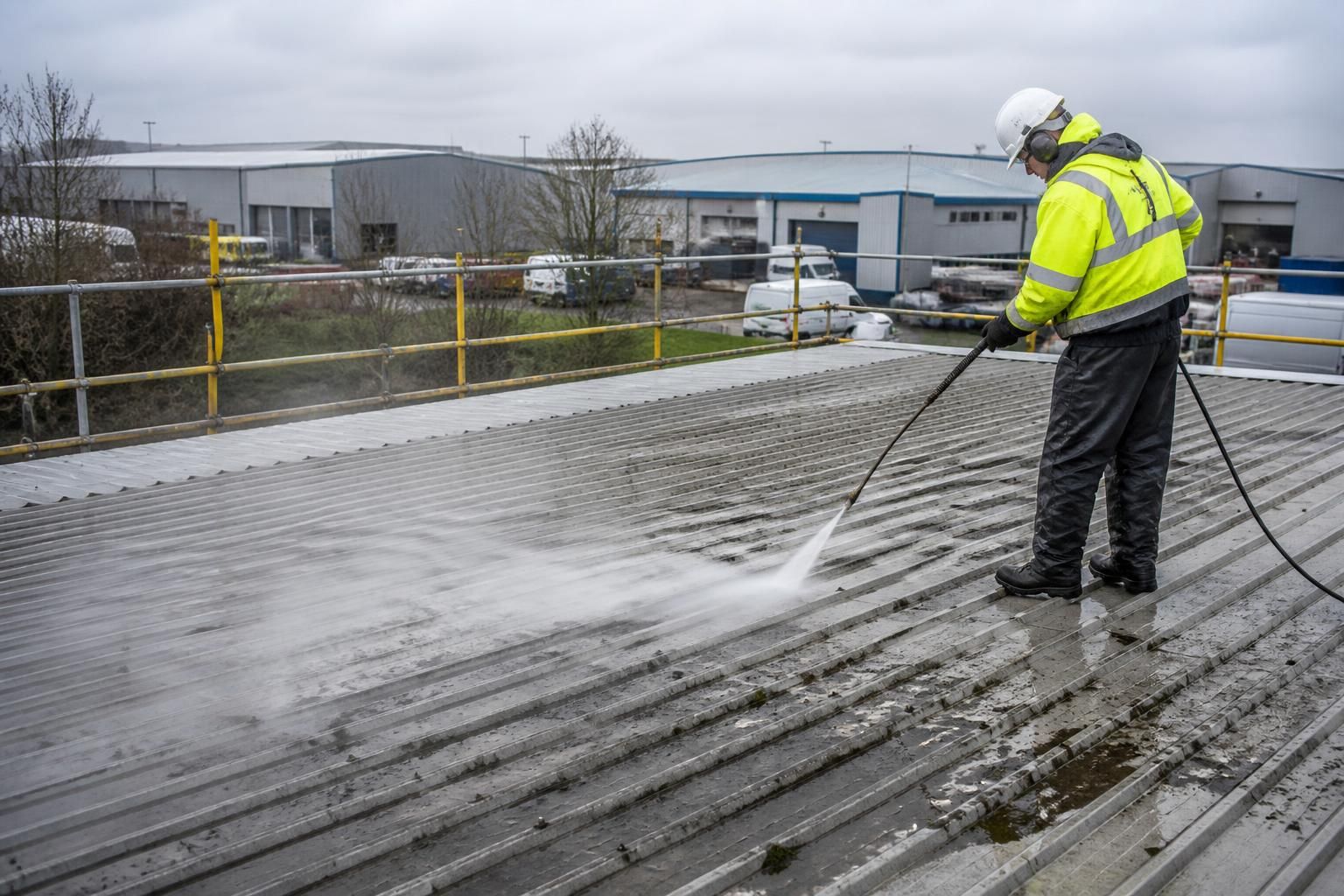
How often should roof and canopy jet washing be performed on commercial properties?
Commercial roofs and canopies should generally be professionally jet washed as part of an annual maintenance programme, with more frequent cleaning where there is heavy traffic, nearby trees, industrial pollution, food residue or persistent moss and algae. The correct interval should be confirmed after assessing the surface, drainage, exposure and existing contamination.
Commercial roofs and canopies should usually be professionally jet washed as part of an annual maintenance programme. More frequent cleaning may be appropriate where there is heavy foot or vehicle traffic, nearby vegetation, industrial pollution, food residue, bird fouling, persistent moss or algae, or drainage that regularly becomes blocked. The correct interval should be confirmed through a site assessment rather than applied as a fixed rule.
Jet washing is only one part of planned exterior maintenance. A suitable programme should combine routine inspections, removal of loose debris, checks to drainage outlets and, where appropriate, low-pressure or steam cleaning instead of high-pressure water. The method and frequency must reflect the roof or canopy material, its condition, construction and exposure.
Factors that affect cleaning frequency
- Location and surroundings: Buildings beneath trees or close to woodland can collect leaves, seeds, sap and organic growth more quickly. Premises near roads, manufacturing sites or construction activity may also accumulate soot, dust and airborne deposits.
- Use of the property: Canopies above entrances, loading bays, walkways, service yards and car parks are exposed to more dirt and contact than less accessible roof areas. Food premises may require closer attention where grease, oils or food residue are carried onto external surfaces.
- Water drainage: Flat and shallow-pitched roofs depend on clear outlets, gutters and channels. If debris or biological growth restricts drainage, cleaning and inspection may be needed before the next scheduled service.
- Surface and construction: Coated metal, concrete, membrane roofs, polycarbonate, glazed canopies and other materials have different tolerances. Some should not be subjected to aggressive pressure or unsuitable detergents, particularly where coatings, seals or joints are deteriorating.
- Existing contamination: Moss, algae, lichen, bird fouling and ingrained atmospheric deposits can vary considerably between elevations. A heavily contaminated roof may need an initial deep clean followed by planned maintenance visits.
- Condition and age: Older roofs and canopies may have fragile finishes, exposed fixings, failed sealant or previous water-ingress issues. These conditions can require repair, specialist cleaning or a gentler method before jet washing is considered.
Typical maintenance approach
For many commercial premises, an annual clean is a practical starting point, particularly when scheduled alongside roof inspections and other planned building maintenance. This interval helps prevent deposits becoming firmly established and allows defects affecting drainage, coatings, flashings and seals to be identified early.
Some sites benefit from cleaning more often. A shorter interval may be justified where a canopy is highly visible to customers, where entrances must remain presentable, or where contamination returns quickly. Industrial premises, sites with extensive tree cover and buildings affected by heavy bird activity may need additional inspection and spot-cleaning visits between full cleans.
Conversely, a roof with limited contamination and good drainage may not require full jet washing every year. It should still be inspected at an appropriate interval, because a visual check can identify blocked outlets, standing water, damaged membranes, loose trims and other issues that cleaning alone will not resolve.
When to arrange an additional clean
- Water is ponding on a flat roof or canopy after rainfall.
- Gutters, outlets or drainage channels are obstructed by leaves, silt or organic growth.
- Moss, algae or lichen is spreading across the surface or entering joints and edges.
- Bird fouling, grease, oil or other deposits are affecting hygiene, appearance or slip risk.
- Run-off is staining façades, paving, vehicles or customer access areas.
- The building is due to undergo an inspection, letting, handover, refurbishment or external redecoration.
- A previous cleaning treatment has not controlled recurring contamination.
Timing also matters. Cleaning is generally easier to plan during a period of stable weather, when the surface can be assessed safely and treated areas can dry properly. However, the work should not be scheduled solely for appearance if a blocked drain, active leak or hazardous build-up requires earlier attention. Weather conditions, access requirements and the risk of run-off must be reviewed before work starts.
Why an assessment is important
A professional assessment should establish what the surface is made from, how it is accessed, where water will discharge, whether there are fragile areas and which cleaning method is suitable. High-pressure jet washing is not appropriate for every roof or canopy. Excessive pressure or incorrect nozzle selection can damage coatings, force water beneath laps and seals, disturb pointing or create avoidable water-ingress risks.
Where pressure washing is unsuitable, a controlled low-pressure process, steam cleaning, soft washing or manual treatment may provide a safer result. Cleaning agents must also be selected for the surface and contamination, with suitable controls for nearby planting, drainage systems, occupants and the wider environment.
Recommended scheduling process
- Arrange an initial inspection to record contamination, surface condition, drainage and access constraints.
- Complete any necessary repairs or clearance before washing, rather than using cleaning to mask defects.
- Set a planned cleaning interval based on how quickly contamination returns and how the site is used.
- Review the roof or canopy after cleaning and record any areas that need monitoring.
- Adjust the schedule if inspections show recurring blockages, accelerated biological growth or damage.
For most commercial properties, an annual professional clean supported by routine inspections is a sensible baseline. The interval should then be increased or reduced according to the site’s exposure, contamination, drainage and surface condition. This planned approach helps maintain appearance and hygiene while reducing the likelihood that debris, organic growth or aggressive cleaning will contribute to avoidable repair costs.
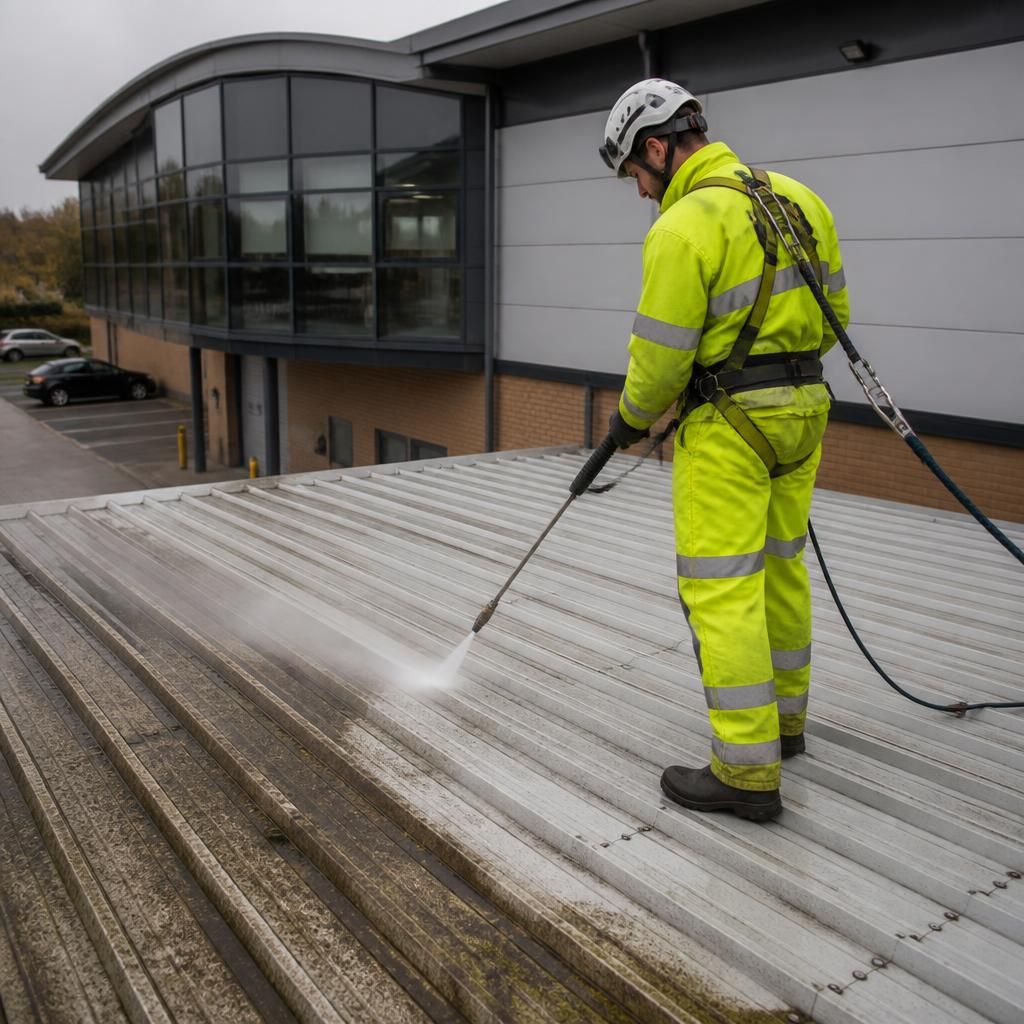
For most commercial properties, annual professional roof and canopy jet washing is a sensible starting point, supported by routine inspections. The interval should be shortened where leaves, moss, algae, bird fouling, industrial deposits or blocked drainage return quickly.
Cleaning frequency should be reviewed after each visit. If contamination is recurring or water is not draining freely, additional cleaning or earlier maintenance may be needed. A site assessment also confirms whether jet washing is suitable, as fragile membranes, coatings, seals and joints may require low-pressure or steam cleaning instead.