
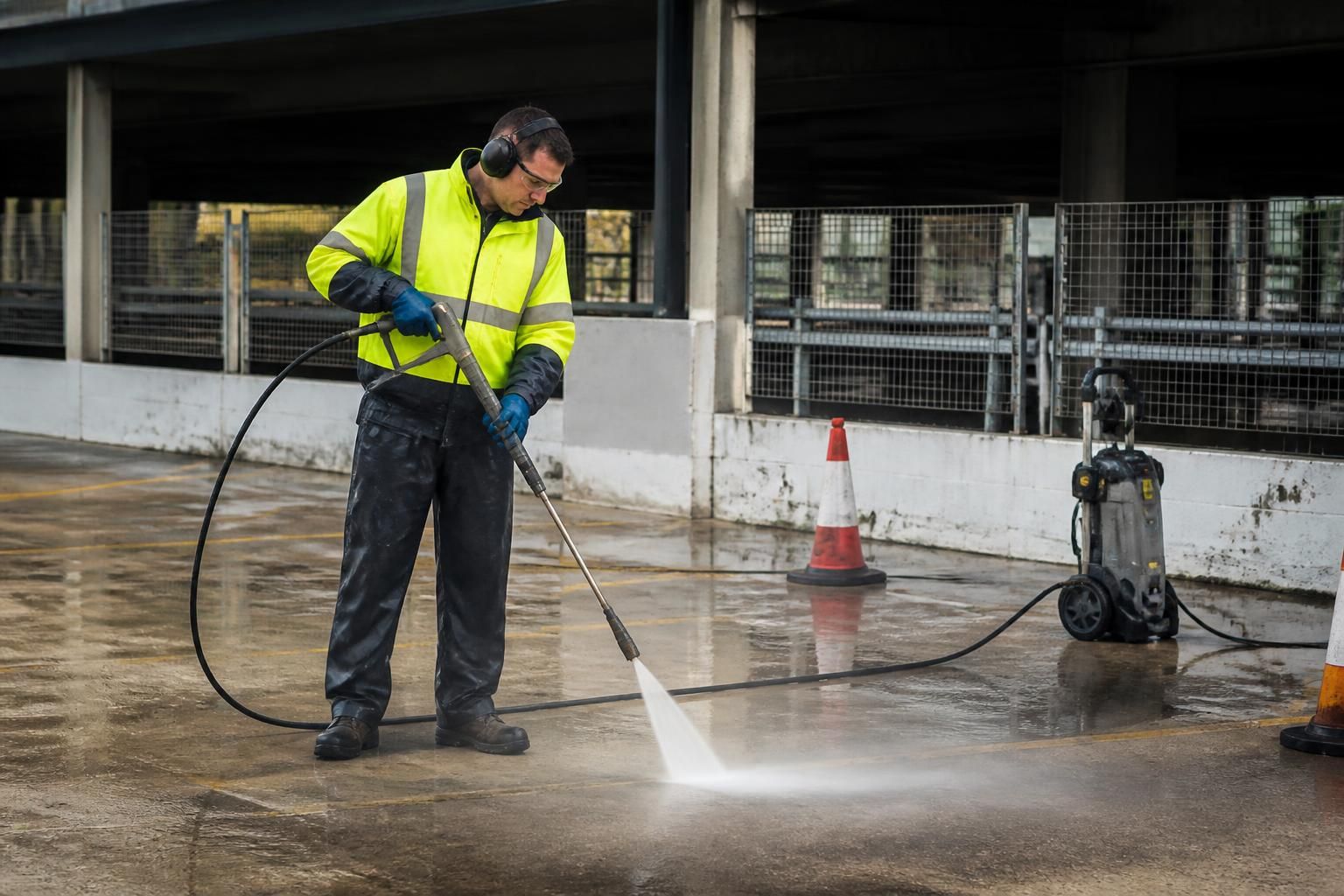
What safety protocols does the company implement while performing jet washing services to ensure the protection of property and people?
Encanto Exterior Cleaning protects people and property during jet washing by completing site-specific risk assessments, controlling access to work areas, using trained operatives and appropriate PPE, and selecting pressure, water temperature and cleaning methods suited to each surface. We also manage hoses, equipment, runoff, traffic and nearby structures throughout the work, with a planned response for changing site conditions or emergencies.
Our jet washing safety protocols are built around a site-specific risk assessment, controlled access, trained operatives, suitable personal protective equipment (PPE), and continuous monitoring of people, property, equipment and runoff. Before work begins, we identify the hazards associated with the car park or forecourt and select a cleaning method, pressure, temperature and detergent that will clean effectively without creating avoidable risk or damaging the site.
Site assessment and method planning
We assess the condition and layout of the area before setting up equipment. This includes identifying vehicle and pedestrian routes, entrances and exits, gradients, drainage points, inspection covers, kerbs, wall bases, doors, glazing, signage, electrical installations and vulnerable surfaces. We also consider the type of contamination present, such as oil, algae, chewing gum, mud or construction residue, because different substances require different treatment methods.
The findings inform the work plan and the control measures required for the site. Where appropriate, we coordinate with the client or site manager regarding access times, vehicle movements, emergency routes, nearby tenants and any operational restrictions. If conditions change during the work, the assessment is reviewed rather than continuing with an unsuitable arrangement.
Segregating the work area
Jet washing is not carried out in an unprotected area where members of the public, staff or passing vehicles could enter the spray zone. We use suitable barriers, cones, warning signs and exclusion zones to separate the work from people and traffic. The extent of the restricted area depends on the equipment, pressure, surface, wind and surrounding layout.
Where a car park or forecourt remains partly operational, we work in controlled sections and maintain a safe route around the active area wherever possible. Vehicle movements must be managed with the client’s assistance when required. Entrances, pedestrian crossings, fire exits and access for emergency services are kept clear, or an agreed alternative route is provided before cleaning starts.
Training and personal protective equipment
Operatives are trained to use pressure washing equipment, attachments, detergents and access equipment safely. They are expected to understand the risks from high-pressure water, slips, flying debris, noise, electrical sources, chemicals and moving vehicles. PPE is selected for the task and site conditions rather than used as a substitute for proper planning and segregation.
Depending on the work, this may include protective footwear with suitable slip resistance, waterproof protective clothing, gloves, eye or face protection, hearing protection and high-visibility clothing. Additional protection is used when chemicals, contaminated deposits or debris present an increased hazard. PPE is checked before use and replaced if it is damaged or no longer provides effective protection.
Controlling pressure, temperature and cleaning products
We do not assume that the highest pressure or temperature is the safest or most effective option. The operator selects settings and accessories according to the surface and contamination. Concrete, paving, resin-bound surfaces, painted finishes, cladding, brickwork, sealants and joints can all react differently to jet washing. A controlled test area may be used to check the cleaning result and confirm that the selected method will not cause etching, surface loss, staining or water penetration.
Cleaning products are selected for the material and contamination, used in accordance with the product information, and stored and handled responsibly. Operatives take account of contact risks, vapour, splash and compatibility with surrounding surfaces. Chemicals are not mixed unless the product instructions specifically allow it, and suitable control measures are applied when a treatment requires additional protection.
Managing hoses, machinery and electrical hazards
Hoses and power leads are routed to minimise trip hazards and are kept away from moving vehicles where practicable. Where they must cross a route, the crossing is controlled or protected. Equipment is positioned on stable ground, checked before use and operated in line with the manufacturer’s instructions. Connections, trigger mechanisms, lances, nozzles and safety devices are inspected for damage or leaks.
Water and electricity require particular care. We identify nearby electrical points, lighting columns, distribution equipment and other installations before cleaning. Equipment is positioned and used to prevent water being directed at electrical components, openings or vulnerable connections. Any electrical concern is reported and managed before work proceeds.
Protecting buildings, vehicles and surrounding property
Before spraying, we identify areas that should not be wetted or exposed to pressure, including door thresholds, vents, air intakes, open windows, delicate signage, sensors and vulnerable coatings. Nearby vehicles, stock, plant and equipment are moved or protected where necessary. We also take account of splash and overspray, particularly around entrances, adjoining façades and occupied premises.
Pressure washing can expose defects that were not visible beforehand, such as loose pointing, failed sealant, damaged paving or unstable coatings. We record or report relevant defects and avoid directing water at areas where cleaning could worsen the condition. Cleaning is paused if the substrate becomes unstable or if a previously unidentified risk is found.
Runoff, drainage and environmental controls
Runoff is controlled so that dirty water, oil residues, detergents and loosened debris do not spread into unsafe areas or enter drainage systems inappropriately. We identify drainage arrangements in advance and use practical measures such as local containment, recovery or controlled discharge where the site and the nature of the waste require it. Solids and collected debris are removed rather than being left to obstruct gullies or create a slip hazard.
Particular care is taken where oil, fuel, chemicals or other contaminants are present. The cleaning approach is adjusted to prevent contaminated water from travelling beyond the work zone, and any disposal requirements are discussed with the responsible site contact.
Monitoring during the work
The operative remains alert to changing conditions throughout the cleaning process. Work may be paused if pedestrians enter the exclusion zone, traffic controls become ineffective, wind carries spray towards people or property, visibility deteriorates, equipment develops a fault, or the surface behaves differently from the initial assessment. Clear communication between the operative and the site contact helps resolve these issues quickly.
Wet surfaces are treated as a slip risk during and immediately after cleaning. We control access until the area is reasonably safe to use and advise the client when residual moisture, restricted access or additional drying time needs to be considered.
Emergency and incident procedures
Before starting, operatives know how to stop the equipment safely, raise an alarm and obtain assistance. In the event of an injury, equipment failure, uncontrolled runoff, property damage or another incident, cleaning is stopped and the affected area is made safe. The site contact is informed, the incident is recorded as appropriate, and further work does not resume until the risk has been assessed and suitable controls are in place.
Completion checks
At the end of the service, we inspect the cleaned area for remaining hazards, displaced covers, blocked drains, loose debris, standing water, equipment left behind and damage that requires attention. Barriers are removed only when the area is safe to reopen, and the client is advised of any restrictions or maintenance issues identified during the work. This final check ensures that the safety process covers not only the jet washing itself, but also the condition in which the car park or forecourt is handed back.
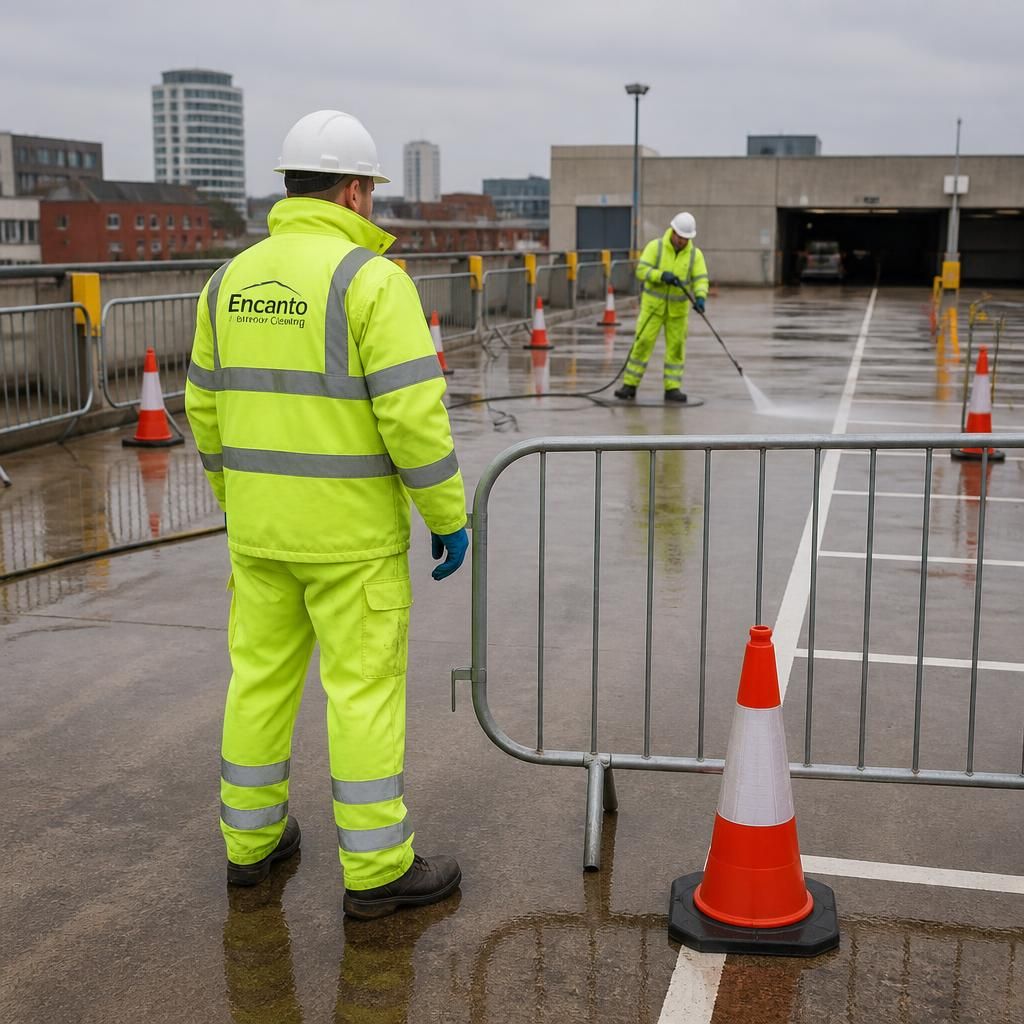
Controlled access is a central safety protocol during jet washing because high-pressure water, loosened debris and wet surfaces can injure people or damage passing vehicles. Before cleaning starts, we agree the working area with the site contact and separate it from pedestrians and traffic using suitable barriers, cones, warning signs and exclusion zones.
Where the car park or forecourt remains partly operational, cleaning is completed in controlled sections. Safe routes, entrances, fire exits and emergency access are maintained wherever possible, while vehicle movements are coordinated with the responsible site contact. Access remains restricted until spray has stopped, equipment and hoses have been removed, runoff is controlled and the surface is safe to reopen.