
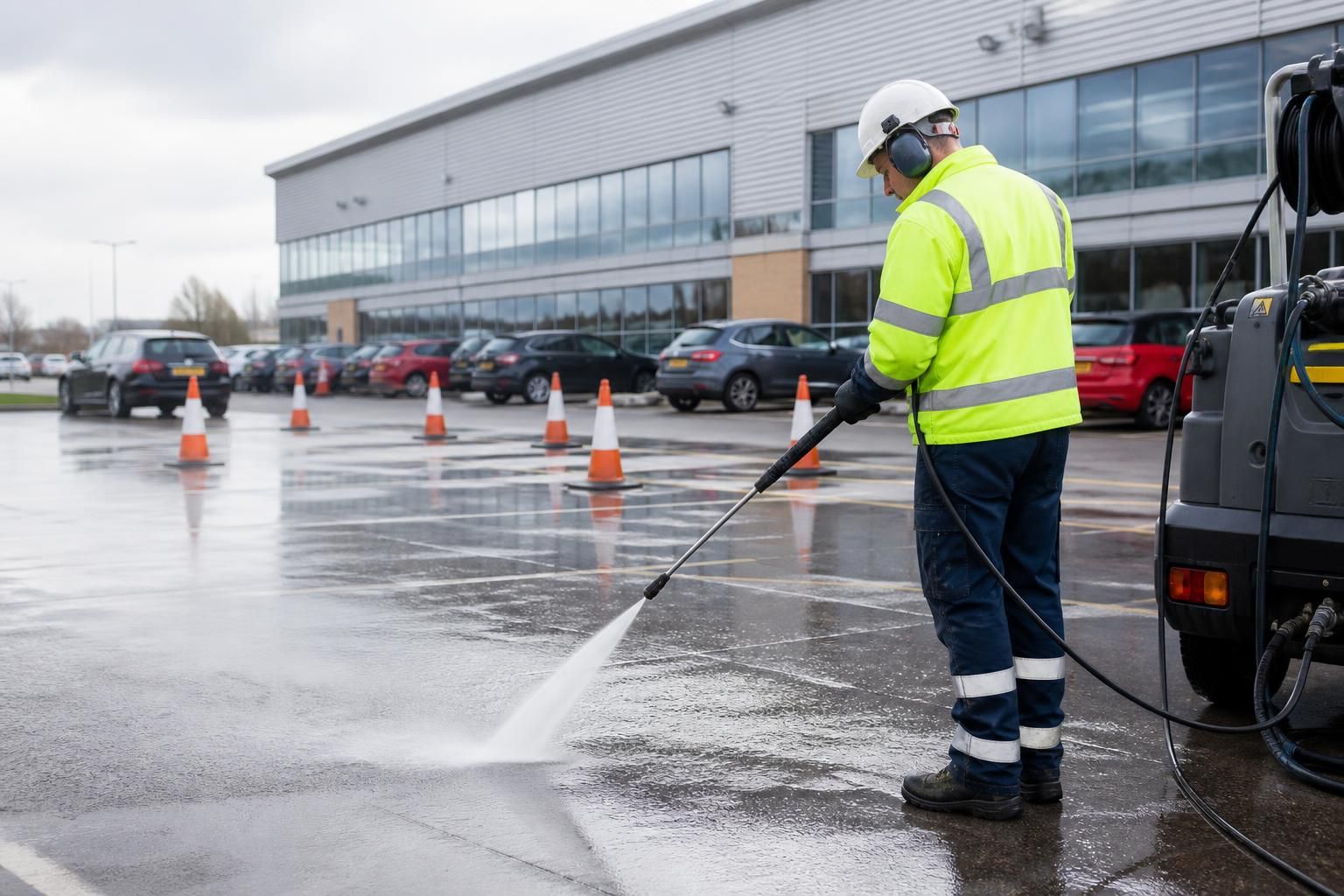
What credentials and experience should a professional jet washing service possess to ensure effective and safe cleaning of car parks and forecourts?
A professional jet washing service should have suitable public and employers’ liability insurance, documented risk assessments and method statements, trained operators, and relevant qualifications for pressure washing, chemical handling and any access equipment used. Experience with commercial car parks and forecourts is equally important, including understanding of drainage, oil and fuel contamination, surface protection, traffic management, wastewater controls and working around customers, vehicles and nearby businesses.
A professional jet washing service cleaning car parks and forecourts should have appropriate insurance, trained and competent operators, documented risk assessments and method statements, suitable equipment, and proven experience of commercial hard-surface cleaning. It should also understand vehicle and pedestrian safety, drainage and wastewater controls, oil and fuel contamination, surface protection, chemical handling and the operational requirements of busy business premises.
Insurance and legal competence are the starting point. The contractor should be able to provide evidence of suitable public liability insurance and employers’ liability insurance where employees are involved. Cover should be appropriate to the scale and nature of the work, including the use of pressure, hot water, cleaning chemicals, access equipment and work around the public. Insurance does not replace safe working practices, but it demonstrates that the contractor operates as a properly established commercial service.
Operators should be trained and competent in pressure washing rather than simply familiar with using a pressure washer. Relevant training should cover equipment operation, pressure selection, hot-water systems, detergents, surface-specific techniques, hose management and the risks created by high-pressure water. Where the work involves chemical products, staff should understand the product information, dilution requirements, personal protective equipment and safe storage or handling procedures.
The contractor should also hold or arrange appropriate training for any additional equipment used on the project. This may include powered cleaning equipment, water recovery systems, traffic-management equipment and powered access platforms. Access operators should have recognised training suitable for the type of equipment and task, while anyone directing vehicles or managing pedestrian movement should be competent to carry out those duties safely.
Risk assessments and method statements should be prepared specifically for the car park or forecourt, not copied from an unrelated job. They should consider:
- vehicle movements, delivery areas, customers, pedestrians and members of the public;
- slip, trip and fall risks created by hoses, wet surfaces, uneven paving and temporary barriers;
- high-pressure water, hot water, noise, spray and possible debris;
- fuel, oil, grease, detergents and other potentially hazardous substances;
- nearby buildings, shopfronts, doors, electrical equipment, vehicles and vulnerable surfaces;
- drainage arrangements, pollution risks and the collection or treatment of contaminated wastewater;
- weather, lighting, visibility and emergency arrangements; and
- the planned sequence of cleaning, drying, inspection and reopening.
A suitable method statement should explain how the identified risks will be controlled in practice. It should identify exclusion zones, signage, barriers, safe access routes, equipment checks, personal protective equipment, spill response arrangements and the person responsible for supervising the work. The assessment should be reviewed if the site layout, weather, cleaning chemicals, equipment or working conditions change.
Relevant commercial experience is particularly important because car parks and forecourts are more demanding than small domestic cleaning jobs. An experienced contractor should understand how different surfaces respond to pressure and heat, including concrete, tarmac, block paving, resin-bound surfacing, stone and coated areas. Excessive pressure or incorrect cleaning methods can remove jointing material, damage coatings, expose aggregate, mark softer surfaces or force water into vulnerable building details.
Experience with forecourts should include the safe removal of fuel residues, oil, rubber marks, dirt and general traffic film without spreading contamination across the site. The contractor should know that contaminated wash water must not simply be directed into surface-water drains. Before work starts, it should establish where water can be contained, recovered, treated or lawfully discharged, taking account of the site’s drainage system and any requirements set by the relevant authority or water company.
Evidence of experience may include suitable project examples, a clear scope of work, photographs of comparable commercial surfaces, client references or records of completed maintenance programmes. The most useful evidence relates to sites with similar traffic levels, contamination, surface types and operating constraints. A contractor should also be willing to inspect the area before quoting, identify limitations and explain what the cleaning process is expected to achieve.
Equipment should be selected for the surface and site conditions, rather than judged by pressure rating alone. A professional service may use cold- or hot-water pressure washers, surface-cleaning attachments, rotary cleaners, wet vacuums, water recovery equipment and low-pressure or steam-cleaning systems. The equipment should be maintained, checked before use and operated at settings that remove contamination without causing avoidable damage. Hoses, electrical leads, fuel systems and safety devices should be inspected as part of normal site preparation.
Good contractors also carry out a pre-cleaning inspection and, where appropriate, a small test area. This helps confirm the safest pressure, temperature, detergent and dwell time for the surface. The inspection should record existing defects such as cracks, loose paving, failed joints, damaged coatings, poor drainage or pre-existing staining. This protects the property and helps distinguish existing defects from issues revealed during cleaning.
Environmental competence should form part of the contractor’s credentials. Staff should know how to minimise water use, prevent dirty water and chemicals entering surface-water systems, control spray and contain spills. Where oil, fuel or other pollutants are present, the work plan should include suitable absorbents, containment and wastewater-management procedures. A responsible contractor will explain these arrangements before work begins rather than treating drainage as an afterthought.
Finally, the service should provide clear documentation before and after the work. This may include the quotation and scope, insurance details, risk assessment, method statement, product information, site-specific induction records, equipment or access qualifications, waste or wastewater records where relevant, and a completion report. The report should identify areas cleaned, restrictions, remaining stains, defects noticed and any recommended follow-up maintenance.
In practical terms, the right contractor combines formal credentials with relevant site experience. Insurance and training demonstrate that the business can operate responsibly; risk assessments and method statements show how risks will be controlled; and comparable commercial work demonstrates that the team can clean effectively without damaging surfaces, disrupting operations or creating pollution and safety problems.
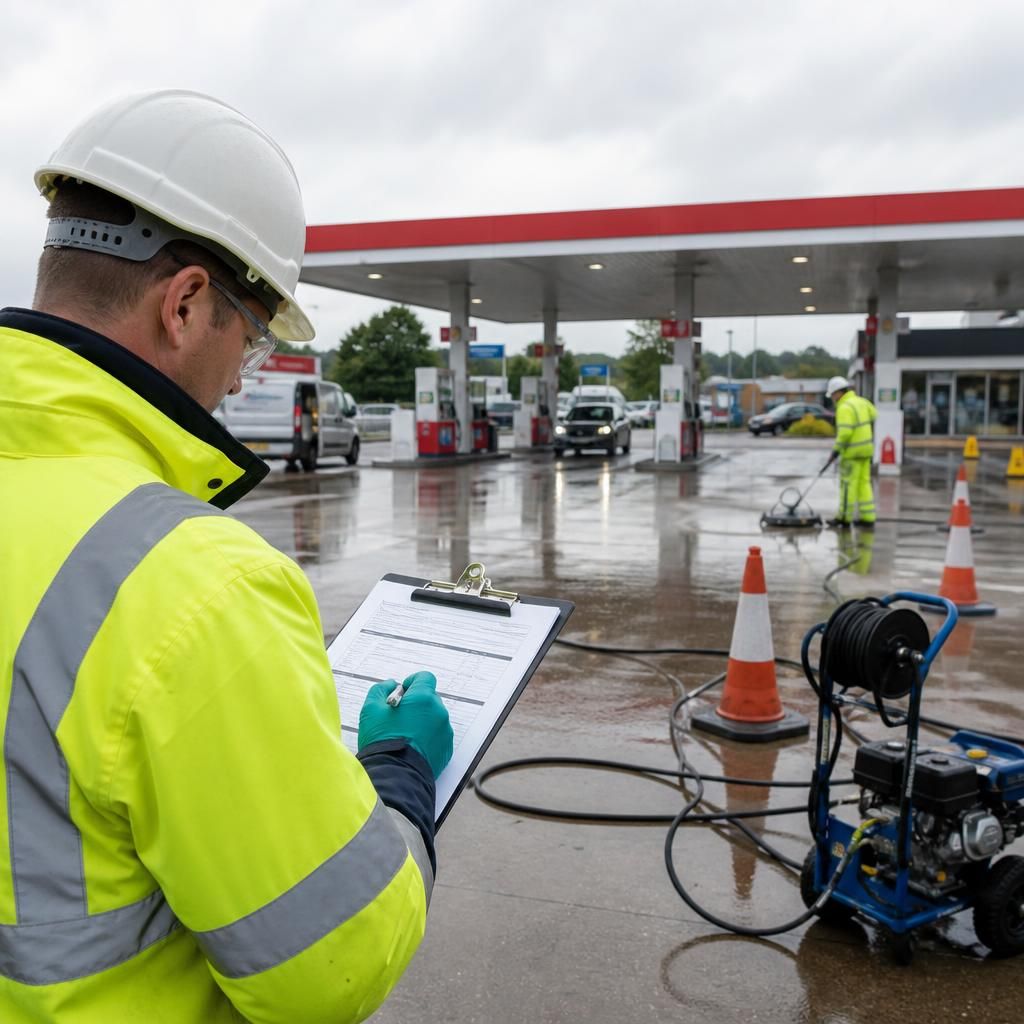
Site-specific risk assessments and method statements are essential credentials for safe car park and forecourt jet washing. They should explain how the contractor will control vehicle movements, pedestrians, wet-surface slip risks, hoses, spray, chemicals, contaminated wastewater and access to nearby buildings or equipment.
A competent service should prepare these documents after inspecting the site, rather than relying on a generic template. The method statement should set out the cleaning sequence, exclusion zones, signage, protective equipment, drainage controls, spill response and reopening checks. It should also be updated if weather, site layout, equipment or cleaning conditions change.
This documentation provides practical evidence that the team understands the specific risks of the premises and has a controlled method for completing the work without avoidable damage, disruption or pollution.
Request a Site Assessment from a Qualified Jet Washing Team
Request a site assessment from our qualified jet washing team to review surface types, contamination, drainage, access and operational risks. We can then provide a suitable cleaning method and site-specific documentation for your car park or forecourt.