
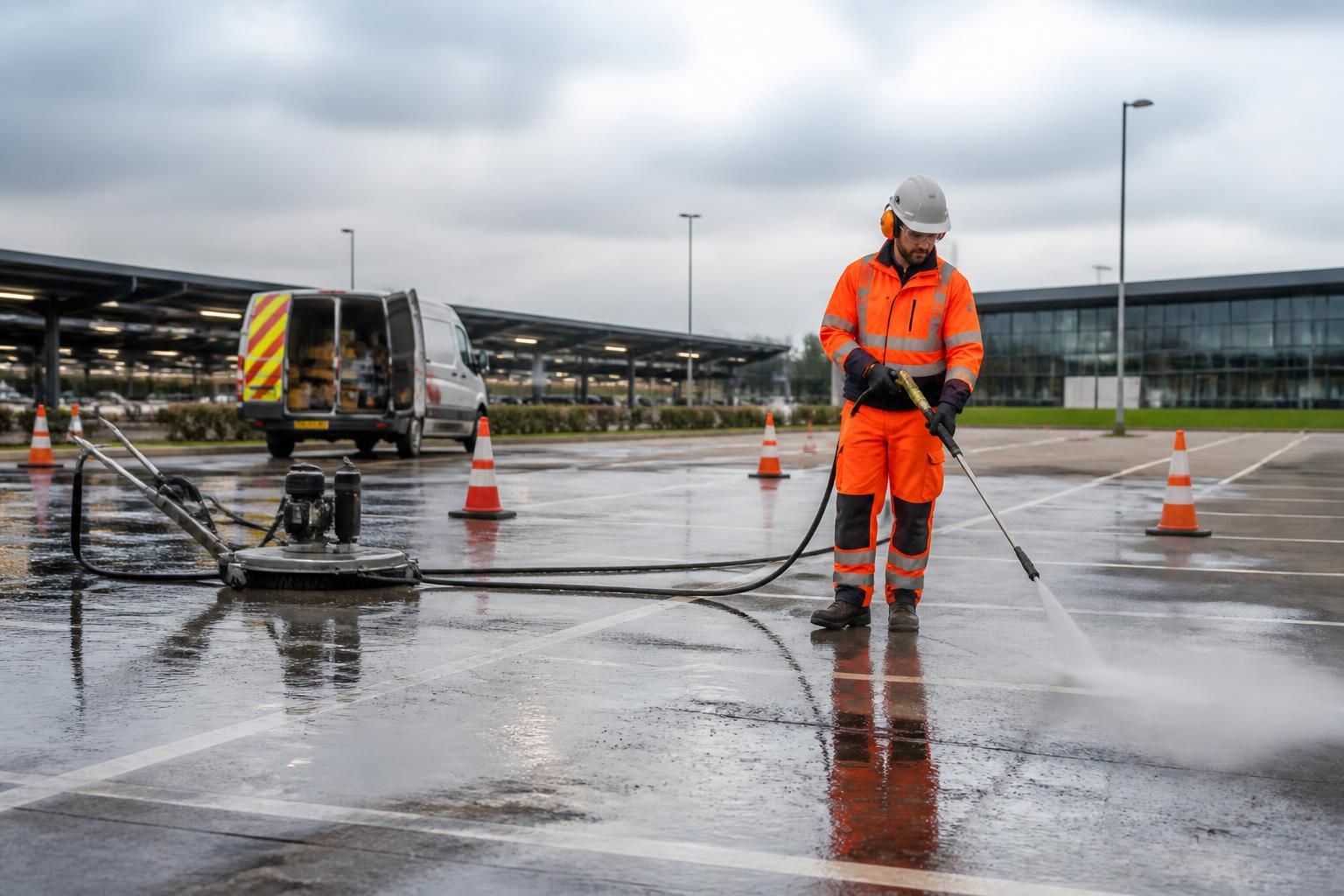
How does the company ensure minimal disruption to business operations while performing jet washing services on car parks and forecourts?
We minimise disruption by planning jet washing around your trading hours, using phased work areas and clearly managed access routes. Our team agrees the schedule and site controls with you in advance, then uses efficient equipment and rapid surface recovery methods to keep car parks and forecourts safe and available wherever practical.
We minimise disruption by scheduling jet washing around your operating hours, dividing the site into manageable work areas and maintaining controlled access wherever it is safe to do so. Before work starts, we agree the cleaning sequence, access arrangements and communication process with your nominated contact, taking account of trading periods, deliveries, staff movements, customer access and any site-specific restrictions.
Planning starts with a site assessment. We review the layout and condition of the car park or forecourt, including entrances and exits, pedestrian routes, disabled parking bays, loading areas, drainage points, gradients, fuel or service areas and nearby buildings. This allows us to identify which areas can remain open, which need temporary closure and how vehicles and pedestrians can be directed safely while cleaning is under way.
- Agreeing suitable working times: where practical, cleaning is arranged outside peak trading and occupancy periods. This may include early mornings, evenings, weekends or planned closure periods, depending on the site and the agreed method statement.
- Coordinating with site activity: the schedule can be aligned with deliveries, contractor access, refuse collections, maintenance work and other operational commitments.
- Planning around weather and surface conditions: we consider rainfall, temperature, wind and the time needed for surfaces to become suitably safe for use. If conditions affect cleaning quality or safety, the programme can be adjusted in consultation with the client.
Phased cleaning keeps more of the site available. Rather than treating a large car park or forecourt as one continuous closure, we normally work in defined sections. One area is cordoned off for cleaning while another remains available, subject to the site risk assessment. Once a section has been cleaned, rinsed, checked and made safe, access can be restored before the team moves on. The appropriate sequence depends on vehicle circulation, drainage and the condition of the surface.
Clearly positioned barriers, cones and warning signs identify the active work area and help prevent vehicles or pedestrians entering it. Where a route must be temporarily restricted, we establish an alternative route in advance. A designated contact can receive progress updates and advise us of any immediate operational change, such as an unexpected delivery or a busy customer period.
Equipment and methods are selected to complete the work efficiently without compromising the surface. We use suitable pressure-washing, steam-cleaning and surface-cleaning equipment according to the material, soiling and drainage arrangements. This can reduce unnecessary passes over the same area and limit the time that hoses, machinery and operators occupy access routes. Power, pressure, temperature and cleaning products are controlled for the surface being treated; excessive pressure can cause damage and may create additional remedial work.
Forecourts and busy commercial sites require particular care because oil, fuel residue, chewing gum, traffic film and other deposits may be present. We use the appropriate cleaning approach for the contamination rather than relying on maximum pressure alone. Where hot water or steam is suitable, it can help remove ingrained deposits efficiently. Any detergent or treatment is selected and used in line with the surface, drainage and environmental requirements of the site.
Water and wastewater are managed as part of the work plan. We inspect available drainage and take precautions to prevent contaminated wash water, oil or cleaning agents from entering unsuitable drains or surrounding areas. Where recovery, containment or additional control measures are required, these are agreed before cleaning begins. This helps prevent avoidable delays, pollution risks and the need to stop work after the operation has started.
We also keep equipment, hoses and vehicles positioned so that they do not obstruct fire access, emergency routes, building entrances or essential services. Hoses are routed and managed to reduce trip hazards, while operators maintain awareness of moving traffic and changing site conditions. Cleaning is paused if an unsafe interaction with vehicles, pedestrians or other contractors cannot be controlled.
At the end of each working phase, the team checks the surface, removes equipment and barriers when appropriate, and confirms that the area is suitable for reopening. We take account of residual water, slippery deposits, loose debris and visibility. If part of the site needs to remain closed for longer, the restriction is communicated clearly rather than allowing premature access.
For larger or regularly occupied premises, we can agree a written programme covering the work sequence, site controls, responsibilities and contact arrangements. This gives your team a clear basis for notifying staff, tenants, customers and delivery drivers. By combining advance planning, phased access, appropriate equipment and active communication, jet washing can be carried out with the operational impact kept to the lowest practical level while maintaining safe and effective cleaning.
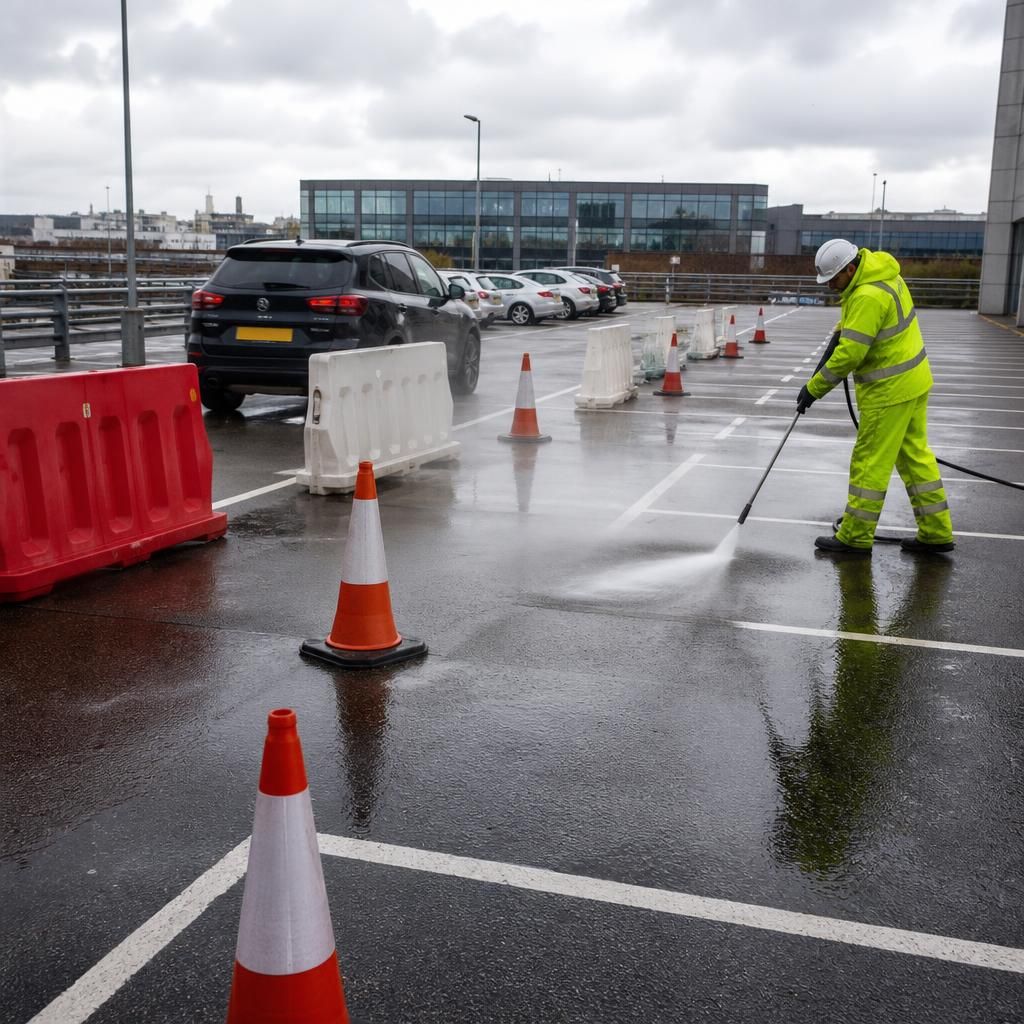
Phased cleaning is a key way to keep car parks and forecourts operating while jet washing takes place. Instead of closing the entire site, we isolate a defined work area and keep other suitable sections available, subject to the agreed risk assessment and traffic conditions.
Barriers, cones and signs identify the active cleaning zone, while clear alternative routes help direct vehicles and pedestrians safely. Once a section has been cleaned, rinsed and checked for residual water, slippery deposits and loose debris, it can be reopened when safe. The team then moves to the next area, with progress coordinated through your nominated site contact.