
What are the specific techniques used in commercial jet washing for different types of contamination?
Commercial jet washing techniques are selected according to the contaminant and surface, using controlled pressure, hot or cold water, steam, suitable detergents and specialist treatments. Oil and grease typically require hot-water cleaning and degreasers, while algae, moss, grime and graffiti may need lower-pressure washing, biocidal treatment, steam cleaning or approved chemical removal to prevent surface damage.
Commercial jet washing uses a combination of controlled water pressure, water temperature, steam, detergents and specialist treatments, selected according to the contaminant and the material being cleaned. Oil and grease generally need hot-water pressure washing with a suitable degreaser, whereas algae and moss require careful biocidal treatment, general dirt is removed with low- to medium-pressure washing, and graffiti may require steam cleaning or a surface-specific chemical system. The aim is to remove the contamination without driving it deeper into the surface, stripping coatings or damaging joints.
Oil, grease and fuel residues
Oil contamination is treated by first removing loose debris and identifying whether the residue is fresh, embedded or chemically bonded to the surface. A traffic-film remover or biodegradable degreaser may be applied and allowed sufficient dwell time to break down the oil. Hot-water jet washing then emulsifies the residue so it can be lifted from concrete, block paving, loading bays and industrial floors. Agitation with a stiff brush or rotary surface cleaner can improve results on textured surfaces.
Heavy deposits may need more than one application, particularly where oil has penetrated porous concrete. Wastewater must be managed carefully so that oils and detergents do not enter surface-water drains. Where appropriate, drain protection, vacuum recovery or collection systems are used, followed by disposal in accordance with site and environmental requirements. Pressure is kept under control around deteriorated concrete, joints, painted markings and drainage channels.
Algae, moss, lichen and organic growth
Algae, moss and lichen are usually removed through a combination of scraping, controlled washing and an appropriate biocidal treatment. On roofs, façades, paving and shaded elevations, excessive pressure can loosen pointing, damage roof finishes or leave organic material embedded in the surface. A lower-pressure application with a suitable treatment is often safer than attempting to remove everything with water force alone.
Biocide is applied to the affected area and left to work for the required contact time before the surface is rinsed or, where suitable, allowed to weather naturally. This helps address biological growth below the visible surface and can reduce rapid regrowth. Particular care is required near planted areas, ponds, watercourses and drainage systems. Run-off controls and protection for nearby vegetation are planned before work begins.
General dirt, dust and atmospheric grime
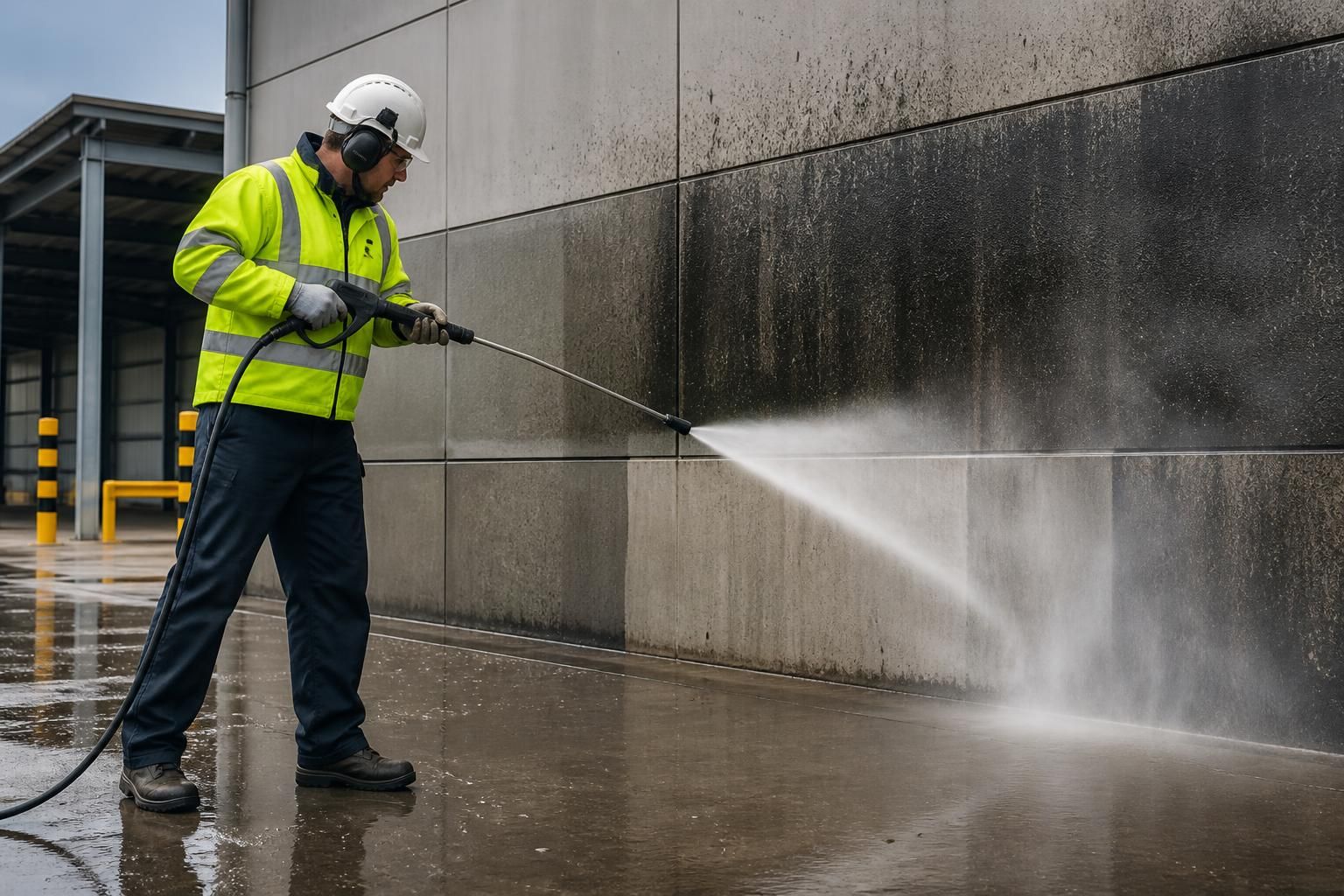
Everyday dirt on façades, cladding, paving, car parks and service yards is commonly removed with cold- or hot-water pressure washing. The operator adjusts the pressure, flow rate, nozzle pattern and working distance for the surface rather than using maximum pressure throughout. A fan nozzle or rotary cleaner can provide an even finish across large hard surfaces, while softer brushes and wider spray patterns are more appropriate for delicate cladding or coated materials.
Detergent may be used where traffic film, airborne pollution or food residue has bonded to the surface. It is normally applied from the bottom upwards on vertical areas to control run marks, then rinsed from the top down using clean water. Test cleaning is important on painted façades, powder-coated cladding, render, natural stone and other finishes where colour variation, oxidation or existing weathering may become visible after cleaning.
Graffiti and paint
Graffiti removal begins with identifying the paint type, substrate and age of the marking. On robust masonry, a controlled pressure wash with a compatible graffiti remover may be effective. On painted surfaces, brickwork, natural stone and sensitive façades, a low-pressure chemical system or steam cleaning is often preferred to avoid removing the original finish along with the graffiti.
Specialist remover is applied only to the affected area and allowed to soften the paint before it is agitated and rinsed away. Several light treatments are generally safer than one aggressive pass. Porous materials may retain pigment beneath the surface, so complete removal can require repeated treatment or a specialist poultice. Adjacent signs, coatings, sealants and windows are protected, and the run-off is contained rather than allowed to spread across clean areas.
Chewing gum, food deposits and sticky residues
Chewing gum and similar deposits are commonly treated with hot-water steam or a targeted gum-removal system. Heat softens the residue, allowing it to be lifted with a scraper or focused treatment rather than blasted across the pavement. Food grease, drink residues and sticky deposits may need a mild detergent or degreaser followed by a controlled rinse. On paving with fragile joints, the operator avoids directing high pressure into the jointing material.
Rust, mineral staining and efflorescence
Rust marks and mineral deposits are not always removed effectively by water pressure alone. A compatible acidic or specialist cleaning treatment may be used after testing, with the product selected for the particular substrate. Natural stone, concrete, brick and metal can react differently, so dwell time and dilution must be controlled carefully. The surface is thoroughly rinsed afterwards, and nearby metals, painted finishes, plants and drainage points are protected from chemical contact.
Efflorescence, the white salt deposit sometimes seen on brickwork and paving, may be brushed away when dry or treated with a suitable masonry cleaner where necessary. Aggressive acid cleaning can damage mortar, alter the colour of brick or affect calcareous stone, so it should not be used without a material assessment.
Concrete, paving and hard-standing contamination
Large concrete areas, car parks and loading yards are normally cleaned with a surface cleaner or rotary head to produce a consistent result and limit visible striping. Oil, tyre marks, chewing gum, moss and general traffic film are dealt with separately because each responds to a different combination of heat, detergent and pressure. Damaged concrete, open joints and areas with exposed aggregate require reduced pressure and careful nozzle control.
Block paving is cleaned with a pressure setting that removes surface contamination without unnecessarily displacing jointing sand. After cleaning, joints may need to be replenished once the paving is fully dry. Any recommendation for sealing should take account of the paving material, residual moisture, expected traffic and the source of the contamination.
Brick, stone, render and façades
Masonry and façade cleaning is planned around the porosity, age, condition and finish of the material. Low-pressure washing, soft brushing, steam or a controlled detergent system may be used instead of high-pressure jetting. Brick faces, mortar joints, render and natural stone can be permanently marked by excessive pressure, unsuitable chemicals or uneven drying.
Before the main clean, a small inconspicuous test area is used to check the cleaning method, appearance and any reaction of the surface. Windows, seals, vents, electrical fittings and vulnerable coatings are protected. Work is then carried out in manageable sections so that the operator can monitor the result and prevent detergent from drying on the façade.
Roofs, cladding and coated surfaces
Roof cleaning is tailored to the roof covering and its condition. Loose moss and debris may be removed manually before low-pressure washing or biocidal treatment. Fragile tiles, aged coatings and roof membranes can be damaged by concentrated high-pressure water, so access and cleaning methods must be selected together. Safe access equipment, edge protection and controlled hose management are essential on elevated work.
Metal and composite cladding is usually cleaned with a lower-pressure system and a compatible detergent. The process must account for oxidation, chalking, damaged paint, sealant joints and panel laps. Strong chemicals and excessive heat can affect coatings, while poor rinsing can leave streaks or residues. A test panel helps establish the safest pressure and product before wider cleaning begins.
Choosing the technique and verifying the result
A competent commercial cleaning assessment considers the contaminant, surface material, age and condition of the building, access constraints, drainage, surrounding activities and the required finish. The operator should establish whether the contamination is superficial or embedded, carry out a test clean where there is any uncertainty, and record the agreed method. Cleaning is then monitored during the work rather than judged solely by the equipment setting.
After jet washing, the area is inspected for remaining staining, surface damage, missed edges and run-off. Some marks, including deep oil staining, rust migration and pigment within porous masonry, may not disappear completely without risking damage to the substrate. In those circumstances, the safest result may be a controlled reduction in appearance rather than increasingly aggressive cleaning. This approach protects the surface, supports compliance with site requirements and provides a more durable basis for future maintenance.
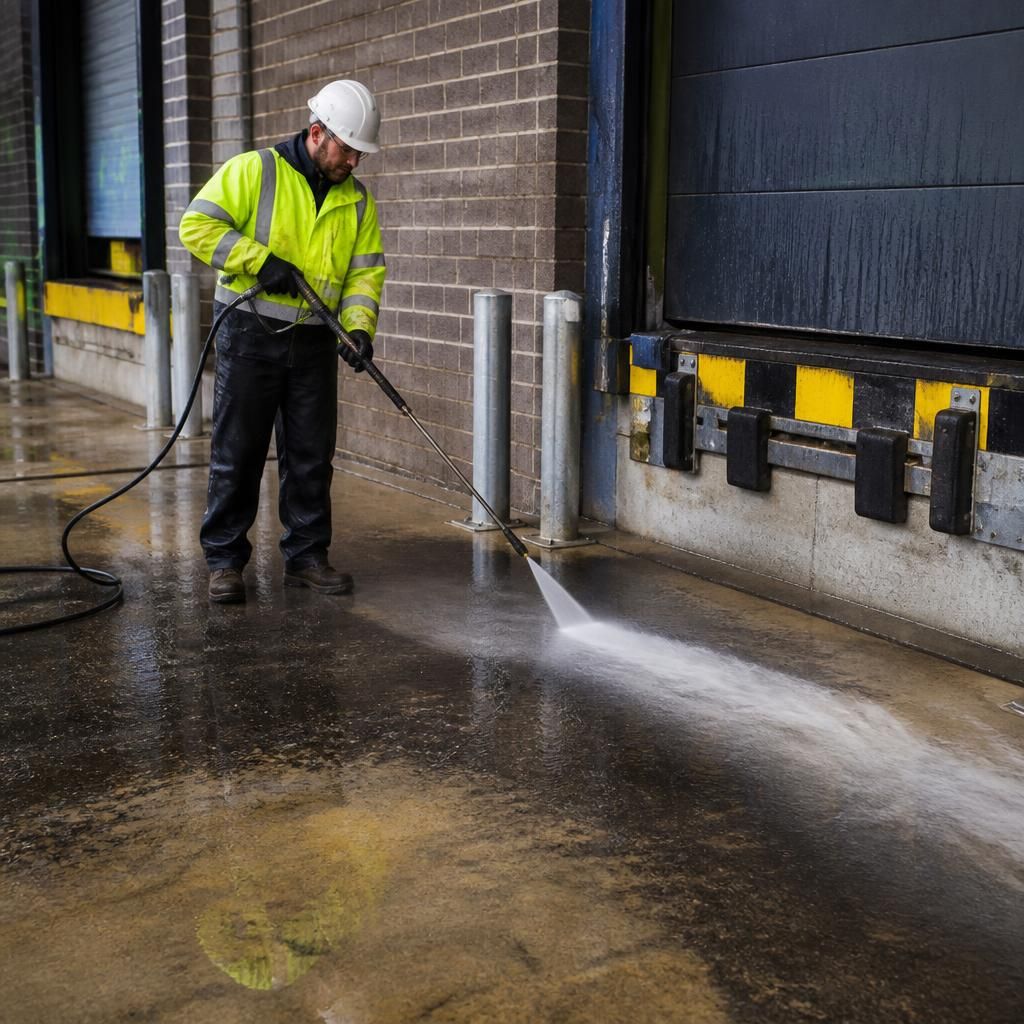
Oil and grease on concrete, loading bays and industrial floors are removed most effectively by combining a suitable degreaser with controlled hot-water jet washing. The detergent breaks down the residue, while heat helps emulsify it so the contamination can be lifted from the surface rather than spread across it.
Where oil has penetrated porous concrete, the treatment may need to be repeated with careful agitation using a rotary surface cleaner or stiff brush. Wastewater must be contained and managed so that oil and cleaning products do not enter surface-water drains. Pressure is reduced around damaged concrete, joints, painted markings and drainage channels to avoid causing additional surface damage.