
What are the benefits of using industrial petrol pressure washers for façade and cladding cleaning?
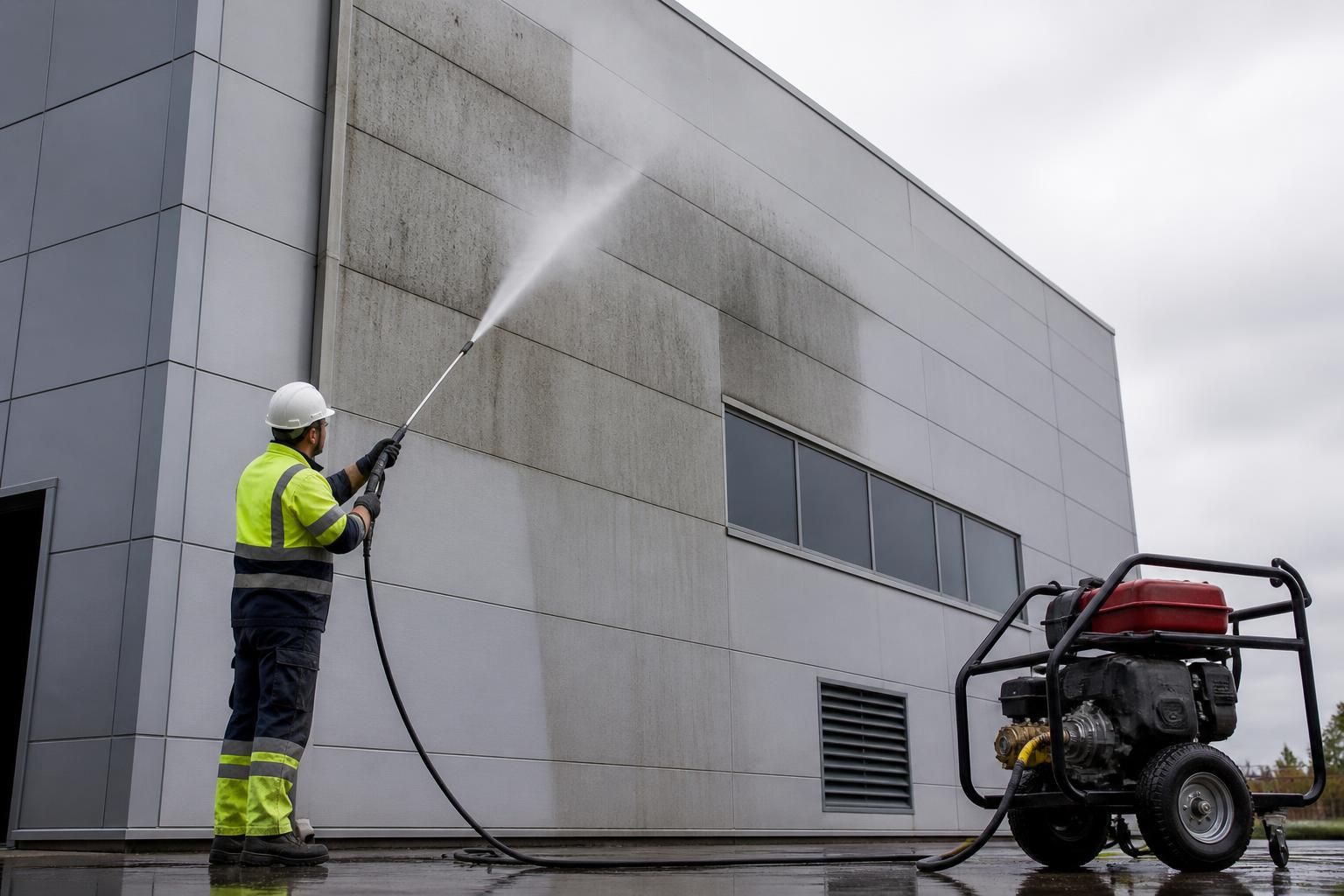
Industrial petrol pressure washers provide high, consistent water flow and pressure for removing ingrained dirt, algae, traffic film and other deposits from large façades and cladding areas efficiently. Their independent petrol power supply is useful on commercial sites without a suitable electrical connection, although pressure, temperature and cleaning methods must be carefully adjusted to protect the building materials.
Industrial petrol pressure washers are high-output machines that use a petrol engine to drive a pump, producing a strong and consistent flow of water for cleaning large façades and cladding. Their main benefits are high productivity, mobility and independence from a fixed electrical supply, making them suitable for extensive commercial and industrial cleaning where ordinary domestic or electrically powered equipment may be too slow or restrictive.
For façade and cladding cleaning, the equipment is only effective when its pressure, flow rate, water temperature and accessories are matched to the building materials. A powerful machine should not be treated as a reason to use maximum pressure. Professional cleaning depends on controlled application, suitable detergents where appropriate, correct working distances and a method that removes contamination without damaging coatings, joints, seals or underlying substrates.
The principal benefits include:
- High productivity: Industrial petrol machines can deliver substantial water flow and sustained cleaning performance across large elevations, cladding systems, loading areas and associated hard surfaces. This can reduce the time spent covering extensive areas compared with smaller equipment.
- Independent power supply: Because the pump is powered by a petrol engine, the machine does not rely on a convenient high-capacity electrical connection at the work area. This is useful on construction sites, industrial estates, vacant premises and external areas where electrical access is limited or unsuitable.
- Greater site mobility: Petrol-powered equipment can be used across larger sites without routing long electrical cables to every elevation. With suitable hoses and access arrangements, operators can work around buildings, service yards and separate structures more efficiently.
- Consistent performance: Commercial-grade pumps are designed for demanding, extended use. Consistent pressure and flow help operators maintain an even cleaning process rather than repeatedly stopping to allow smaller equipment to recover.
- Effective removal of heavy soiling: Correctly configured equipment can remove traffic film, algae, moss staining, dust, bird fouling, construction residue and other deposits that may not respond to low-powered washing. On suitable surfaces, the combination of water flow, pressure and an appropriate cleaning solution can improve the quality of the result.
- Useful versatility: The same machine may support different lance types, rotary surface cleaners, soft-washing equipment and controlled detergent application. This allows the cleaning method to be adapted for façades, cladding panels, canopies, paths, car parks and other external areas, subject to a material assessment.
- Reduced dependence on mains water pressure: Industrial systems are designed to work with an appropriate water supply and can provide the operating performance required for commercial cleaning even where the available mains pressure is not sufficient on its own. The water source and any supply restrictions still need to be checked before work begins.
- Suitability for remote or developing sites: Petrol equipment can be practical where temporary utilities are unavailable, including new-build developments and larger industrial sites. This can help cleaning teams work before a permanent electrical infrastructure is fully operational.
Pressure and flow are both important. Pressure provides the force that helps loosen contamination, while water flow carries loosened material away and rinses the surface. A machine with a high pressure rating is not automatically the best choice for façade work. Excessive pressure can strip paint, mark softer materials, open defective joints, force water behind panels or damage sealants. In many cases, a balanced flow rate with moderate pressure, a wider spray pattern and the correct cleaning agent provides a safer and more even result.
Industrial petrol pressure washers can be particularly useful for robust substrates such as sound concrete, some masonry and certain hard-wearing coated surfaces, provided the operator has confirmed their condition and adjusted the method accordingly. Metal cladding, painted panels, render, brickwork, stone, composite panels and glazed surfaces all have different tolerances. Weathered coatings, corroded fixings, cracked render and failed sealant may require a lower-pressure approach, a soft-washing method or repairs before cleaning.
Petrol power also brings limitations that must be managed professionally. The engine produces exhaust fumes and noise, so the machine should be operated outdoors or in adequately ventilated areas, away from air-intake systems, occupied entrances and sensitive neighbours. Fuel must be stored and handled safely, and the equipment should be positioned to reduce the risk of fumes entering the building. Noise controls may be needed around offices, residential areas, schools and healthcare premises.
Water management is another important consideration. Façade cleaning can mobilise oils, detergents, metals, paint particles and other pollutants. Run-off should not be allowed to enter surface-water drains unless it is confirmed to be permitted and suitably clean. A responsible method may include drain protection, collection, filtration, controlled discharge or recovery of contaminated water, depending on the site and the substance being removed. Detergents should be selected for the surface and used only where they add value to the cleaning process.
Safe use requires more than selecting a machine with a suitable pressure rating. Before cleaning, the team should inspect the façade or cladding, identify fragile areas, check access requirements, protect doors, vents and electrical equipment, and complete a suitable risk assessment. Operators should use appropriate personal protective equipment and maintain secure footing, particularly when working from access equipment or on wet surfaces. Petrol-powered equipment should be handled by trained personnel, with attention to hose management, spray recoil, fuel safety and the risks associated with falling debris or contaminated water.
A small test area is an important part of the process. Testing helps confirm whether the proposed pressure, nozzle, temperature and detergent are compatible with the material. It can reveal colour change, coating damage, etching, water penetration or an uneven cleaning effect before the method is applied across the full elevation. The test area should be reviewed after rinsing and, where relevant, after the surface has dried.
Industrial petrol pressure washers therefore offer a practical advantage when a project involves large areas, difficult access to power or heavy external contamination. They are not a universal solution for every façade. The correct choice depends on the substrate, the condition of the surface, the type of deposit, available water, run-off controls, access arrangements and the surroundings. Where the façade is delicate or the contamination is biological, a lower-pressure cleaning or soft-washing system may be more appropriate.
For a commercial project, the most reliable approach is to specify the cleaning objective and surface materials first, then select the equipment and method around those requirements. This ensures that the benefits of petrol-powered performance—speed, reach and sustained output—are achieved without exchanging short-term cleaning efficiency for damage, water ingress, coating failure or avoidable environmental risk.
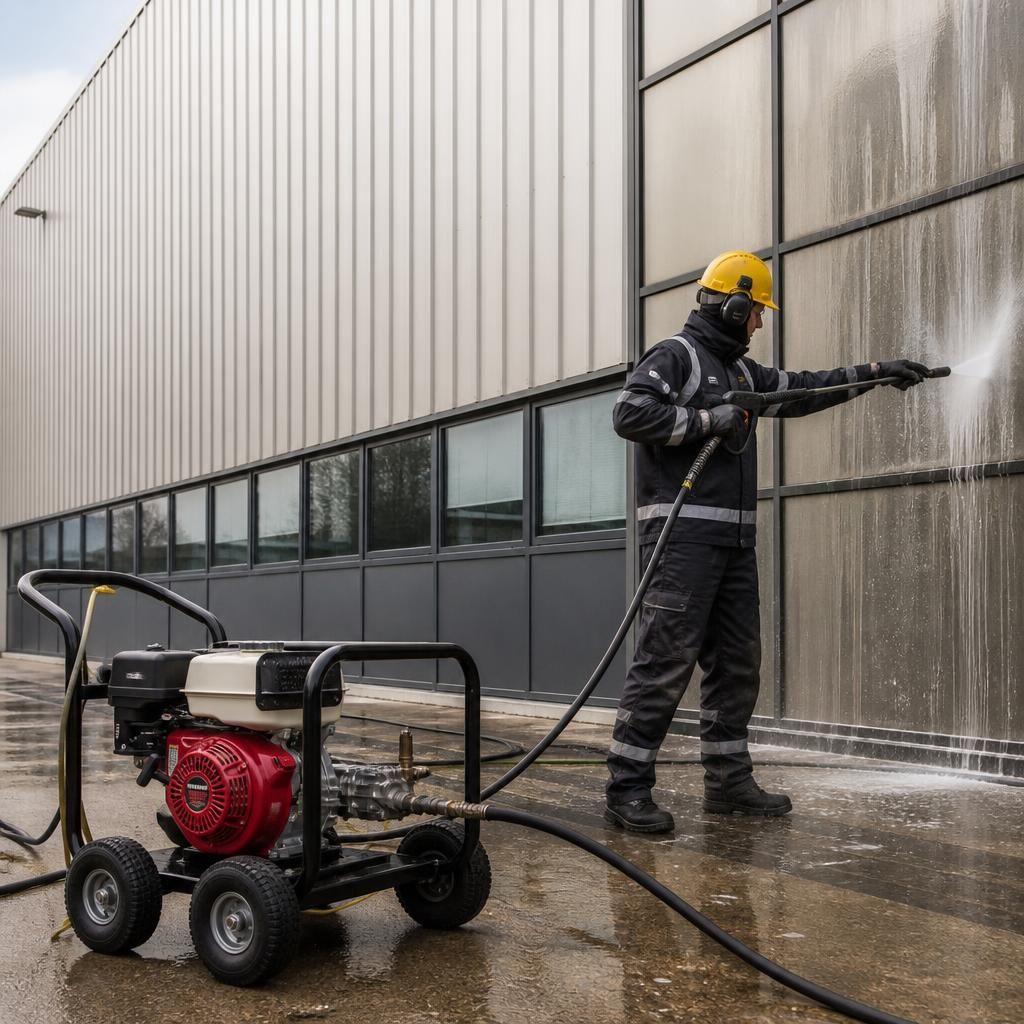
Industrial petrol pressure washers use a petrol engine to power the pump, delivering sustained water flow and pressure without relying on a fixed electrical connection. This makes them particularly useful for large façades and cladding areas where standard equipment may be too slow or where suitable mains power is unavailable.
Their main practical benefit is productivity. A commercial machine can maintain consistent performance across extensive elevations, helping operators remove traffic film, algae, bird fouling, dust and construction residue without frequent interruptions. Petrol-powered equipment can also be positioned around larger sites, reducing the need to route electrical cables between access points.
These benefits depend on controlled use. Pressure, flow, temperature, nozzle selection and working distance must be matched to the cladding or façade material. Excessive pressure can damage coatings, render, joints and sealants, so a test area should be assessed before full cleaning begins. Operators must also manage engine fumes, noise, fuel storage and contaminated run-off, particularly near occupied buildings, air-intake systems and surface-water drains.