
How can I assess the safety protocols and environmental considerations of the jet washing company?
Assess a jet washing company by checking its documented risk assessments, method statements, operator training, insurance, equipment controls and procedures for protecting people, property and nearby utilities. For environmental standards, ask how it manages wastewater, detergents, chemical runoff, water use and waste disposal, and confirm that its methods comply with relevant UK regulations and site requirements.
Assess a jet washing company by reviewing its documented safety controls, operator competence, insurance and site-specific working method, then checking how it contains wastewater, controls detergents and disposes of waste. A responsible contractor should be able to explain these arrangements before work begins and provide records or supporting documents where appropriate.
Check the company’s pre-work documentation
For a commercial façade or cladding project, the contractor should prepare a site-specific risk assessment and method statement (RAMS). These should cover the building, surrounding areas, cleaning method, access arrangements and foreseeable hazards rather than relying on a generic template.
- Work at height, including the use of mobile elevated work platforms, towers, ladders or rope access where relevant.
- High-pressure water, steam, hot surfaces and the risk of injection injuries or burns.
- Falling debris, loose cladding, fragile roof areas and damage to seals, joints, windows or coatings.
- Electrical supplies, external lighting, ventilation openings, fire systems and nearby utilities.
- Vehicle and pedestrian movements around the work area.
- Public access, tenant activity, neighbouring premises and emergency arrangements.
- Noise, overspray, visibility restrictions and slip hazards caused by water or cleaning products.
The method statement should identify the proposed pressure, temperature, nozzle or attachment, detergent and access equipment, together with controls for testing the surface before full cleaning. It should also state who will supervise the work, how areas will be segregated and what will happen if the surface, weather or site conditions differ from those assessed.
Verify competence, training and supervision
Ask who will carry out and supervise the work, and whether they have relevant training for pressure washing, steam cleaning, chemical handling and access equipment. Competence should match the task: a team cleaning a multi-storey façade has different requirements from one washing a small ground-level area.
Where equipment is used, the contractor should be able to demonstrate suitable inspection and maintenance arrangements. This includes appropriate controls for work equipment under the Provision and Use of Work Equipment Regulations (PUWER), and examination requirements for lifting equipment under the Lifting Operations and Lifting Equipment Regulations (LOLER), where those regulations apply. Operators using powered access equipment should hold suitable training for the equipment and conditions involved.
For cleaning products, check that the company uses current safety data sheets and has completed a suitable COSHH assessment. The assessment should explain how products are stored, diluted, applied and removed, as well as the required gloves, eye protection, respiratory protection or other personal protective equipment. PPE should support, not replace, safer equipment and working methods.
Confirm insurance and contractor controls
Request evidence of current public liability insurance and, where relevant, employers’ liability and other cover appropriate to the work. The level and scope of insurance should be suitable for the building, access equipment, workforce and potential risks involved. Insurance does not prove that a contractor works safely, but a refusal to provide basic evidence is a reason to investigate further.
For larger commercial sites, ask whether the contractor can meet your own contractor approval, induction and permit-to-work requirements. Membership of a recognised safety assessment scheme may provide additional evidence, but it should not replace reviewing the actual RAMS, training and site controls for your project.
Inspect the proposed equipment and work area controls
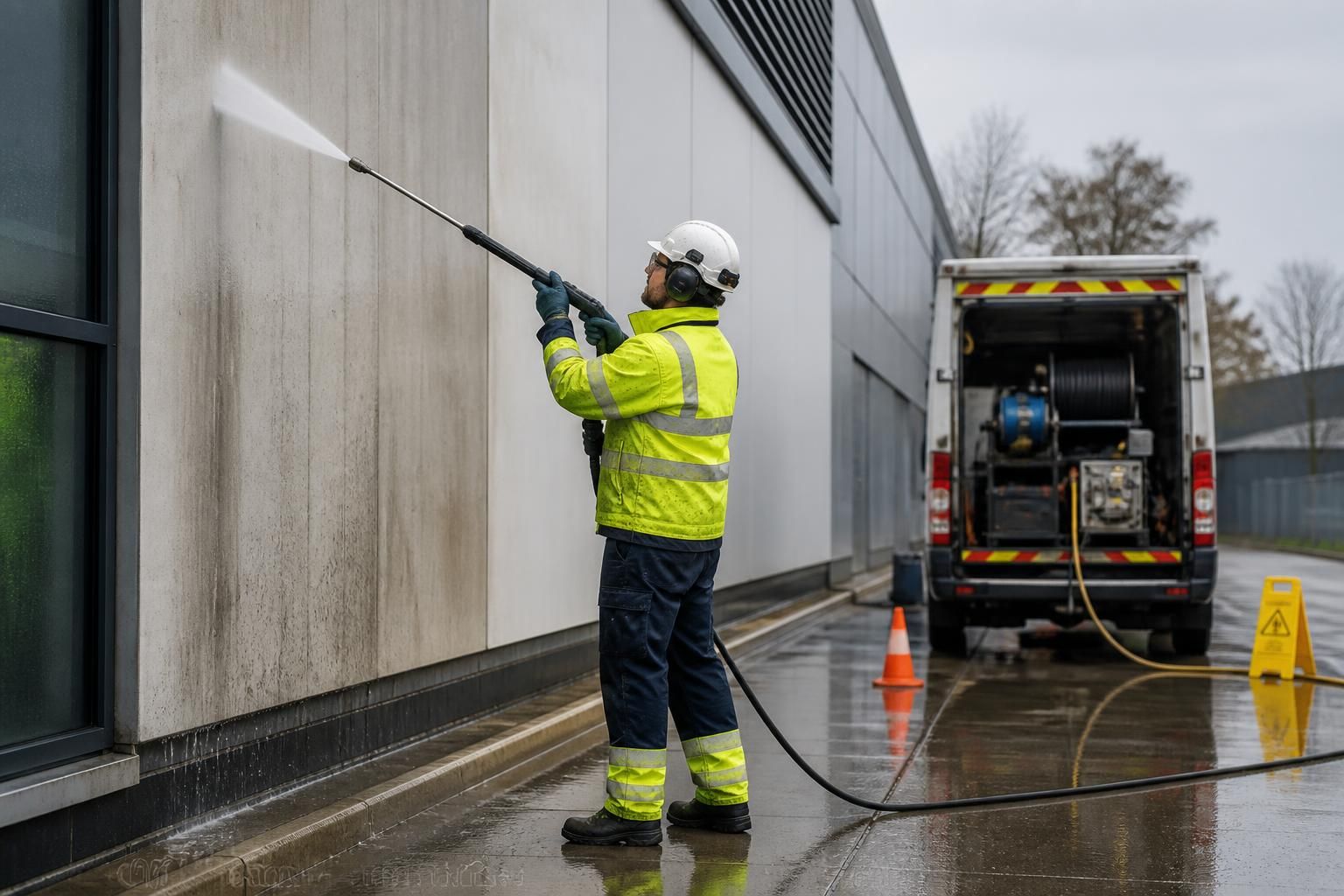
A competent team should use equipment that is suitable for the surface and maintained in safe working order. Hoses, couplings, electrical leads, fuel systems, guards and emergency shut-offs should be checked before use. Petrol-powered equipment must be positioned and ventilated safely, particularly near entrances, air intakes and enclosed or semi-enclosed areas. Exhaust fumes should not be allowed to enter the building.
Ask how the team will protect people and property during cleaning. Appropriate controls may include barriers, warning signs, exclusion zones, banksmen, temporary closure of walkways, protection for doors and air-conditioning units, and communication with building occupants. The contractor should check weather and wind conditions because overspray, poor visibility and unstable access equipment can make a planned operation unsafe.
A small test area is an important safety and quality control. It can reveal whether the pressure, heat, chemical and dwell time are likely to strip coatings, mark stone, open joints or force water behind cladding. The test should be reviewed before the main work proceeds, particularly on aged, repaired, painted or previously treated façades.
Ask how wastewater and runoff will be controlled
Environmental performance depends heavily on what happens to the dirty water after it leaves the façade. The contractor should identify all likely drainage routes and prevent contaminated water from entering surface-water drains, watercourses, soil or neighbouring property. Surface-water systems commonly discharge to the environment without the treatment provided by foul drainage, so they must not be used for contaminated runoff without appropriate controls.
Ask the contractor to explain:
- How drains will be identified, protected and temporarily sealed where necessary.
- How slurry, paint residue, oil, biological growth, metals or other contaminants will be captured.
- Whether water will be vacuumed, filtered, collected, treated or removed from site.
- Where any discharge will go and whether the required permission, consent or agreement is in place.
- How spills, failed drain seals and unexpected contamination will be dealt with.
Discharge to a foul sewer may require consent from the relevant sewerage undertaker, while certain discharges to the environment may require regulatory approval. The correct arrangement depends on the substance, location, volume and receiving drainage system. A contractor should not describe all wastewater as harmless or assume that a nearby drain is suitable.
Review detergents and chemical use
Ask for the proposed product types and their safety data sheets rather than accepting a general statement that the chemicals are environmentally friendly. Consider whether detergents, biocides, degreasers, acidic cleaners or alkaline products are necessary for the surface and soiling involved. The safest approach is usually to use the least hazardous effective product, at the lowest effective concentration, with controlled application and thorough recovery of runoff.
Check how products are transported, stored, mixed and labelled, and whether the team has spill kits and procedures for accidental releases. Chemical application should be controlled to avoid mist, overspray and unnecessary impact on landscaping, vehicles, windows, metals and adjacent materials. Any requirement for a biocidal product should be assessed carefully, including its intended use and the precautions specified by the manufacturer.
Consider water use and energy use
Water consumption should be assessed alongside the cleaning result, not treated as the only environmental measure. The contractor should be able to explain whether low-flow equipment, controlled nozzles, trigger guns, staged cleaning or recovery systems can reduce unnecessary use. Reusing recovered water may be possible for some operations, but it must not transfer contaminants or compromise the cleaning process.
Energy and emissions also depend on the equipment and access method. Ask whether the contractor has considered efficient equipment, suitable operating pressures, avoiding unnecessary idling and planning the work to reduce repeat visits. This should be balanced with safety: selecting a petrol pressure washer solely for power, for example, is unsuitable if its exhaust creates a hazard near occupied areas or air intakes.
Check waste handling and evidence of compliance
Paint flakes, sludge, filters, absorbent materials, empty containers and contaminated protective materials should be classified, contained and disposed of through the appropriate waste route. Where waste is removed from a commercial site, request the relevant waste documentation, such as a waste transfer note, and confirm that the carrier and receiving facility are authorised where required.
Useful evidence may include the RAMS, training records, equipment inspection records, insurance certificates, COSHH assessments, safety data sheets, wastewater arrangements, permits or discharge consents, and waste transfer documentation. You do not necessarily need every document before requesting a quotation, but the contractor should answer specific questions clearly and provide the documents relevant to the agreed scope before work starts.
Use a practical selection checklist
- Require a site visit or sufficiently detailed survey before agreeing the method.
- Confirm the cleaning pressure, temperature, chemicals, access equipment and test-panel process.
- Review the RAMS and confirm who is responsible for site supervision.
- Verify appropriate insurance, operator competence and equipment inspection arrangements.
- Agree exclusion zones, protection measures, working hours and emergency contacts.
- Document how wastewater, chemicals, spills and solid waste will be controlled.
- Confirm any required drainage consent, environmental permission or site approval.
- Include these controls in the quotation or contract, not just in a verbal discussion.
A reliable jet washing company should welcome this level of checking because safety and environmental controls are part of the cleaning specification. If the proposed method is vague, the contractor cannot explain where wastewater will go, or the price depends on ignoring access and containment requirements, obtain clarification before authorising the work.
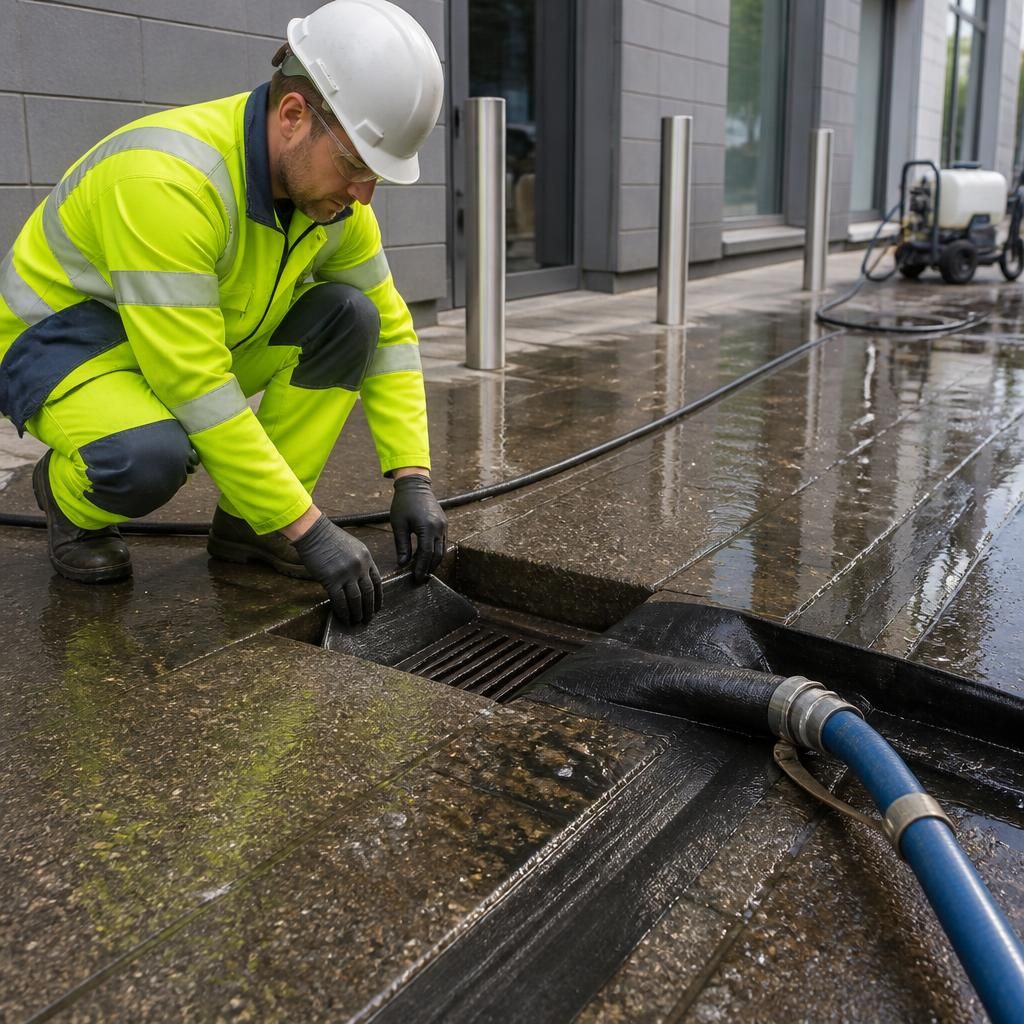
The most important environmental check is how the jet washing company will contain and dispose of wastewater. Before cleaning starts, the contractor should identify nearby drains, prevent contaminated runoff entering surface-water systems, and explain whether water will be captured, filtered, treated or removed from site.
Ask for clear arrangements covering detergents, paint residue, oil, biological growth and other contaminants. Discharge to a foul sewer may require the sewerage undertaker’s consent, while discharge to land or a watercourse may require regulatory approval. A responsible contractor will confirm the disposal route, provide any relevant permissions and explain how spills or failed drain protection will be managed.
Ask us to review your site’s safety and environmental requirements
Ask us to review your site’s safety and environmental requirements before work begins, including access, exclusion zones, wastewater control and disposal arrangements. We can help confirm that the proposed façade or cladding cleaning method is suitable for your building and site conditions.